ACCOUNT MANAGEMENT · B2B AGENCIES
Account Management for Small Agencies: A Simple Routine
Account management for small agencies in one page: a daily, weekly, monthly and quarterly routine that keeps every client looked after in about 3 hours a week.
Picture an agency with eight people and a dozen clients. Everyone is busy, delivery fills every day, and the founder still answers a few client emails at night. Nobody is ignoring the clients. But nobody has been asked to look after them in a planned way either, so account management happens when something is on fire.
That is normal for a small agency, and it is fixable without hiring a head of accounts or buying software. This guide describes account management for small agencies as a simple routine: what to do every day, week, month and quarter, who does it, and how long it takes. It is also the last post in our 3-week series on keeping and growing existing clients, so each step points to the longer guide on that topic.
The routine is deliberately small. If your team cannot keep it for six weeks, it is too big. Start with the weekly review and the one-page plan, and add the rest when those two hold.
What account management for small agencies really needs
Account management is the work of looking after a client after the sale: knowing what they want, spotting trouble early, keeping the work on track and finding the next piece of work together. In a large company that is a department. In a small agency it is a habit that a handful of people share.
Small agencies have two advantages that large ones do not. The founder knows the clients personally, and a decision can be made in a hallway. They also have two problems. Everyone is delivering, so account work is the first thing dropped. And knowledge lives in a few heads, so one holiday or one resignation leaves a client with nobody who knows the history.
The routine below answers those problems. It makes account work small enough to survive busy weeks, and it writes things down so that the knowledge is shared. It does not try to copy an enterprise process. If you want the longer argument for keeping it simple, read our guide to the simple account management system for agencies.
Three principles run through everything below. First, one owner per client, always a named person. Second, every routine has an output, even a short one, because a meeting that produces nothing will be dropped by March. Third, the routine is for the whole client list, but the effort goes mostly to the few clients who matter most. We will call those your key accounts.
Takeaway: account management for a small agency is a few short, repeated habits with named owners.
The simple account management system behind our 110-person agency ↗
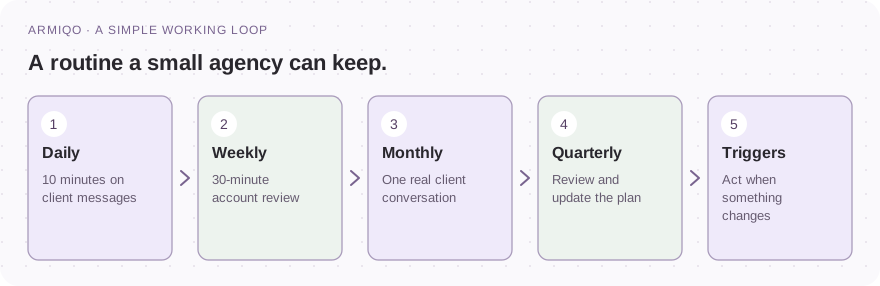
The whole routine on one page
Before the detail, here is the full picture. The times are defaults for an agency with about ten to fifteen active clients and two to four people who talk to clients. Adjust them to your size, but keep the order.
| Rhythm | Who | Time | What happens | Output |
|---|---|---|---|---|
| Daily | Each account owner | 10 minutes | Check client messages, answer or assign, note anything unusual | Nothing waiting more than one working day |
| Weekly | Account owners and a founder | 30 minutes | Review the client list, risks, renewals and next steps | Updated risk list and one next step per account |
| Monthly | Account owner with the client contact | 30 minutes per key account | A real conversation about their business, plus a short report | Notes and one follow-up email |
| Quarterly | Owner, founder and the client sponsor | 60 minutes per key account | Review results, update the account plan, check scope and price | An updated one-page plan and a decision |
| When something changes | Whoever notices, then the owner | As needed | Contact leaves, complaint, scope request, renewal date appears | A short action plan within 48 hours |
Add it up for an agency with twelve clients and five key accounts. The daily check is under an hour a week per owner. The weekly review is half an hour. The monthly conversations and quarterly reviews for five key accounts, split between two or three owners, add a few more hours a month each. For most owners that lands at roughly two to three hours a week, and a good part of it you are probably already spending on client conversations without writing anything down. Treat these numbers as planning estimates, not measurements.
Takeaway: five rhythms, each with a time box and an output.
Want help putting this into practice? See how we can help
Daily: 10 minutes so no client waits
The daily habit is the least glamorous and the most protective. Each account owner spends ten minutes at the same time every day looking only at client messages and requests. The goal is simple: nothing from a client waits more than one working day without a reply, even if the reply is "we have this, and you will hear from us on Thursday".
Slow replies are one of the earliest and cheapest signals of a weakening relationship, on both sides. When your replies get slower, the client notices. When their replies get slower, you should notice. A daily check keeps you honest about the first and alert to the second.
Keep the check structured. Look at three things: unanswered messages, requests that have no owner, and tone. If a message feels irritated, short or unusually formal, write one line in your notes and raise it at the weekly review. You are not trying to solve everything in ten minutes. You are trying to make sure nothing sits unseen.
If the team is small enough that everyone sees every client email in a shared inbox, say who is on point each day, otherwise everyone assumes someone else replied. A simple rota works: the owner of the account answers, and a named backup covers holidays.
For the messages themselves, keep a few short, reusable replies. Our guide to client follow-up emails has templates for after a meeting, for no reply and for a renewal nudge, and the free Client follow-up email generator can draft one from your notes in a minute.
Takeaway: ten minutes a day, and no client message waits longer than a working day.
Weekly: the 30-minute account review
The weekly review is the heart of the routine. If you keep only one habit from this guide, keep this one. Once a week, the account owners and one founder or senior person sit down for 30 minutes and walk through the client list.
Use the same agenda each time. First, five minutes on what changed since last week: new requests, new people, any complaints. Second, fifteen minutes on the key accounts, one at a time, asking three questions: what is the risk, what is the next step and who owns it? Third, five minutes on dates in the next 90 days: renewals, reviews, invoices that might trigger a conversation. Finally, five minutes to confirm the actions and update the list.
Keep the list somewhere simple, a spreadsheet or a shared page, with one row per client: owner, health (green, amber, red), next step, next date and renewal date. The point is not the tool. The point is that everybody sees the same list.
The full agenda, with scripts for the awkward moments, is in our guide to the weekly account review. If you want a simple way to colour the health column, our client health score for agencies explains a five-factor model, and the free Customer health score builder produces a score from your own answers.
One rule makes this meeting work: it ends on time, and every red or amber account leaves with a named next step. If a conversation needs more time, schedule it separately and move on.
Takeaway: the same 30 minutes, the same agenda, and a next step for every account at risk.
Monthly: one real conversation per key account
Once a month, each key account gets a proper conversation with the client contact. Not a status update, which is already covered by delivery. A conversation about their business: what is changing, what worries them, what they are planning for next quarter, and whether our work is still pointed at the right thing.
Prepare for ten minutes. Look at last month's notes, the results since the last review and anything the client has said that you have not followed up on. Then open with one question that is about them rather than the project, such as "What is the thing on your plate you would most like off it by Christmas?" Listen, write it down, and follow up in writing the same day.
A 30-minute agenda is easier to run than a free-form catch-up. Our guide to a 30-minute client meeting agenda gives a structure, and the free Client meeting agenda generator builds one from your goal. If you only ever talk to one person at a client, use the monthly conversation to ask about the others. Our guide to single-threaded accounts shows how to widen a relationship without making your contact feel bypassed, and the free Stakeholder map generator turns your notes into a map.
At the end of the month, write one short follow-up email per key account that confirms what you heard and what you will do. That is the paper trail that saves you when a contact leaves or the story gets muddled.
Takeaway: one real conversation a month, with a follow-up email the same day.
Quarterly: review, update the plan and check the price
Every quarter, hold a 60-minute review with each key account, and use it to update a one-page account plan. The review looks back at what the work achieved against the goals the client gave you, and forward at the next three months. The plan records goals, people, risks, next steps and the renewal date.
Do not turn this into a long presentation. A short review with a few real numbers, honest notes about what did not work, and a clear proposal for next quarter is more useful than a polished deck. Our guide to the QBR action plan shows how to turn the meeting into a plan for the next quarter in the 48 hours after it, and the free QBR template builder gives you the slides.
The quarterly review is also where you check three commercial points. Is the scope still what was agreed, or has it drifted? Our guide to scope creep with clients has scripts for raising extra work calmly. Is the price still right for the work? If you have not raised rates for a client in a long time, read how to raise rates with existing clients before the next renewal. And is the renewal date visible? Put it in the plan.
If writing a plan from scratch feels heavy, use the free Account plan generator, which produces a dated plan from a goal in a few minutes, or follow the account plan template written for a 30-minute session.
Takeaway: every quarter, one review, one updated plan and a scope and price check.
QBR Action Plan: Turn Your Review Into a Next-Quarter Plan ↗
Scope Creep With Clients: How to Say No to Extra Work ↗
Where this routine fits into B2B key account management
Key account management means giving your most important clients a named owner, a plan and a regular rhythm. In B2B key account management, the routine above is exactly that rhythm. The weekly review keeps the key accounts visible, the monthly conversation builds the relationship, and the quarterly review turns what you learn into the key account plan.
You do not need a separate department for this. In a small agency the key account manager is usually the person who already knows the client best, often the founder or a senior account lead. What changes is that their role becomes explicit: they own the plan, they run the monthly conversation and they are responsible for the renewal date. Our guide to key account management vs account management explains how to decide which clients deserve that treatment and which can run on a lighter version of the routine.
A useful rule for choosing key accounts is to look at three things together: revenue, growth potential and how hard the client would be to replace. A client who ticks two of those three is a candidate. Review the list once a year, because it will change.
This is strategic account management in a small, practical form. You are not building a framework for its own sake. You are making sure the clients that matter most get a plan, a regular conversation and someone who is accountable. Over time, that becomes your account management strategy: the clients you invest in, how you invest, and what you expect back.
For the base plan, the B2B account management plan template gives you a structure you can copy, and the free Account plan generator drafts one in about half an hour.
Takeaway: the routine is your key account rhythm: a named owner, a written plan and a regular conversation.
Key Account Management vs Account Management: A B2B Guide ↗
Client Account Management Template: A Simple B2B Plan (With Examples) ↗
The simple account management system behind our 110-person agency ↗
When something changes: five triggers that override the routine
The routine runs on a calendar, but accounts change on their own schedule. Five events should interrupt the calendar and start a short action plan within 48 hours. Each has a longer guide in this series.
| Trigger | First move | Guide |
|---|---|---|
| Your main contact leaves | Ask for an introduction, meet the new owner within two weeks, rebuild the relationship map | When your client champion leaves |
| A complaint arrives | Reply the same day, agree a fix and a date, review again in 30 days | Client complaints without losing the account |
| An extra request appears | Name it as extra, offer options and agree scope in writing | Scope creep with clients |
| A renewal is 90 days away | Collect proof, decide your position, book the conversation | Retainer renewal conversation |
| A team member hands over an account | Use a written handover with history, people and risks | Account handover checklist |
Add one more habit: whenever two warning signs appear on the same account, such as slower replies and a missed meeting, treat it as a risk. Our guide to client renewal risk warning signs lists seven to watch for, so you can spot them earlier than the client has to tell you.
Takeaway: keep a small set of triggers that start an action plan within 48 hours.
Client renewal risk: 7 warning signs to spot 90 days out ↗
When Your Client Champion Leaves: The First 30 Days ↗
Client Complaint: Handle It Without Losing the Account ↗
Start in four weeks, and who owns what
Do not launch all of this on Monday. Introduce it in four steps, and do not move on until the previous one has held for a full week.
- Week 1: name an owner for every client and list the clients with their renewal dates in one shared place. Pick the five accounts that matter most, using revenue, growth potential and how hard they would be to replace.
- Week 2: start the weekly 30-minute review with the key accounts only. Use the same agenda each week and end on time, with a next step for each amber or red account.
- Week 3: hold the first monthly conversation with each key account, and write the one-page plan for the two accounts you worry about most. Use the Account plan generator if you want a head start.
- Week 4: book the quarterly reviews for the next three months in the calendars, add a trigger list to the shared page, and ask the team what felt heavy so you can cut it.
Notice what is missing: no new software, no training course and no policy document. A spreadsheet and a calendar are enough. If the routine proves useful and the list grows, you can add tools later. A common mistake is to buy a platform first and hope it creates the habit. The habit comes first.
Review the whole routine after eight weeks. Ask three questions: which meetings produced an action, which produced nothing, and which accounts were surprised by something we should have seen? Remove or shorten what produced nothing, and add one thing only if you can say which surprise it would have prevented.
Who owns what in a team of five to fifteen.
Small teams blur roles, and the routine falls between the cracks unless you write down who does what. Here is a simple split that works for most agencies of five to fifteen people.
Each client has one account owner. That person does the daily check, runs the monthly conversation, keeps the account plan current and brings the account to the weekly review. For key accounts, a founder or senior lead acts as sponsor: they join the quarterly review, know the renewal date and step in when the relationship needs weight.
Each client also has a named backup, who can answer messages during holidays and knows where the plan lives. This single habit prevents most handover emergencies. One person coordinates the weekly review and keeps the shared list tidy. In many agencies that is an operations lead or the founder.
If the founder is the account owner for every client, decide which accounts you will hand over first and how. Handing over a relationship is easier when the client hears it from you and meets the new owner in person. Our account handover checklist covers what the next owner needs, and the guide to assigning managers to client accounts shows how to decide who looks after what.
A note on billing: account management takes time, and if it is never charged for and never planned for, it is the first thing cut when the agency is busy. Decide whether it is part of the retainer or a separate line, and be consistent. We cover the options in our guide to how to bill for account management.
Takeaway: introduce one rhythm a week, with one owner and one backup per client and a sponsor for key accounts.
Account handover checklist: what the next owner needs ↗
Should you assign a PM to a client account? Product vs project roles ↗
A worked example and the common mistakes
Here is an invented example, not a real case. Harbor Digital is a ten-person agency with eleven retainer clients. The founder, Sam, handled every account. Sam named three account leads, chose five key accounts and started a 30-minute Tuesday review. In the second week, the review showed that two key accounts had not had a real conversation for three months, and one had its renewal date six weeks away. Sam booked the conversations that week, and a renewal prep note was started 45 days before the date instead of the week before. The numbers here are illustrative; the point is that the routine surfaced what was already true but not visible.
Now the mistakes we see most often in small agencies.
- Starting too big. A routine with ten meetings a month will be dropped in March. Start with the weekly review and add only what the team can keep.
- No output. If a meeting does not produce a next step and an owner, it is a chat. Write the action down before anyone leaves.
- One owner for everything. If the founder owns every account, the routine collapses when the founder is travelling. Spread the owners and name backups.
- Treating all clients the same. Your five key accounts need the full routine. A small client with a short contract can run on a monthly email and a half-yearly review.
- Skipping the plan. Without a written plan, the monthly conversation has no direction and the renewal arrives as a surprise.
- Measuring nothing. You do not need a dashboard, but track two things: how many clients left in the last twelve months, and how many were expected to stay. Our guide to churn rate vs retention rate for agencies gives the formulas, and the client lifetime value guide shows how to see what a client is worth over time.
- Forgetting onboarding. The first 90 days set the pattern for the whole relationship. Our guide to B2B client onboarding covers what to do before the routine even starts.
Use the one-page template below to write your own version.
COPY & ADAPT
ACCOUNT MANAGEMENT ROUTINE: [Agency name]
Owner of the routine: [name]    Start date: [date]    Review date: [date + 8 weeks]

Key accounts (max 5 to start)
1. [Client]  Owner: [name]  Backup: [name]  Renewal date: [date]
2. [Client]  Owner: [name]  Backup: [name]  Renewal date: [date]

Daily (10 minutes): [time of day]. Rule: no client message waits more than one working day.
Weekly (30 minutes): [day, time]. Agenda: what changed, key accounts, dates in 90 days, actions.
Monthly (per key account): conversation with [contact]. Follow-up email the same day.
Quarterly (per key account): review date [date]. Update the one-page plan, check scope and price.

Triggers (start an action plan within 48 hours)
- Main contact leaves
- Complaint received
- Extra work requested
- Renewal within 90 days
- Account handed to a new owner

Where we keep it: [link to shared sheet or page]
What we will cut if it feels heavy: [item]
Takeaway: start small, write it on one page and review it after eight weeks.
Churn Rate vs Retention Rate for Agencies: Formulas ↗
Client Lifetime Value for Service Firms: Formula + Example ↗
B2B client onboarding: a practical first-90-days checklist ↗
Start with one account this week
- Name one owner and one backup for every client.
- Pick up to five key accounts using revenue, growth potential and replacement difficulty.
- Put every renewal date on one shared calendar.
- Reply to every client message within one working day.
- Hold a 30-minute weekly account review with the same agenda each time.
- Hold a monthly conversation with each key account and send a follow-up email the same day.
- Write a one-page account plan for each key account.
- Hold a quarterly review and check scope and price.
- Keep a short trigger list and start an action plan within 48 hours.
- Review the whole routine after eight weeks and cut what produced nothing.
Common questions
How do you manage client accounts in a small agency?
Give every client one named owner, hold a 30-minute weekly review of the whole client list, and have a real conversation with each key account every month. Update a one-page account plan every quarter. Write down renewal dates and next steps so nothing depends on memory.
How much time should account management take in a small agency?
A realistic start is about three hours a week per account owner: ten minutes a day on client messages, a 30-minute weekly review, and a few hours a month on conversations and quarterly reviews for key accounts. Adjust to the size of your client list.
What is the simplest account management process for an agency?
The simplest process has four parts: a named owner per client, a weekly internal review, a monthly client conversation and a quarterly review with a short plan. Add a small list of triggers, such as a contact leaving or a complaint, that start an action plan within 48 hours.
Do small agencies need key account management?
Yes, in a light form. Key account management means giving your most important clients a named owner, a written key account plan and a regular rhythm. In a small agency the key account manager is often a founder or senior lead, and the plan can fit on one page.
Do we need account management software?
Not at the start. A shared spreadsheet and a calendar are enough to run the routine for the first few months. Add software when the client list grows and the manual list becomes the bottleneck. Build the habit first, and choose the tool to fit it.