CLIENT RETENTION · B2B AGENCIES
Retainer Renewal Conversation: A 7-Step Prep Guide
Prepare for a retainer renewal conversation in 7 steps: gather proof, set your position, map who decides, run the meeting and send the renewal email.
Your retainer ends in ten weeks. The work has been steady, the client says thanks in most emails, and you have not talked about the future once. You tell yourself it will sort itself out. Then the contact writes "can we have a quick chat about next year?" and you realise you are about to walk into a retainer renewal conversation with no notes, no numbers and no idea what the client really wants.
This guide shows how to prepare for a retainer renewal conversation in a B2B agency or consultancy, from the first notes 90 days out to the email you send after the meeting. You will see what evidence to gather, how to decide your position on scope and price before you speak, who needs to be in the room, how to run the meeting, and how to respond when the client pushes back.
It is written for agency founders and account managers who look after a small number of long-term clients. A renewal is not an admin step at the end of the contract. It is the moment the client decides, again, whether you are worth the money, and the conversation is easier when most of the work was done before it started.
What a retainer renewal conversation is really for
A retainer renewal conversation has one job: help the client make a confident decision to keep working with you, on terms that work for both sides. It is not a sales pitch, and it is not a negotiation you try to win. If the client feels pushed, they will renew reluctantly, or they will say yes now and quietly look elsewhere at the next review.
It helps to separate three things that often get mixed up. The first is the relationship: do they trust you and like working with you? The second is the value: can they point to something that changed because of your work? The third is the terms: scope, price, length and notice period. Most renewal conversations go wrong because the team jumps straight to terms. If the first two are not settled, the third becomes a fight about price, because price is the only thing left to discuss.
So the order matters. Confirm the value first, then talk about what the next term should look like, and only then talk about the number. A client who has just agreed that the last six months moved something they care about is in a very different frame of mind from a client who opens the call by asking for a discount.
A retainer also has a particular risk that a project does not. Because it renews automatically or by default, the client may never make an active decision. When it finally gets reviewed, often by a finance person looking for savings, it is judged on one question: what do we get for this each month? If you cannot answer that in a sentence, you are exposed. Preparing for the conversation is mostly about having that sentence ready.
If you want to spot trouble earlier, read our guide to client renewal risk warning signs. This guide covers what to do once the renewal is on the calendar.
Takeaway: confirm the value, then the shape of the next term, then the price. In that order.
Start the retainer renewal 90 days before the term ends
The most useful thing you can do for a retainer renewal is start early. Ninety days before the term ends is a good default for a twelve-month retainer, and thirty to sixty days is enough for a rolling monthly one. The point is not the exact number. It is that you open the topic while there is still time to change the work, fix a problem, or bring in a budget owner.
Starting late has a cost. In the final month, the client is thinking about paperwork, budgets are often already set, and any problem you hear about is too late to repair. In the final week, you are negotiating with a deadline, and the person with the deadline is rarely you.
Use a simple timeline. You can adjust it to the contract length, but keep the order.
| When | What you do | Output |
|---|---|---|
| 120 to 90 days out | Review the account internally, check the contract terms and notice period, start the evidence file | A one-page renewal prep note |
| 90 days out | Tell the client you want to review the last term and plan the next one, book a 30-minute meeting | Meeting in the calendar |
| 75 to 60 days out | Run the renewal conversation: confirm value, ask what changes next term, share your thinking on scope | Agreed direction, open questions listed |
| 60 to 45 days out | Send the renewal email with the proposed scope, price and next step | Written proposal the client can forward |
| 45 to 15 days out | Answer questions, bring in the budget owner if needed, adjust scope | Final terms agreed |
| 15 days to end date | Paperwork only, then plan the first 30 days of the new term | Signed renewal and a kick-off date |
Two details are easy to miss. First, check the notice period in your own contract. Some retainers roll over unless someone gives notice, and some need a fresh signature. You should know which one you have before the client does. Second, find out when the client sets budgets. If their planning cycle closes in a month, your renewal conversation needs to happen before that, not before your contract ends.
This post concentrates on the conversation itself rather than the full checklist.
Takeaway: book the renewal conversation 90 days out, and know the notice period and the client's budget dates.
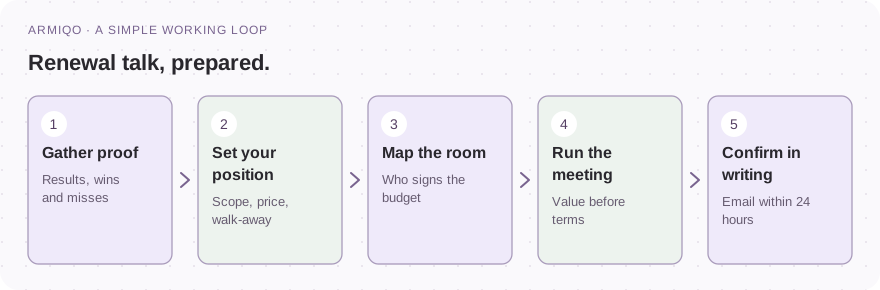
Want help putting this into practice? See how we can help
Gather the proof before the renewal conversation
A good renewal conversation starts with evidence. Before you meet, build a short file that answers one question: what changed for this client because of our work? You do not need a long report. You need a handful of facts you can check, and the client's own words wherever possible.
Collect five things. First, the goals you agreed at the start of the term, in the client's words, and what has happened to them. Second, the work you delivered: what shipped, what was late, what was cancelled and why. Third, the results that are tied to the work, and an honest note of where the link is weak. Fourth, the problems and complaints of the term and how they were resolved. Fifth, anything the client said they wanted that you have not yet delivered.
Be honest about what you cannot prove. If a result came from several things, say so. A client who trusts your numbers will trust your next proposal, and a client who catches one inflated claim will discount everything else. Do not invent a number, round up a trend or take credit for something the client did themselves.
Also gather the less comfortable material: the missed deadline from month three, the contact who changed, the quarter when reports were thin. If you have it ready, you can bring it up yourself and show what changed. If you hide it, the client will bring it up at the worst moment.
Finally, write down the human side. Who is the day-to-day contact? Who signs the budget? Who has left, who has joined, and who has gone quiet? If you only know one person, our guide to single-threaded accounts shows how to widen the relationship before the renewal.
Use a one-page prep note to keep this tidy.
Takeaway: a renewal meeting without evidence becomes a conversation about price. Bring the proof.
COPY & ADAPT
RETAINER RENEWAL PREP NOTE

Client:                          Renewal date:
Account owner:                   Notice period:
Current retainer: [scope] at [price] per month, [term]

1. What we agreed at the start (client's words):
2. What has happened to those goals (facts, with source):
3. What we delivered (shipped / late / dropped, and why):
4. Problems and complaints this term, and how they ended:
5. What the client asked for that we have not yet done:
6. Who decides: day-to-day contact / sponsor / budget owner:
7. Signals to watch (slow replies, new sponsor, budget talk):
8. Our position for next term: scope / price / what we would change:
9. Our walk-away: the lowest price and the smallest scope we accept:
10. One sentence on what they get from us each month:
Decide your position before the contract renewal negotiation
Many teams walk into a renewal with no position at all. They plan to "see what the client says" and react. That makes you the one who is negotiated, instead of the one who is helping the client decide. Before you meet, decide three things.
First, what do you want the next term to look like? Think about scope, not only price. Is the current work still the right work? Is there something the client needs that you are not doing, or something you are doing that they no longer value? The best renewals change a little. They fix what has drifted and use the term to start the next priority.
Second, what price do you want to propose, and why? If you plan a rate increase, work out the reason before the meeting and tie it to value, scope or cost. Our guide to raising rates with existing clients shows how to do that, and the free Price increase letter generator can draft the message once you have decided. If you plan to hold the price, decide whether you are offering anything extra, or whether you are keeping the scope and the rate exactly as they are.
Third, what is your walk-away? This is the lowest price and the smallest scope you would accept, written down before the call. It protects you from a bad decision made under pressure in the room. If a client asks for a cut, you already know whether you can say yes, whether you can offer a smaller scope instead, or whether it is a no. A discount without a change in scope teaches the client that your price was soft.
For contract renewal negotiation, it also helps to think about what you can trade. A longer term in exchange for a stable rate. A quarterly payment in exchange for a lower monthly fee. A narrower scope for a lower price. A named senior person for a higher price. Having two or three options is better than having one number, because the client then chooses between versions of yes rather than between yes and no.
Be careful with sudden concessions. If you offer a discount in the first minute, the client learns that the price was negotiable, and they will ask again next year.
Takeaway: arrive with a scope you recommend, a price you can explain and a walk-away you wrote down.
Map who decides on the renewal
The person you work with every day is often not the person who decides the renewal. A marketing manager may love you and still have to ask a finance director to approve the budget. If you only ever speak to the manager, you learn about the budget decision after it has been made.
Before the meeting, answer four questions. Who uses the work? Who sponsors it? Who signs the budget? Who could block it? In many B2B accounts these are three or four different people, and each of them cares about something different. The user cares that the work is easy. The sponsor cares that it supports their goal. The budget owner cares about cost against value. The blocker, such as procurement or a new manager, cares about risk and saving money.
You do not need to invite everyone. But you should know how your main contact will explain the renewal to the budget owner, and whether they have the words to do it. The strongest move is to help them. Give your contact a short summary they can forward: what changed, what you propose, and the price in one line. A renewal that is easy to explain is easier to approve.
If you cannot reach the budget owner, ask your contact plainly: "Who else needs to be comfortable with this before it can be signed?" It is a normal question, and it often reveals the real process. For a larger account, ask whether a short joint review with the sponsor would help.
Our guide to mapping stakeholders on a client account shows a simple way to keep this up to date, and the free Stakeholder map generator can turn your notes into a one-page map.
Takeaway: find out who signs the budget before the meeting, and give your contact something easy to forward.
Run the retainer renewal conversation in 30 minutes
Keep the meeting short and structured. Thirty minutes is enough if you have prepared, and it signals that you respect the client's time. Send an agenda a few days before so nobody is surprised. The agenda should say that the goal is to review the last term and agree what the next one should look like.
Use the order described earlier: relationship, value, then terms. Here is a structure that works for most B2B retainers.
Steps for the meeting:
- Open by setting the goal: "I would like to look back at the last six months, hear what you want from the next term, and then share how I would suggest we shape it."
- Ask first, before you present: "What has worked best for you? What has been frustrating? What matters most in the next six months?" Take notes and do not defend.
- Share your evidence briefly: three results, one miss you own, and what changed because of it. Use the client's own goals as the frame.
- Repeat back what you heard: "So the priorities are X and Y, and you want less of Z. Is that right?" Wait for a yes.
- Share your thinking on the next term in plain words: what you would keep, change and add, without a price yet if the budget owner is not there.
- Ask about the decision: "What does the process look like on your side? Who else needs to see this before it can be approved?"
- Agree the next step and date: "I will send a short proposal by Friday. Can we speak again on the 24th if there are questions?"
A good question to keep ready is "What would make this an easy yes for you?" It surfaces the real concern quickly. A client might say price, or they might say they need to show the board a result, or they might say they are not sure the new director wants an agency at all. Each answer changes what you do next.
Watch for two traps. One is presenting for twenty minutes before asking a single question. The other is jumping to price too early, because silence feels uncomfortable. If the client asks "so what will it cost?" before you have shared your thinking, answer briefly and return to value: "I will send the exact number in writing today. I want to make sure the scope is right first."
Takeaway: ask before you present, repeat back what you heard, and leave with a next step and a date.
How to negotiate a contract renewal when the client pushes back
Pushback in a renewal is normal and not always a bad sign. A client who negotiates is still engaged. The skill is to find out what is underneath the objection before you respond, because the same words can hide very different problems.
| What the client says | What may be underneath | A first response |
|---|---|---|
| "We need to cut costs." | Budget pressure, a new finance owner, or a value question | "Understood. Can I ask where the pressure is coming from? I would like to look at what we can change in scope before we change the rate." |
| "Can you do it for less?" | A test, a real budget limit, or a comparison with another offer | "I can look at a smaller scope at a lower fee. Which parts matter least to you?" |
| "We want to pause for a quarter." | Uncertainty, a reorganisation, or a priority shift | "Let us talk about what would need to be true to restart. Could we keep a lighter version so you do not lose momentum?" |
| "Send us a proposal." | Genuine interest, or a polite way to end the call | "Happy to. So I can make it useful, what would the proposal need to show for your team to approve it?" |
| "We are talking to other agencies." | A price check, a fresh start, or a real exit | "That makes sense. What would you want to see from us for the next term to feel confident?" |
| "The results are not clear." | Weak reporting, shifting goals, a new sponsor | "Fair. Let us go back to the goals you set and look at the evidence together. What would count as clear?" |
Notice what the responses have in common. They ask a question first. They do not argue with the objection. They offer a change in scope before a change in price, which protects your rate and often gives the client what they actually need.
When the client asks for a discount, it helps to have the trade ready. "I can reduce the fee if we reduce the scope to X and Y." "I can hold the current rate for twelve months if we agree a twelve-month term." "I can include one extra deliverable, but the rate stays." Each of these keeps the price tied to what the client receives.
If the answer is a genuine no, accept it with grace. Thank the client, offer a clean handover, and ask what would bring them back. A respectful end leaves the door open, and some clients return when their situation changes.
Takeaway: ask what is underneath the objection, and offer a change in scope before a change in price.
The renewal email: put it in writing within 24 hours
The conversation does not end the process. What you send afterwards often decides it. Send a short renewal email within 24 hours of the meeting. It should confirm what you heard, set out the proposed next term, and give one clear next step with a date. Keep it short enough that your contact can forward it to the budget owner without rewriting it.
Include the term and the scope in plain language, the price and how it is billed, the start date, and anything that is different from the current agreement. If you are raising the price, say so directly, give the reason once, and keep it calm. Do not bury it in the last paragraph, and do not hide it in an attachment.
Avoid three habits. Do not send a long proposal when a one-page summary would do. Do not repeat your whole pitch. And do not end with "let me know your thoughts", because it gives the client nothing to do. End with a specific request: "Could you confirm by the 28th so we can plan the kick-off?"
If you want help with wording, our guide to client follow-up emails has examples, and the free Client follow-up email generator can draft a renewal nudge from your notes. Use the template below as a starting point.
COPY & ADAPT
Subject: Next term: summary and a decision by [date]

Hi [name],

Thank you for the conversation on [day]. Here is what I took away:

- You want [priority 1] and [priority 2] to be the focus.
- You would like less of [item], and [concern] needs attention.
- The next step on your side is [process or person].

What I propose for [start date] to [end date]:

- Scope: [what we keep, change and add]
- Fee: [amount] per [month], billed [how]
- Changes from today: [one line, or "none"]

I have attached a one-page summary you can forward to [budget owner].

Could you confirm by [date], or tell me what you would like to adjust? I can also join a call with [person] if that helps.

[Your name]
Takeaway: send a short written summary within 24 hours, with one request and one date.
Where the retainer renewal fits into B2B key account management
Key account management means giving your most important clients a named owner, a plan and a regular rhythm. In B2B key account management, the renewal is not a separate event at the end of the contract. It is one point in a cycle that runs all year, and the key account manager is the person who makes sure it does not arrive as a surprise.
A renewal should be visible in the key account plan from day one. The plan should show the end date, the notice period, who signs the budget, the goals the client set, and the evidence you are collecting against them. When the plan is kept up to date, the retainer renewal conversation is a review of something you have been tracking, not a scramble to remember what happened.
This is strategic account management in a small way. You use the renewal to ask where the client is going next, not just whether they want to continue. A good renewal conversation often reveals the next priority, a new stakeholder or a change in budget, and each of those should go back into the account management strategy for the next term.
For a small agency, the B2B account management routine is short. Name one owner per key account. Write a one-page key account plan, and the free Account plan generator can draft one in about half an hour. Put every renewal date on one calendar, with the 90-day mark highlighted. Review upcoming renewals in your weekly account review, and include the renewal in the client health score so a quiet account does not look green. The simple account management system for agencies shows how these pieces fit together, and the B2B account management plan template gives you a plan to start with.
Takeaway: if the renewal date lives in the key account plan, the conversation is never a surprise.
The simple account management system behind our 110-person agency ↗
Client Account Management Template: A Simple B2B Plan (With Examples) ↗
A worked example and the common retainer renewal mistakes
Here is a fictional example. It is made up to show the steps. It does not describe a real client or a real result.
A small agency, call it Fernhill Studio, runs a six-month content and reporting retainer for a software company, Brightpath. The retainer ends on 31 January. On 1 October, the account owner opens a prep note. The notice period is thirty days, the budget owner is the finance director, Dana, and the day-to-day contact, Sam, reports to a marketing lead who joined in August.
The prep note shows that the original goal was to publish a steady content programme and report monthly. Publishing was on time in five of six months. One report was late in month three, after a staff change. The account owner decides to name this in the meeting. The new marketing lead has not seen any of the earlier results, so the note also lists three examples of work the lead has not yet seen.
On 3 November, the account owner books a thirty-minute call and sends an agenda. In the meeting, the owner asks first. Sam says the work has been solid but the new lead wants fewer blog posts and more material for sales. The owner repeats it back, then shares a draft idea: swap two posts a month for one sales one-pager and one customer story. The owner asks, "Who else needs to be comfortable with this?" Sam mentions Dana, who reviews every contract above a certain value.
Within a day, the owner sends the summary email with the proposed scope, the fee, which is unchanged, and a one-page version for Dana. The owner offers a short call with Dana if she has questions. Dana asks for the cost breakdown, the owner sends it, and the renewal is signed on 12 January, three weeks before the end date.
Nothing here is dramatic. The renewal succeeded because the owner started early, brought evidence, asked before presenting, found the budget owner and wrote things down.
Takeaway: a prepared renewal is a series of small, ordinary steps taken in the right order.
Now the mistakes. Most renewal problems come from a short list of mistakes. Check your plan against it before each meeting.
Starting too late is the most common. If the first conversation is in the final month, you have no room to fix anything. Treating the renewal as a price discussion is the second. If the client has not agreed the value, the only thing left to argue about is the number. Talking only to your day-to-day contact is the third, because the person who decides the budget may never hear your side.
Other mistakes are quieter. Presenting for most of the meeting and asking few questions. Offering a discount before the client asks. Hiding a price increase in the paperwork. Promising extra work to win the renewal, which then becomes scope you have to deliver at the same fee. Skipping the written summary, so the client's version of the meeting and yours drift apart. And forgetting the first thirty days of the new term, when the client decides whether the renewal was a good idea.
A last mistake is treating a signed renewal as the end. The new term is where the evidence for the next renewal begins. Put the next review date in the calendar as soon as the contract is signed.
Takeaway: start early, confirm value before price, talk to the person who signs, and put it in writing.
Start with one account this week
- Put the renewal date and the notice period in the key account plan and on one shared calendar.
- Book the renewal conversation about 90 days before the term ends.
- Build a one-page prep note with goals, results, misses and open requests.
- Check that every result you quote has a source and an honest link to your work.
- Decide your scope, your price and your walk-away before the meeting.
- Find out who signs the budget and who could block the renewal.
- Send an agenda a few days before the call.
- Ask before you present, and repeat back what you heard.
- Confirm the value before you talk about price.
- Offer a change in scope before a change in price.
- Send a short written summary within 24 hours with one request and one date.
- Give your contact a one-page version they can forward.
- Plan the first 30 days of the new term as soon as it is signed.
Common questions
How do you prepare for a retainer renewal conversation?
Start about 90 days before the term ends. Collect proof of results, list what was late or missed, check the notice period and find out who signs the budget. Decide your scope, price and walk-away in writing, then book a 30-minute meeting and send an agenda.
When should you start the retainer renewal conversation?
For a twelve-month retainer, start about 90 days before the end date, and use 30 to 60 days for a rolling monthly one. Starting early leaves time to fix problems, change the scope and involve the person who approves the budget before paperwork begins.
How do you negotiate a contract renewal with a client?
Confirm the value first, then discuss the shape of the next term, and only then the price. When the client pushes back, ask what is underneath the objection and offer a change in scope before a change in rate. Know your walk-away number before the meeting.
What should you put in a contract renewal email?
Summarise what you heard, then state the proposed scope, fee, billing, start date and anything that changes from the current agreement. End with one clear request and a date. Keep it short enough that your contact can forward it to the budget owner without editing it.
What if the client wants a discount at renewal?
Do not agree in the room. Ask where the budget pressure comes from, then offer options that change scope: fewer deliverables, a narrower focus or a longer term at a steady rate. A discount without a change in scope tells the client your price was soft.
How does key account management help with retainer renewals?
In B2B key account management, the key account manager keeps the renewal date, the budget owner and the evidence in the key account plan all year. That makes the renewal a planned review rather than a surprise, and it feeds what you learn back into your account management strategy.