ACCOUNT MANAGEMENT · B2B AGENCIES
Single-Threaded Accounts: What to Do With One Contact
Single-threaded accounts depend on one client contact. Learn how to spot the risk, ask for introductions and multi-thread the account in 30 days.
A single-threaded account is a client relationship that depends on one person. You talk to them, they approve the work, they pass your updates upstairs, and everything the client thinks about you is filtered through their view. While that person is happy, it feels like the best kind of account: quick answers, no politics, no committees. The trouble is that it only works until something changes. They go on leave, change roles, get a new boss, or simply lose interest, and you discover that you barely know anyone else.
This guide is for agency founders and account managers who suspect they have one or more accounts like that. You will see how to tell whether an account is really single-threaded, why it happens, and how to widen the relationship without going behind your contact's back. There is a coverage table, a script for asking for introductions, a copyable account note, a 30-day plan and a list of common mistakes.
The method is deliberately modest. You are not trying to run a political campaign inside the client. You are trying to make sure that if your one contact disappears tomorrow, at least two other people already know who you are and what you have done for the business. The free Stakeholder map generator on this site can help you plot the people involved, and the rest of this guide shows what to do with the gaps you find.
What a single-threaded account is and why it is risky
The word comes from sales, where a single-threaded deal is one that depends on a single contact inside the buyer's company. In account management the same idea applies to a client you already serve. If one person is your day-to-day contact, your main sponsor and your only source of information about what the business wants, the account has one thread. If that thread snaps, the relationship goes with it.
Multi-threading is the opposite. It means building real working relationships with several people across the client: the person who uses your work, the person who pays for it, the person who signs the contract, and ideally someone senior who understands why you are there. Each of those people is another thread. When one weakens, the others hold the account up.
Single-threaded does not mean the relationship is bad. Many single-threaded accounts have a warm, productive contact. The risk is concentration. Everything depends on one person's job security, mood, workload and opinion of you, none of which you control. A client champion who leaves is one of the most common reasons an otherwise healthy account becomes a renewal problem, because the replacement arrives with no history and no reason to prefer you.
There is also a quieter cost. A single contact can only tell you what they know. They may not see the budget plans, the new priorities set by the leadership team, or the complaints from a department you never meet. You are making decisions about the account with a partial picture, and you may not realise how partial until someone new arrives and tells you what the business actually wanted.
Why accounts become single-threaded in the first place
Almost nobody chooses to run a single-threaded account. It happens because the first person you meet is usually the one who hired you, and the relationship grows around them. They are responsive, so you keep going to them. They are busy, so you avoid asking for more of their time. Over months the pattern sets, and widening it starts to feel like an awkward change of habit.
Efficiency is another cause. Working through one contact is fast. You send one email, get one answer and make one decision. A second or third stakeholder adds replies, opinions and delays, so a delivery team under pressure quietly prefers the single line. The cost of that preference only shows up later, at renewal or when the contact leaves.
Sometimes the contact encourages it. A person who wants to be seen as the owner of the agency relationship may not want you talking to their boss or their peers. That is human and often well meant, but it deserves a gentle response. You can respect their role and still ask who else should hear about the results.
Finally, agencies often confuse activity with coverage. A shared inbox and a busy project channel can make it look as though many people are involved, when in practice one person approves everything and the rest only see the output. Counting the names on an email thread is not the same as having a relationship with each of them.
Want help putting this into practice? See how we can help
How to tell if an account is single-threaded
The simplest test is a question: if your main contact left tomorrow, who else at the client could describe what you do for them? If the honest answer is nobody, or one person who has only seen the monthly report, the account is single-threaded. Run the question across your client list and write down the answers rather than relying on memory.
A more detailed check looks at coverage across roles. Most B2B accounts have at least four useful roles: someone who uses your work every week, someone who manages that person, someone who controls the budget, and someone senior who cares about the outcome. The table below shows a simple way to rate each account. It is a working tool, not a benchmark.
Rate every account at the start, then again each month. The goal is not a perfect score. The goal is to see which accounts sit in the first two rows and decide, deliberately, how much effort each deserves. A small client on a short project can reasonably stay thin. A client that makes up a large share of your revenue cannot.
| Rating | What it looks like | What to do next |
|---|---|---|
| Single thread | One person knows you and approves everything | Treat as urgent: start the 30-day plan and name an owner |
| Thin | One strong contact, one or two people who know your name | Ask for introductions and book one value-led meeting each |
| Covered | Three or more people across user, manager and budget roles | Keep the rhythm going and refresh the map every quarter |
| Deep | Covered, plus a senior person who can describe the value you bring | Protect it, and use it to plan growth and renewal early |
- List the people at the client who use your work, manage it, fund it and sign for it.
- Mark the ones you have spoken to in the last 90 days, and note whether it was a real conversation or only a copied email.
- Count how many roles have at least one person who would recognise your name and describe your value.
- Place the account in the table below and write the rating in your account notes.
How to multi-thread an account without going around your contact
The most important rule is to widen the relationship with your contact, not around them. If they discover that you have been talking to their boss behind their back, you may lose the one relationship you have. Done openly, multi-threading actually makes their life easier, because it shares the work of keeping the agency informed and makes them look good to colleagues.
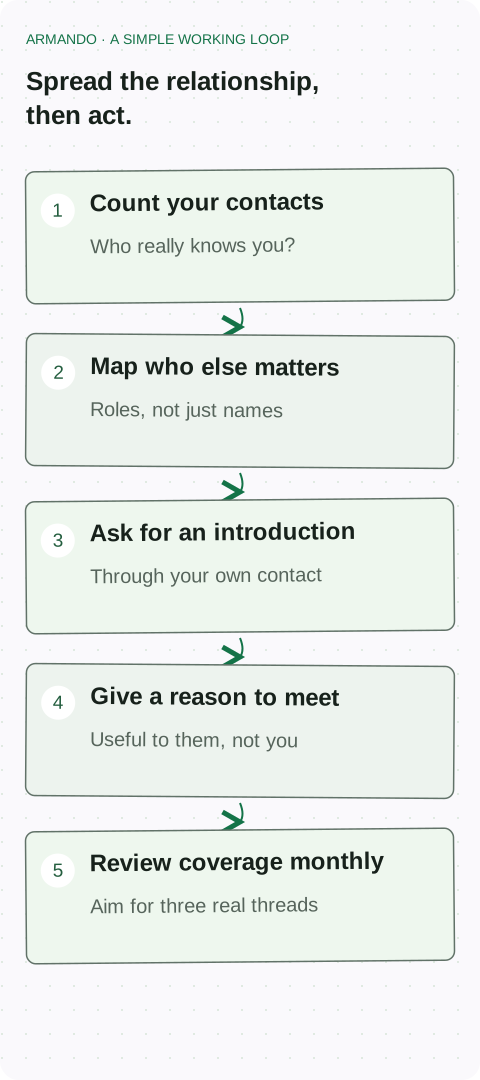
Start by mapping who matters. Write down the roles, not just names, and be honest about which ones you cannot name. A gap in the map is useful information. Then pick the two or three people who would add the most protection if your contact left: usually the contact's manager, the person who owns the budget, and a day-to-day user from another team.
Next, decide what each person needs from you. A senior leader wants to know that money is working. A budget owner wants predictability and no surprises. A user wants the work to make their job easier. Each of these is a different conversation, and a generic status update will not reach any of them. Our stakeholder map guide walks through the mapping step in more detail.
Finally, sequence the approach. Do not try to meet everyone in the same month. Start with the easiest introduction, make it useful, and use the result to open the next one.
Stakeholder map for client accounts: a 6-step method ↗
- Map the roles you need and mark who you know, who you have met once and who is unknown.
- Choose two people to add first, based on the damage it would do if your contact left.
- Tell your contact what you are planning and why, in plain words.
- Ask for an introduction or a place on an existing meeting, rather than requesting a new one.
- Give the new person a clear reason to spend time with you and follow up with something short and useful.
- Record what you learned and update the map before the next step.
How to ask your one contact for introductions
Asking for an introduction feels risky because you are afraid of sounding as if you do not trust your contact. The trick is to frame it around their interest, not yours. People are usually glad to help when the request makes their project more likely to succeed or gives them credit with colleagues.
Pick a moment when things are going well, such as after a good result or a smooth delivery, and keep the request specific. Name the role you would like to meet, say why, and offer to make it easy. Compare these two requests. A vague one reads: could you introduce me to some other people on the team? A better one reads: the leadership team will likely ask about results at budget time, so would it help if I joined your next review for ten minutes and walked through the numbers?
If your contact says no or hesitates, do not push. Ask what would make it comfortable, or offer a lower-stakes option such as sending a short summary they can forward. You can also try again after the next good result. The aim is a steady widening of the relationship, not a single dramatic ask.
Use the script below as a starting point and adjust it to your own voice. Keep it short, make the benefit for your contact clear, and always leave them with an easy way to say not yet.
COPY & ADAPT
Subject: A quick idea to make renewal easier for you

Hi [name],

Thanks for [specific good outcome]. Because [leader or team] will probably want to see how this fed into [their goal], I wonder if it would help if I prepared a one-page summary for [role].

Would you be comfortable introducing me to [name or role], or letting me join your next [meeting] for ten minutes? I would keep it focused on [their priority] and send you the notes first.

If now is not a good time, no problem. I can send you the summary and you can decide what to share.

Thanks,
[your name]
Give every new stakeholder a reason to meet you
A new contact will only give you time if the meeting is useful to them. This is where many attempts at multi-threading fail: the agency asks for a meeting to introduce itself, and the stakeholder, who has no problem to solve with you, politely declines. A better approach is to bring something that helps their own priorities.
Think about what each role cares about. A manager wants fewer surprises and a team that is performing. A finance owner wants to understand costs and what they bought. A user in another team might benefit from a short walkthrough of work that touches their area. Each of these gives you a legitimate reason to ask for twenty minutes.
Keep the first meeting small and well prepared. Share one insight, ask two or three questions about their goals, and agree one next step. Afterwards, send a short note that summarises what you heard and what you will do. That note matters more than the meeting, because it proves you listened and creates a record your contact can see.
Over time, vary your touchpoints. A quarterly review for the sponsor, a short results email for the budget owner and a practical tip for users are all different threads. Each is light on its own and strong in combination. You can use the follow-up email generator on this site to draft the notes after each conversation.
Client follow-up emails: 3 templates that get replies ↗
- Write one sentence about what this person cares about, based on the client's goals.
- Prepare one insight or result that connects to that goal.
- Ask for twenty minutes, not an hour, and say what you will bring.
- Send a short follow-up with what you heard and the next step, and copy your main contact when appropriate.
What to do when your only contact resists or goes quiet
Some contacts guard the relationship. They may say that the team is too busy, that leadership does not get involved, or that they will pass things on themselves. Treat this as information rather than as a wall. Ask what they are protecting, and look for a way to meet that need while still widening your reach.
One option is to widen through the work. Invite other people to workshops, results sessions or planning meetings that already have a purpose. Another is to use shared artefacts: a monthly dashboard, a summary or a plan that your contact can circulate. A third is to ask for a standing agenda item at a meeting they already attend, so you are visible without needing a new calendar slot.
If your contact has gone quiet, the problem is more urgent. A silent contact is one of the classic warning signs of renewal risk, and it hurts most when you have no other thread. Reach out with something specific and useful, and in parallel use any existing contacts, even minor ones, to learn what has changed. If your only other link is a person you met once, send a short, friendly note rather than waiting for a crisis.
If your contact leaves, move quickly. Ask them for a handover introduction before they go, if you can, and use the time to meet their successor and manager. Our account handover checklist covers what the next owner needs to know, and the same thinking applies on the client side.
A 30-day plan to multi-thread a single-threaded account
Thirty days is enough to move an account from one thread to two or three, provided you keep the steps small. The plan below assumes one account and one owner. If you have several single-threaded accounts, start with the most valuable and the nearest renewal, and do not try to run them all at once.
Each week has one job. Week one is about seeing the account clearly, week two about talking to your contact, week three about the first new conversations, and week four about recording and deciding what comes next. Put the dates in a calendar, because the plan fails when it depends on spare time.
At the end, rate the account again using the coverage table. Even a move from single thread to thin is a real improvement, and it should be recorded in the account plan so that the next person can see how the relationship has changed.
| Week | Focus | What you do |
|---|---|---|
| Week 1 | See the account | Map roles, rate coverage, list gaps, check the renewal date |
| Week 2 | Talk to your contact | Share the plan, ask for one introduction or meeting |
| Week 3 | Meet the first new person | Hold a short value-led meeting and send a follow-up note |
| Week 4 | Record and decide | Update the map, re-rate coverage and choose the next person to add |
COPY & ADAPT
Account coverage note: [client]
Owner: [name]    Date: [date]
Renewal date: [date]
Coverage rating: [single thread / thin / covered / deep]

People we know (role, last real conversation):
- [name, role, date]

Roles with nobody yet:
- [role]

Next two people to meet and why:
1. [name or role] - reason: [their priority]
2. [name or role] - reason: [their priority]

Ask of our main contact: [introduction or meeting]
Next step: [action] by [date], owner [name]
Where single-threaded accounts fit into B2B key account management
Key account management is the practice of giving your most valuable clients a named owner, a written plan and a regular rhythm of attention. In B2B account management, a single thread is one of the clearest risks a key account manager should look for, because the accounts that matter most to your revenue are often the ones where you know the fewest people.
A key account plan should therefore include a coverage section: who we know, who we do not, and what we will do about it. Strategic account management goes a step further and asks how the relationship connects to the client's longer-term goals, which requires access to people who think beyond the next project. A good account management strategy treats multi-threading as a normal part of the plan, not as an emergency measure.
You do not need a large team. Choose your five or ten most important accounts, rate each for coverage, and make the weakest ones the first priority. The free Account plan generator can turn the answers into a one-page plan, and our guides on a simple account management system and a B2B account management plan template show where coverage fits in the wider routine.
Review the list monthly. If an account stays single-threaded for several months, escalate the decision: either invest the time to widen it, or accept the risk and write down that you have done so.
A simple account management system for agencies ↗
B2B account management plan template ↗
- List your key accounts and rate each one for coverage using the table above.
- Add a coverage section and a named owner to each key account plan.
- Choose the two weakest accounts and run the 30-day plan on them first.
- Review coverage once a month in your account meeting and record any change.
Common mistakes when multi-threading client accounts
The first mistake is going around your contact. Even when your intentions are good, an unannounced approach to their boss can damage trust. Always tell your contact what you plan to do, and give them a chance to shape it.
The second is waiting for a crisis. By the time your contact has left or the renewal is in doubt, it is too late to build relationships from scratch. Spread the work across ordinary months, when nobody is under pressure and every conversation can be friendly.
The third is confusing copies with relationships. Adding a senior person to the cc line does not make them a thread. A thread exists when someone knows you, trusts you and could describe what you do for them without a prompt.
The fourth is making every meeting about you. People respond to usefulness, so bring a result, an insight or a clear answer to something they care about. The fifth is failing to write things down: a good conversation that is not recorded in the account notes will be forgotten by the next owner, and the thread will fade.
Start with one account this week
- List the people at each key client who use, manage, fund and sign for your work.
- Rate every key account for coverage: single thread, thin, covered or deep.
- Tell your main contact that you want to widen the relationship, and explain why.
- Ask for one specific introduction or meeting, tied to a result or a priority.
- Prepare one useful insight for each new stakeholder before you meet.
- Send a short follow-up note after every new conversation.
- Record names, roles and last contact dates in the account plan.
- Review coverage for your key accounts once a month.
Common questions
What is a single-threaded account?
A single-threaded account is a client relationship that depends on one person. That person is your main contact, sponsor and source of information. If they leave, change roles or lose interest, you have no one else who knows you or your results.
How do you multi-thread an account?
Map the roles that matter, tell your main contact what you plan to do, and ask for specific introductions. Then give each new person a reason to meet you, send a short follow-up, and record what you learn. Aim for at least three real relationships.
How many contacts should I have at a client?
There is no fixed number, but three real relationships across different roles is a sensible aim for important accounts. Cover a day-to-day user, a manager or budget owner, and ideally a senior person. Smaller accounts can reasonably have fewer.
How do I ask for an introduction without upsetting my contact?
Frame the request around their interest. Explain how a wider view will help them and the project, name the role you want to meet, and offer to make it easy. If they hesitate, ask what would make it comfortable and try again later.
What should I do if my only contact leaves the client?
Act quickly. Ask for a handover introduction before they go, then meet their successor and manager, and share a short summary of the work and results. Review the account against your renewal warning signs and update the account plan.
How do single-threaded accounts relate to key account management?
In B2B key account management, a single-threaded account is a risk for the key account manager to track. A good key account plan includes who you know at the client, who you do not, and the steps to widen the relationship over time.