ACCOUNT MANAGEMENT · B2B AGENCIES
Client health score for agencies: a simple 5-factor model
Build a client health score for your agency in an hour: five factors, simple weights, green, amber and red limits, a worked example and a template to copy.
A client health score is a single number that tells you how safe a client relationship is right now. Most agencies do not have one. They rely on a feeling: the account manager says "it seems fine", and nobody looks harder until a client sends a termination email. By then the warning signs have usually been visible for months.
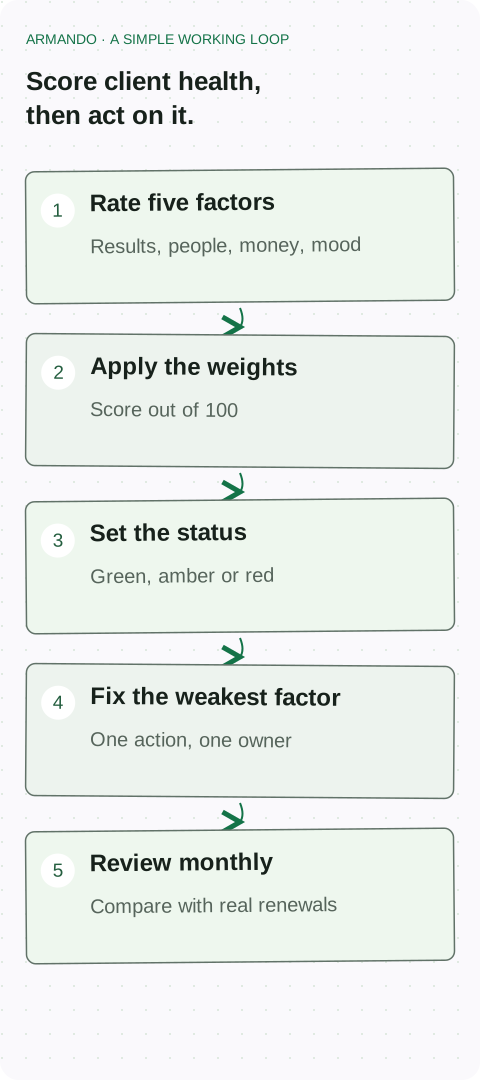
This guide shows you how to build a simple client health score for your agency in about an hour. You will choose five factors, give each one a weight, score every client from 1 to 5, and turn the result into a green, amber or red status. There is a worked example with real arithmetic, a template you can copy, and a monthly routine that keeps the score honest.
You do not need a customer success platform or product usage data. Agencies sell services, so the signals that matter are about results, people, money and mood, and you can judge all four from what you already know. If you would rather skip the spreadsheet, the free Customer health score builder on this site does the weighting and ranking for you.
What a client health score is (and what it is not)
A client health score is a weighted summary of a few signals about one client relationship. Each signal is rated on a small scale, the ratings are combined using weights that reflect how much each signal matters, and the result is a number between 0 and 100. That number is then mapped to a status: green for healthy, amber for watch, red for at risk.
You will also see this called a customer health score, customer health scoring or an account health score. In software companies it is usually built from product usage data such as logins and feature adoption. Agencies do not have that data, so the model here uses judgement ratings instead. That is not a weakness. A rating from the person who talks to the client every week is often a better signal than a dashboard.
What a health score is not: it is not a prediction and it is not a performance review of the account manager. It cannot see a sudden change at the client, such as a new marketing director or a budget freeze. Its job is narrower and more useful. It forces you to look at every client on the same criteria, on a regular schedule, so that a slow decline gets noticed while it can still be fixed.
Think of it as a thermometer, not a diagnosis. A high reading does not prove the client is happy and a low reading does not prove they are leaving. It tells you where to spend your next conversation.
Why agencies need a client health score, and when you can skip it
Without a score, client attention follows noise. The client who emails five times a day gets the energy, and the polite client who has gone quiet gets none. A health score reverses that. It makes a quiet account visible because the sponsor engagement rating drops, even though nobody is complaining.
It also makes handovers and team reviews easier. When two account managers describe the same client as "fine" they may mean opposite things. When both say "amber, because we only know one person there and the last report was not opened", you can have a useful conversation. The score gives the team a shared language for client retention, which is the real prize.
There are cases where you can skip it. If you have fewer than five clients and you speak to each of them weekly, a short written note per client is enough. A score earns its place when you have more accounts than you can hold in your head, when more than one person looks after clients, or when renewals have started to surprise you.
If you already track warning signs ahead of renewal, the health score is the monthly, always-on version of that check. The renewal risk guide on this site covers the 90-day review. The score covers the other nine months.
Want help putting this into practice? See how we can help
The five factors in a simple client health score model
Choose four to six factors. Fewer than four and the score is too blunt. More than six and nobody will fill it in. The five below work for most B2B agencies because they cover the work, the people, the money and the mood, and each one can be judged without special tools.
Results delivered asks whether the client is getting what was agreed. Relationship depth asks how many people at the client you know and how well. Sponsor engagement asks whether the person who signs the budget is still paying attention. Commercial health looks at invoices, scope changes and the state of the contract. Sentiment is the tone of recent conversations and feedback.
The most important step is to write what a 1, a 3 and a 5 look like for each factor. Without anchors, one account manager's 4 is another's 2, and the score becomes a mood ring. Keep the anchors short and concrete, and put them where the team will see them every time they score.
Use the table below as a starting point and edit the wording to match your own services. If you sell performance work, add a line about the main metric. If you run retainers with a lot of approvals, add a line about turnaround times on the client side.
| Factor | What you look at | A score of 1 looks like | A score of 3 looks like | A score of 5 looks like |
|---|---|---|---|---|
| Results delivered | Progress against the goals in the account plan | Goals missed with no recovery plan, or goals never agreed | Mixed results, some goals on track, a plan for the rest | Goals met or beaten and the client can say so |
| Relationship depth | Number and seniority of people you know | One contact only, no senior access | Two or three contacts, one senior | Several contacts across teams, including the decision maker |
| Sponsor engagement | Whether the budget owner attends, replies and reads | No contact with the sponsor for a quarter | Sponsor replies but skips some meetings | Sponsor attends reviews and asks forward-looking questions |
| Commercial health | Payments, scope changes, contract terms | Late payments, open disputes or a request to cut scope | Occasional late invoices, scope stable | Pays on time, scope stable or growing, renewal discussed early |
| Sentiment | Tone of emails, calls and feedback | Frequent complaints or a cold, short tone | Neutral, no strong signals either way | Positive feedback, unprompted praise or referrals offered |
- List the five factors and write one sentence defining each.
- Write anchors for a 1, a 3 and a 5 on each factor, using facts a colleague could check.
- Test the anchors on two clients you know well and adjust any that feel wrong.
- Save the scorecard where every account owner can reach it.
Weights and the client health score formula
Weights say how much each factor counts. If every factor counts the same, a client with great sentiment and a failing campaign can still look healthy. Give the factors that predict losing a client more weight. In most agencies that means results and the people factors, so a sensible starting split is results 30 per cent, relationship depth 20, sponsor engagement 20, commercial health 15 and sentiment 15. These are working assumptions, not benchmarks. Change them after you compare scores with what actually happened at renewal.
The formula is simple. Rate each factor from 1 to 5. Multiply each rating by its weight and add the results together. This gives a weighted average between 1 and 5. Divide by 5 and multiply by 100 to get a score out of 100. In short: score = (sum of rating × weight) ÷ 5 × 100, with the weights written as decimals that add up to 1.
Here is the arithmetic for three fictional clients using those weights. Client A is rated 4, 3, 4, 5, 4. That gives 1.2 + 0.6 + 0.8 + 0.75 + 0.6 = 3.95, which is 79 out of 100. Client B is rated 3, 2, 3, 4, 3. That gives 0.9 + 0.4 + 0.6 + 0.6 + 0.45 = 2.95, which is 59. Client C is rated 2, 1, 2, 3, 2. That gives 0.6 + 0.2 + 0.4 + 0.45 + 0.3 = 1.95, which is 39.
These numbers are invented to show the method, not taken from any real account. The method is what matters: anyone on your team can repeat it and get the same answer.
| Client | Ratings (results, depth, sponsor, commercial, sentiment) | Weighted average | Score out of 100 | Status |
|---|---|---|---|---|
| Client A | 4, 3, 4, 5, 4 | 3.95 | 79 | Green |
| Client B | 3, 2, 3, 4, 3 | 2.95 | 59 | Amber |
| Client C | 2, 1, 2, 3, 2 | 1.95 | 39 | Red |
B2B account management plan template ↗
- Set the five weights so they add up to 100 per cent.
- Rate each factor for one client from 1 to 5.
- Multiply each rating by its weight and add the five results.
- Divide the total by 5 and multiply by 100 to get the score.
Green, amber and red: setting limits and override rules
Turn the score into a status so people can act without reading the arithmetic. A workable starting point is green at 70 and above, amber from 50 to 69, and red below 50. These limits are a rule of thumb, not an industry standard. If every account comes out green, your scoring is probably too kind, so tighten the anchors. If most accounts come out red, check that the anchors are not unrealistic before you panic.
Averages hide single points of failure, so add override rules. Imagine a client rated 5, 1, 4, 5, 4. The weighted average is 1.5 + 0.2 + 0.8 + 0.75 + 0.6 = 3.85, which is 77 and green. But a relationship depth of 1 means you know only one person there, and if that person leaves, the account is exposed. A good override rule is that any factor rated 1 caps the status at amber, and any two factors rated 1 make it red.
Add a second rule for movement. A score that drops by 15 points or more since last month deserves a conversation even if it is still green. Direction often matters more than the level, because a slide from 85 to 68 usually has a cause you can still find.
Write the rules at the top of your scorecard in plain words. When the thresholds are visible, nobody argues about whether an account is "really" amber. They argue about what to do, which is the right argument.
- Set green, amber and red limits and write them on the scorecard.
- Add the cap rule: any factor rated 1 limits the status to amber.
- Add the movement rule: a fall of 15 points or more triggers a review.
- Revisit the limits after the next three renewals and adjust them.
How to build your first client health score in one hour
Block one hour with the people who know the clients best. Start with your ten largest accounts, or all of them if you have fewer. Do not try to score everything the first time. The aim is to learn how the scorecard behaves, not to produce a perfect picture.
Score each account in turn, and do it as a pair if you can. When an account manager and a founder both rate the same client and the numbers differ by two or more points, the gap itself is a finding. Someone knows something the other does not. Write the reason beside the rating in a single line.
Record the weakest factor and one next action for each account. That is the part that turns a score into a plan. A score of 59 with no action beside it is a number on a page. A score of 59 with "we only know the marketing manager, so ask her to introduce us to the finance lead by 15 November" is a plan.
Copy the template below into a shared document or a spreadsheet. One row or one block per client is enough. The free Customer health score builder does the same job in the browser if you prefer to enter ratings and see the ranking at once.
- Pick the clients to score and block one hour with the account owners.
- Rate each factor from 1 to 5 using the anchors, and note the evidence in a line.
- Calculate the score, apply the cap and movement rules, and set the status.
- Name the weakest factor and write one action with an owner and a date.
- Sort the list with red first and agree what happens this week.
COPY & ADAPT
Client health score: [client]
Date scored: [date]    Scored by: [name]
Account owner: [name]    Annual revenue: [amount]

Ratings (1 to 5) and evidence
Results delivered (30%): [1-5] - [one line of evidence]
Relationship depth (20%): [1-5] - [people we know]
Sponsor engagement (20%): [1-5] - [last meaningful contact]
Commercial health (15%): [1-5] - [payments, scope, contract]
Sentiment (15%): [1-5] - [recent tone]

Score out of 100: [number]    Last month: [number]    Change: [+/-]
Status: [green / amber / red]    Override applied: [yes/no, which rule]
Weakest factor: [name]
Next action: [action] by [date], owner [name]
What would change my mind: [one fact]
What to do with green, amber and red accounts
A score only helps if it changes behaviour. Decide in advance what each status triggers, so nobody has to improvise. For green accounts the job is to protect and grow. Keep the normal rhythm, look for expansion and ask for a referral or a case study when the moment is right. Do not neglect green accounts, but do not spend extra time on them either.
Amber accounts get a named fix for the weakest factor within two weeks. If relationship depth is the problem, plan introductions to two more people. If results are the problem, bring the next report forward and add a short recovery plan. If sponsor engagement is the problem, ask for a short call with the sponsor, not another email to the day-to-day contact.
Red accounts go to the founder or head of accounts this week. Agree who will speak to the client, what you will say and what you are prepared to offer. A red account is not always a lost account, and a calm, specific conversation often turns one around. But a red account that nobody discusses will usually stay red.
When you speak to the client, avoid mentioning the score. They do not need to know you rate them. Use the weakest factor to shape a natural question instead. For a thin relationship you might say: "We have mostly worked with you on this, and I would like to make sure the wider team gets what they need. Who else should we be speaking to?" For a results gap: "We have not hit the target we set for this quarter. I would like to walk you through why and what we are changing."
How to build B2B client relationships ↗
- Green: keep the rhythm, look for expansion and note any good news.
- Amber: choose the weakest factor, set one action with an owner within two weeks.
- Red: escalate to the founder or head of accounts this week and agree who speaks to the client.
- Record every action in the account plan and check it at the next review.
COPY & ADAPT
Amber or red account note: [client]
Weakest factor: [name]
What we will say to the client: [one or two sentences, no mention of the score]
What we will offer or change: [action]
Who speaks to the client: [name] by [date]
How we will know it worked: [observable fact, not a feeling]
A monthly client health score routine that stays honest
Scores go stale fast. A rating made in March is no use in June. Put a 30-minute health review in the diary on the same day every month, ideally right after your monthly client check-ins so the information is fresh. Each account owner updates their ratings before the meeting, and the group spends the meeting on red and amber accounts only.
Honesty is the hard part. People round up, especially on their own accounts, because a red status can feel like a verdict on their work. Say clearly at the start that the score measures the relationship, not the person. Reward early flags. The account manager who marks an account amber in October has done you a bigger favour than the one who marks it green until the day the client leaves.
Calibrate against reality every quarter. After each renewal, a loss or a major expansion, look back at the score from three and six months earlier. Did the red accounts leave? Did green accounts leave without warning? If a factor never seems to predict anything, lower its weight. If something the score missed keeps causing surprises, consider adding a sixth factor. This is where the weights stop being guesses and start becoming yours.
Keep the whole thing in one place that the team already uses. A shared spreadsheet is fine. The best system is the one people update, and a simple one beats a clever one that nobody opens.
| When | What happens | Who |
|---|---|---|
| Week 1 of the month | Ratings updated with a line of evidence | Account owners |
| Week 2 of the month | 30-minute review of red and amber accounts, actions agreed | Founder or head of accounts plus owners |
| Following weeks | Actions carried out and noted in the account plan | Account owners |
| Every quarter | Scores compared with renewals and losses, weights adjusted | Founder or head of accounts |
- Account owners update ratings in the week before the monthly review.
- Run a 30-minute review covering red and amber accounts, plus any score that fell 15 points or more.
- Agree one action per account and confirm owners and dates.
- Each quarter, compare past scores with renewals and losses, and adjust weights.
Where a client health score fits into B2B key account management
Key account management is the practice of giving your most important clients a named owner, a written plan and a regular rhythm of reviews. In B2B account management, a small number of accounts usually carry a large share of revenue, so they deserve more deliberate attention than the rest. The person responsible is the key account manager.
The health score is the measurement layer of that approach. A key account plan says where you want the relationship to go. The health score says whether the relationship is on course. Without the second, a plan can look impressive while the sponsor quietly stops replying. With it, the plan is checked against reality every month.
Strategic account management goes further than the next renewal. It looks at the client's wider goals, the other teams you could help and the people you need to know across the organisation. The relationship depth and sponsor engagement factors give an early read on how well your account management strategy is working. A key account with a depth rating of 1 has a strategic gap, whatever the revenue says.
You do not need a large team to start. Score all your clients once, then run the monthly routine on your five to ten key accounts. Use the free Account plan generator to give each key account a written plan, and link the weakest factor from the score to the first action in that plan. The simple account management system guide on this site shows how the pieces connect.
A simple account management system for agencies ↗
B2B account management plan template ↗
- Pick your five to ten key accounts by revenue, strategic value or growth potential.
- Give each a named key account manager and a written key account plan.
- Score each one monthly and link the weakest factor to an action in the plan.
- Review the key account list with the founder once a month.
Common mistakes when you score client health
Too many factors is the first. A twelve-factor model looks rigorous and gets abandoned by the second month. Stay with four to six, and add one only when you can name the surprise it would have caught.
Scoring without evidence is the second. If a rating has no supporting line, it is an opinion. Ask for one fact per rating, such as "last reply from sponsor: 6 weeks ago", so that anyone can challenge it.
Treating the number as precise is the third. A score of 62 is not meaningfully different from 58. Look at the status, the movement and the weakest factor, not the decimal places.
Confusing health with revenue is the fourth. A large client can be fragile and a small client can be a strong advocate. Show revenue beside the score so you can prioritise sensibly, but do not let it change the rating.
The last mistake is scoring and then doing nothing. If the review ends without actions, owners and dates, the score is decoration. Cut the review short rather than let it become a reporting ritual.
Start with one account this week
- Choose four to six factors that you can judge without special tools.
- Write anchors for a 1, a 3 and a 5 on every factor.
- Set weights that add up to 100 per cent and note that they are assumptions.
- Set green, amber and red limits and write them on the scorecard.
- Add a cap rule so that any factor rated 1 limits the status to amber.
- Score your ten largest accounts with a line of evidence for each rating.
- Name the weakest factor and one next action with an owner for every account.
- Escalate red accounts to the founder or head of accounts within the week.
- Run a 30-minute health review every month.
- Compare scores with real renewals each quarter and adjust the weights.
Common questions
What is a client health score?
A client health score is a single number, usually out of 100, that shows how healthy a client relationship is. It combines weighted ratings of factors such as results, relationship depth, sponsor engagement, commercial health and sentiment into a green, amber or red status.
How do you calculate a client health score?
Rate each factor from 1 to 5, multiply each rating by its weight, add the results, divide by 5 and multiply by 100. For example, a weighted average of 3.95 gives a score of 79 out of 100.
What should go into a customer health score for an agency?
Agencies can use results delivered, relationship depth, sponsor engagement, commercial health and sentiment. These can be judged from what the account team already knows, without product usage data. Keep it to four to six factors.
How often should you update client health scores?
Monthly works for most key accounts. Update sooner after a major event, such as a missed deadline, a change of sponsor, a disputed invoice or a sudden drop in replies. Quarterly is too slow for accounts at risk.
What is key account management and how does a health score help?
Key account management gives your most valuable B2B clients a named key account manager, a key account plan and regular reviews. A health score measures whether each relationship is on course, so strategic account management is based on evidence, not on gut feeling.
What do green, amber and red mean in a health score?
Green means healthy and needs the normal rhythm. Amber means watch, so fix the weakest factor within two weeks. Red means at risk and goes to the founder this week. Limits such as 70 and 50 are rules of thumb you should adjust.