ACCOUNT MANAGEMENT · B2B AGENCIES
Account Plan Template: How to Write One in 30 Minutes
Write an account plan in 30 minutes with a timed six-step method and a copy-and-paste account plan template for agency founders and account managers.
An account plan is the shortest route from "we do good work for this client" to "we know exactly what we are doing for them next quarter and why". Most agencies do not have one for most clients. The reason is rarely laziness. It is that the account plan sounds like a big strategic exercise, something with a workshop, a slide deck and a week of preparation, and nobody has a week to spare for a client who is already paying the invoices.
It does not have to be that heavy. A useful account plan fits on one page and takes about 30 minutes to write when you work from what you already know. This guide gives you the timed method, a copy-and-paste account plan template, a worked example with a fictional client, and a routine to keep the plan alive after you write it. It is written for agency founders and account managers who look after real clients every day and want something they will actually use.
If you would rather start from a draft than a blank page, the free Account plan generator on this site turns a few answers into a first version you can edit. Use it alongside the steps below, and remember that the goal is not a perfect document. The goal is a plan that changes what your team does on Monday morning.
What an account plan is, and why one page is enough
An account plan is a written plan for one client. It records where the client wants to get to, who matters on their side, what could go wrong, and what you will do about it in the next three months. It is different from a project plan, which covers one piece of work, and different from a proposal, which sells one. The account plan covers the whole relationship and answers a single question: what are we doing for this client, and why?
The reason one page is enough is that the plan is a thinking tool first and a document second. The act of writing down the client's goal in one sentence, naming the three people who matter and choosing three actions forces decisions that otherwise stay vague. A ten-page plan tends to contain the same decisions buried under description, and nobody reads it after the first week.
A short plan also survives contact with a busy agency. If the plan takes half a day to update, it will not be updated. If it takes ten minutes at the start of each month, it will be. Keep the format small enough that the account manager, the delivery lead and the founder can all read it in two minutes and agree on what it says.
Finally, an account plan is shared, not secret. The best ones can be summarised to the client in a meeting, which is a quiet test of quality. If you would be uncomfortable showing the client your goal for their account, or the risks you see, the plan is probably either too sales-driven or too defensive.
Before you start: what to gather in five minutes
The 30 minutes only work if you do not go hunting for information halfway through. Spend the first few minutes opening what you already have, and stop gathering when the time is up. If a fact is missing, write "to find out" in the plan and make finding it one of the actions. A gap in the plan is useful information. A guessed answer is not.
You need five things on the screen: the contract or retainer summary, the notes from the last two meetings, the latest report or results you sent the client, the list of open requests and issues, and your own list of the people you deal with. If you have a stakeholder map from the free Stakeholder map generator, open that too. Do not open the whole email history. The point is to capture what you already know and make it visible.
- Open the contract or retainer summary: scope, term, price and renewal date.
- Open the last two meeting notes and the latest report you sent.
- List the open requests, delayed items and unanswered questions.
- Write down the people you deal with and how often you speak to each.
- Set a 30-minute timer and decide that anything missing becomes an action.
Want help putting this into practice? See how we can help
How to write an account plan in 30 minutes: six timed steps
Here is the whole method with a time budget. The numbers are working guidance, not rules. If a step runs over, take the time from the one after it, and never from the final step, which is where the plan becomes action.
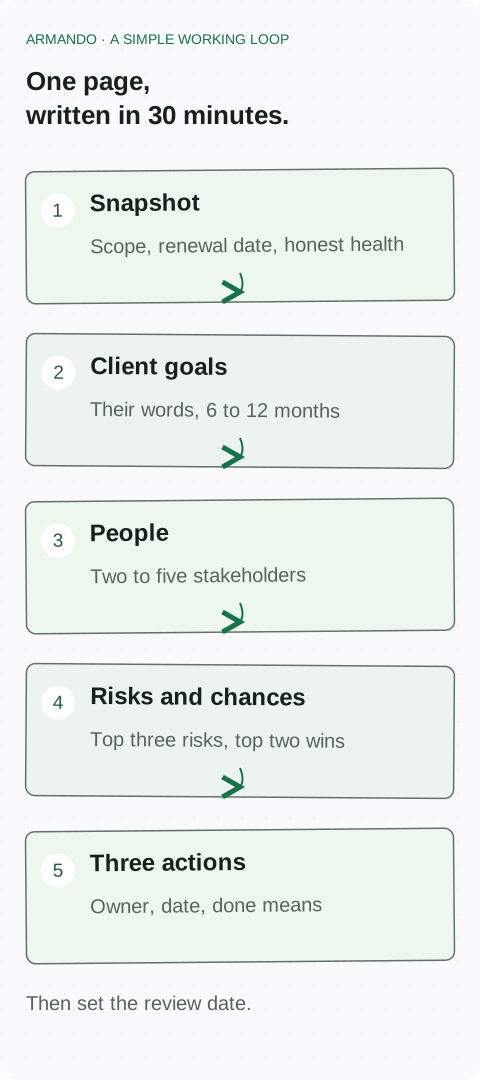
Step one is the client snapshot, which takes three minutes. Write the client's name, what you sell them, the contract term and the renewal date, plus a single sentence on how healthy the relationship feels today. Be honest here. If you feel nervous about the renewal, say so. The rest of the plan will make more sense if the snapshot does not flatter you.
Step two is the client's goals, which takes six minutes. Write down what the client is trying to achieve in the next 6 to 12 months, in their words where you can. These are business goals such as winning a new market, launching a product or cutting cost, not your deliverables. If you do not know, that is the most important finding in the plan, and your first action is a conversation to learn it.
Step three is the people, which takes five minutes. List the two to five stakeholders who matter: the day-to-day contact, the person who signs, anyone who can block or influence the decision, and anyone who has recently joined or left. Note how well you know each one and when you last spoke. Gaps are common here. Many agencies discover that all their contact runs through one person.
Step four is risks and opportunities, which takes six minutes. Write the three biggest risks to the account and the two best opportunities. Risks might be a single point of contact, a delayed approval or unclear results. Opportunities might be a new service the client has mentioned or a team you could be introduced to. Keep each to one line.
Step five is actions, which takes eight minutes. Choose no more than three actions for the next 90 days. Each gets an owner, a date and a short statement of what done looks like. If you have more than three, rank them and park the rest. Three actions that happen beat ten that do not.
Step six is the review date, which takes two minutes. Put the next review in the calendar before you close the document. Monthly is a sensible default for important accounts and quarterly for the rest. A plan without a review date is a document. A plan with one is a process.
- Snapshot (3 min): client, scope, term, renewal date and an honest health note.
- Goals (6 min): what the client wants in 6 to 12 months, in their words.
- People (5 min): two to five stakeholders, how well you know them, last contact.
- Risks and opportunities (6 min): top three risks, top two opportunities.
- Actions (8 min): up to three actions with owner, date and a definition of done.
- Review date (2 min): put it in the calendar before you close the file.
A copy-and-paste account plan template
Use this account plan template as a starting point and remove anything you do not need. It is deliberately short. Each heading maps to one of the six steps above, so you can fill it in order without thinking about structure. Keep it in a place the whole team can see, such as your shared drive or project tool, and name the file the same way for every client so it is easy to find.
The honest health line at the top is the one people skip. Resist that. A health rating of green, amber or red, with one sentence of reasoning, gives the founder a quick view across all accounts and starts the right conversations early. Define your own meaning for each colour and keep it consistent.
COPY & ADAPT
ACCOUNT PLAN: [Client name]
Owner: [Account manager]   Last updated: [date]   Next review: [date]

1. SNAPSHOT
What we do for them: [services and scope]
Contract term and renewal date: [dates]
Relationship health: [green / amber / red] - [one sentence why]

2. CLIENT GOALS (next 6 to 12 months)
- [Goal in the client's words]
- [Goal in the client's words]
What we do not yet know: [questions]

3. PEOPLE
- [Name, role] - [sponsor / day-to-day / influencer / blocker] - last spoke [date] - strength [strong / ok / weak]
- [Name, role] - [role in decision] - last spoke [date] - strength [strong / ok / weak]

4. RISKS AND OPPORTUNITIES
Risks: 1) [risk]  2) [risk]  3) [risk]
Opportunities: 1) [opportunity]  2) [opportunity]

5. ACTIONS (next 90 days, maximum three)
1) [Action] - owner [name] - by [date] - done means [result]
2) [Action] - owner [name] - by [date] - done means [result]
3) [Action] - owner [name] - by [date] - done means [result]

6. REVIEW
Next review: [date]. What changed since last time: [notes]
Worked example: an account plan for a fictional client
A template is easier to trust when you see it filled in. The example below is fictional. The client, the people and the numbers do not describe a real company, and nothing here is evidence of results. It shows the level of detail to aim for: specific enough to act on, short enough to read in two minutes.
Imagine a small agency that runs content and email marketing for a regional food distributor, which we will call Northwind Foods. The retainer renews in four months. The agency has one regular contact, a marketing manager, and has never spoken to the managing director who signs the contract. The account manager has a feeling that the client is pleased but has no proof of it.
In the snapshot, the account manager writes amber and gives a reason: single point of contact and renewal in four months. Under goals, she writes that the client wants more orders from independent restaurants and wants to reduce reliance on one large customer, in the marketing manager's words from the last call. Under what we do not know, she lists the managing director's view of the work.
Under people, she lists the marketing manager as strong, the managing director as unknown, and a new sales lead who joined last month as weak. Under risks, she writes three: all contact runs through one person, results have been reported by activity rather than by orders, and the renewal date is close. Under opportunities she writes two: the sales lead could use the email content in outreach, and the client has mentioned a possible new product range.
The three actions follow directly. First, ask the marketing manager to introduce the managing director for a 20-minute review, owner the account manager, by the end of the month. Second, change the next report to show orders from the targeted segment next to the activity, owner the analyst, by the next report date. Third, book a short intro with the new sales lead, owner the account manager, within two weeks. The plan fits on one page and every line leads to something somebody will do.
Which clients need an account plan and how much detail
Not every client needs the same depth. Writing a full plan for every account is one of the quickest ways to make the habit collapse, because the effort per plan does not match the value of the account. A simple rule is to match the depth of the plan to the importance and the risk of the account, and to review the list twice a year.
The table below shows one way to tier your accounts. The tiers and review rhythms are suggestions to adapt, not benchmarks. If you have fewer than ten clients, you may simply write the full plan for the top three and a short one for the rest. What matters is that every client has some plan, even if it is five lines, and that the plans for your most important accounts get the most attention.
| Account type | Plan depth | Review rhythm | Who writes it |
|---|---|---|---|
| Top accounts: largest revenue or highest strategic value | Full one-page plan with stakeholder map | Monthly | Account manager with founder input |
| Growing accounts: clear opportunity to expand | One-page plan focused on goals and opportunities | Every six weeks | Account manager |
| Steady accounts: stable, low risk | Short plan: snapshot, goal, three actions | Quarterly | Account manager |
| At-risk accounts: warning signs present | Full plan with a recovery action list | Every two weeks until stable | Founder and account manager |
| New accounts: first 90 days | Plan built from the onboarding kickoff | Monthly | Account manager and delivery lead |
Keep your account plan alive: a 10-minute monthly review
Writing the plan is the easy part. The hard part is that plans age quickly. A goal changes, a stakeholder leaves, a risk becomes a problem, and a plan that does not reflect any of that becomes worse than no plan because it gives a false sense of control. The fix is a short, regular review rather than a big annual rewrite.
Block ten minutes a month per important account. Read the plan from the top, change anything that is no longer true, tick off finished actions and add the next one. Write one line in the review section about what changed. Over a year, those lines become the history of the account, which is invaluable when someone new takes over. The account handover checklist builds directly on this record.
Link the plan to your other routines. Bring it into the weekly internal account review so the team sees what is on track, and use it to prepare for client meetings so that you walk in knowing what you want from the conversation. Use it again when a renewal conversation approaches, because the goals, people and risks you recorded are the raw material for that discussion.
Account handover checklist: what the next owner needs ↗
Client renewal risk: warning signs and what to do ↗
- Block ten minutes per important account each month.
- Read the plan from the top and change anything that is no longer true.
- Mark finished actions done and add the next one.
- Write one line under review: what changed since last time.
- Flag any account whose health rating moved to amber or red.
Where an account plan fits into B2B key account management
Key account management is the practice of giving your most important clients a named owner, a written plan and a regular rhythm of contact. In B2B key account management, the account plan is the central document. It is where the strategy for a client is written down, so everyone who works on the account can see the same picture and pull in the same direction.
A key account plan is usually a fuller version of the one-page plan in this guide. It adds the longer-term view: where the client wants to be in two or three years, how your services could grow with them, and which senior relationships you need to build. The key account manager owns it, updates it monthly, and uses it to prepare meetings and renewals. The same six steps apply. You simply spend more time on people and opportunities.
Strategic account management takes the plan one step further by asking how the account fits into your own business. Which clients should you invest in, which should you simply serve well, and which are better left to run on a lighter process? That is the heart of an account management strategy for a small agency, and the tier table above is a simple way to make those choices visible. Good B2B account management is not the same effort for everyone. It is the right effort for each account.
To go further, read the guides on a simple account management system for agencies and the B2B account management plan template, and use the free Account plan generator to draft the first version for each key account. Start with your top five, name an owner for each, and book the first review.
A simple account management system for agencies ↗
B2B account management plan template ↗
- Choose your top five to ten key accounts and name a key account manager for each.
- Write a one-page plan for each using the six timed steps.
- Add a longer-term section: two-to-three-year view and senior relationships to build.
- Review each key account plan monthly and share a summary with the founder.
Common account plan mistakes and how to fix them
The first mistake is writing the plan as a list of your deliverables. A plan that says "produce four blog posts a month and send a newsletter" describes your workload, not the client's goals. Fix it by writing the client's goal first and asking how each action serves it. If an action does not connect to a goal, question why it is there.
The second mistake is making the plan too long. Plans balloon because people try to record everything they know. Fix it by keeping the template fixed and moving background material into notes. The plan should hold decisions and actions. The notes can hold the context.
The third mistake is writing it once and filing it. A plan that is not reviewed is out of date within a quarter. Fix it with the monthly ten-minute review and a visible next review date. If a plan has not been touched for three months, treat that as a warning sign for the account itself.
The fourth mistake is hiding the uncomfortable parts. Plans written to impress the founder leave out single points of contact, weak results and a sponsor nobody has met. Fix it by making honesty the norm: an amber rating with a clear reason is a good plan. A green rating nobody believes is not.
The fifth mistake is inventing facts. If you do not know the client's goal or the sponsor's opinion, do not guess. Write "to find out" and make the discovery an action. Plans built on assumptions fail quietly, usually at renewal, when it is hardest to repair them.
Start with one account this week
- The plan fits on one page and takes under 30 minutes to write.
- The client's goals are written in business terms, in their words where possible.
- Two to five stakeholders are listed with the date of last contact.
- Top three risks and top two opportunities are named.
- No more than three actions, each with an owner, a date and a definition of done.
- A relationship health rating is recorded with one sentence of reasoning.
- A review date is in the calendar before the plan is saved.
- Gaps in knowledge are written as actions, not guessed answers.
- The plan could be summarised to the client without embarrassment.
Common questions
How do you write an account plan?
Gather the contract, recent notes and open issues. Then write a client snapshot, the client's goals, key stakeholders, top risks and opportunities, and up to three actions with owners and dates. Finish by setting a review date. Done in order, this takes about 30 minutes.
What should an account plan include?
At minimum: a snapshot of the account, the client's goals, the people who matter, risks and opportunities, a short action list with owners and dates, and a review date. Anything beyond that should earn its place by changing what your team does.
How long should an account plan be?
For most agency clients, one page is enough. Top accounts may need a fuller version with a longer-term view and a stakeholder map. If the plan is too long to read in two minutes, people stop using it, so move background detail into separate notes.
Which clients need an account plan?
Every client should have at least a short plan. Spend the most effort on your largest, most strategic and most at-risk accounts, and keep plans for stable, low-risk clients to a snapshot, one goal and three actions reviewed quarterly.
What is key account management and how does it relate to an account plan?
Key account management is giving your most important clients a named key account manager, a written key account plan and a regular rhythm of contact. The account plan is its central document, recording goals, stakeholders, risks and next actions for each key account.