ACCOUNT MANAGEMENT · B2B AGENCIES
Client Lifetime Value for Service Firms: Formula + Example
Client lifetime value for B2B service firms: a simple formula, a worked example, churn sensitivity and a monthly routine to raise what each client is worth.
Client lifetime value is the number that answers a question most agency and consultancy owners ask in some form every month: how much is a good client really worth to us? You may know what a client pays each month. You may even know how long your longest retainer has lasted. But putting revenue, margin and retention together into one figure is what lets you decide how much to spend winning a client, how hard to work to keep one, and which accounts deserve your best people.
This guide explains client lifetime value for B2B service firms in plain English. You will see the formula, a worked example with a fictional agency, why gross profit matters more than revenue, how a few points of churn can change the answer, how to compare lifetime value with the cost of winning a client, and how to calculate it by segment when you only have a small number of clients. There is a comparison table, a copyable review template and a short list of mistakes that make the number look better than it is.
Treat every figure here as an estimate. Lifetime value is a forecast built on past behaviour, and a service firm with 20 clients does not have the data volume of a software company with 20,000 customers. Used sensibly, it still gives you a sharper way to argue for investment in retention. If you would rather skip the arithmetic, the free B2B customer lifetime value calculator on this site runs every formula in this guide.
What client lifetime value means for a service firm
Client lifetime value, often shortened to CLV or LTV, is the total gross profit you expect to earn from one client between the day they start and the day they leave. Customer lifetime value is the same idea under a name that software and retail businesses prefer. For an agency, consultancy or other service firm, the client is the unit, and the lifetime is however long the relationship lasts, whether that is eight months or eight years.
Three things drive the number. The first is how much the client pays you each year. The second is how much of that you keep after the cost of delivering the work. The third is how long the client stays. Change any one of them and lifetime value moves. Most owners focus on the first, because it is the one they can see on an invoice. In practice, margin and retention often matter more, and both are partly within your control.
It helps to separate lifetime value from a few neighbouring ideas. Revenue per client is only the top line. Average contract value describes one deal, not the relationship. Retainer size is a monthly figure. Lifetime value takes all of these, adds margin and time, and expresses the result as a single amount of profit. That is why it is useful for decisions: it puts a price tag on the relationship, which you can then compare with what you spend on sales, onboarding and account management.
One caution before the formula. Lifetime value looks forward, but you can only estimate it from the past. If your service mix, pricing or team has changed a lot, old retention data may not describe the clients you are winning today. Use your best recent evidence and say plainly which period you used.
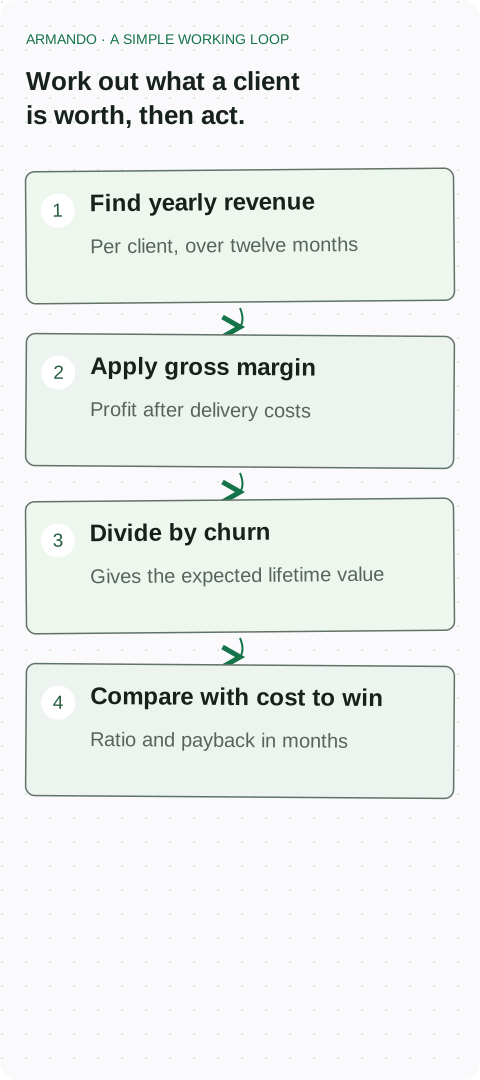
The client lifetime value formula, step by step
The simple formula is short. Client lifetime value equals annual revenue per client, multiplied by gross margin, divided by annual churn rate. The multiplication gives you the gross profit a client generates in a year. The division by churn converts that yearly profit into a lifetime figure, because one divided by churn is the average number of years a client stays. With 20% annual churn, the average lifetime is five years. With 10%, it is ten.
Write the churn rate as a decimal when you do the sum. A churn rate of 15% becomes 0.15. Annual revenue of 60,000 at a 40% margin is 24,000 of gross profit a year, and dividing by 0.15 gives 160,000. If you do not yet track churn, start with our guide to churn rate and retention rate, which shows how to calculate both by client count and by revenue.
The simple version assumes a client pays the same amount every year and that the chance of leaving is the same each year. That is rarely exactly true, but it is a fair first estimate and easy to explain to a partner. A multi-year version improves on it by adding yearly growth of a kept client, a limit on how many years you look ahead, and a discount rate for money received later. The table below sets out the main measures.
Whichever version you use, keep the inputs consistent. If revenue is annual, churn must be annual. If margin is a gross margin after delivery costs, say so every time. A number whose inputs shift from one report to the next cannot be compared over time, and comparison is where most of the value lies.
| Measure | Formula | What it tells you |
|---|---|---|
| Gross profit per client per year | Annual revenue per client × gross margin | How much a client contributes after delivery costs |
| Average client lifetime (years) | 1 ÷ annual churn rate | How long a typical client stays |
| Simple client lifetime value | Annual revenue × gross margin ÷ annual churn | Expected lifetime gross profit per client |
| Multi-year value (capped) | Sum of yearly gross profit × the chance the client is still with you that year | Value over a fixed horizon, such as five years |
| Lifetime value to cost ratio | Client lifetime value ÷ cost to win the client | How well new business pays back |
| Payback period | Cost to win ÷ monthly gross profit per client | How many months until the client has repaid the cost of winning them |
Want help putting this into practice? See how we can help
A worked client lifetime value example for an agency
Here is a fictional agency, so the arithmetic is easy to follow. It is not real client data. The agency sells monthly marketing retainers. A typical client pays 5,000 a month, which is 60,000 a year. After the cost of the people who deliver the work, the agency keeps a 40% gross margin. Over the last few years, around 15% of clients left each year.
Gross profit per client per year is 60,000 multiplied by 0.40, which is 24,000. Average lifetime is one divided by 0.15, which is about 6.7 years. Client lifetime value is 24,000 divided by 0.15, which is 160,000. In words: a typical new client is worth roughly 160,000 of gross profit to this agency over the relationship, if the past pattern holds.
Now add the cost of winning that client. Suppose sales time, proposals and onboarding cost 20,000 per new client. The lifetime value to cost ratio is 160,000 divided by 20,000, which is 8 to 1. Payback is 20,000 divided by the monthly gross profit of 2,000, which is 10 months. Those two numbers tell a very different story from revenue alone. They say the agency can afford to spend more to win clients like this one, and that the first year is the risky part, because the cost is only repaid after about ten months.
A capped five-year view is more cautious. If a client has an 85% chance of staying each year, the expected number of paid years over five is about 3.7, so the five-year value is about 89,000 rather than 160,000. Reporting both is sensible: the simple figure shows the long-run potential, and the capped figure shows what you can realistically count on in a planning horizon.
- Find annual revenue per client: 5,000 × 12 = 60,000.
- Multiply by gross margin to get yearly gross profit: 60,000 × 0.40 = 24,000.
- Take annual churn as a decimal: 15% = 0.15.
- Divide yearly gross profit by churn: 24,000 ÷ 0.15 = 160,000.
- Compare with the cost to win: 160,000 ÷ 20,000 = 8 to 1, with payback in about 10 months.
Use gross profit, not revenue, to value a client
The most common mistake in client lifetime value is using revenue as if it were profit. Revenue ignores the cost of delivering the work. A client who pays 120,000 a year but consumes a team of four is not worth more than a client who pays 60,000 and runs smoothly. For a service firm, delivery is mostly people, so the real cost sits in hours.
To estimate gross margin by client, take the fees you billed and subtract the cost of the time spent on that client, using a loaded hourly cost for each person. If you do not track time, even a rough estimate is better than none. Ask each lead how many hours a week their team spends on the account, multiply by an agreed cost per hour, and compare with the monthly fee. Add direct costs such as freelancers, software seats and media handling charges.
Watch the hidden hours. Unpaid extra work, long email threads, last-minute revisions and endless meetings all cost money without appearing on the invoice. A client that looks profitable on paper can have a thin margin once those hours are counted. This is one reason scope discipline matters, and why agreeing what is in and out of a retainer protects lifetime value as much as it protects the team.
Two clients can show the same revenue and very different value. Client B pays 120,000 a year at a 30% margin, which is 36,000 of gross profit. Client C pays 30,000 a year at a 50% margin, which is 15,000. With the same 15% churn, B is worth 240,000 and C is worth 100,000. Revenue says B is four times larger than C. Lifetime value says B is worth about two and a half times as much, and it would be worth less still if B demanded more hours.
How churn and retention change client lifetime value
Because churn sits in the denominator, small changes in retention have a large effect on lifetime value. Take the example client with 24,000 of yearly gross profit. At 20% churn, the lifetime is five years and the value is 120,000. At 15%, it is 160,000. At 10%, it is 240,000. At 5%, it is 480,000. A ten-point improvement in churn can double the value of a client, and it costs nothing to acquire.
This is the strongest argument for putting time into retention. A better retention rate does not just stop revenue leaking out. It lengthens the life of every client you already have, and each extra year is a year of gross profit with no new sales cost. For a firm that wins clients through referrals and relationships, retention is often the cheapest growth lever available.
The same sensitivity works in reverse, so be careful when you interpret a very low churn figure. If you have only a handful of clients and none has left yet, churn looks like zero and lifetime value looks infinite. That is not a result, it is missing data. In that case, use a conservative assumption, such as a lifetime of three to five years, and label it as an assumption.
The table below shows the sensitivity for a client with 24,000 of yearly gross profit. It uses the simple formula, so treat it as an illustration rather than a forecast.
| Annual churn | Average lifetime | Client lifetime value | Change vs 15% churn |
|---|---|---|---|
| 5% | 20 years | 480,000 | Three times higher |
| 10% | 10 years | 240,000 | One and a half times higher |
| 15% | About 6.7 years | 160,000 | Baseline |
| 20% | 5 years | 120,000 | A quarter lower |
| 25% | 4 years | 96,000 | 40% lower |
Client lifetime value vs the cost of winning a client
Lifetime value becomes a decision tool when you set it beside the cost of acquiring a client. Add up what you spend on sales and marketing, including the time of the people who pitch, write proposals and run onboarding, then divide by the number of new clients won in the same period. That gives you a cost to win. Compare it with lifetime value to get a ratio, and divide it by monthly gross profit to get a payback period.
Many teams aim for a lifetime value of around three times the cost to win, but this is a rule of thumb, not a law. A firm with plenty of cash can accept slower payback in return for faster growth. A firm that is short of cash may need payback inside a year. Decide your own threshold, write it down and review it when your pricing or costs change.
Do not forget the cost of keeping a client. Account management time, regular reviews and reporting are real costs, and they should come out of gross profit if you want an honest view. When you include them, you may find that a small client with a large share of your account manager's time has a much lower value than it first appears.
Finally, remember that expansion belongs in the picture. If a client typically adds a new service in year two, simple lifetime value understates their worth. You can model this by adding a yearly growth rate to revenue, or you can keep it out of the calculation and treat expansion as upside. Either approach is fine, provided you say which one you used.
B2B client lifetime value by segment: a monthly template
An average hides the clients that matter. In B2B account management, a few large accounts usually carry a big share of the income, and their lifetime value is far above the typical client. Calculate it by segment instead: by size band, by service line, by industry, or simply key accounts versus everyone else. Each segment should have its own revenue, margin and churn.
With a small number of clients, segments can get thin very quickly. If a segment has only four clients, a single departure moves churn by 25 points. Use a longer window, such as the last three years, widen the segment, or show the range from a cautious to an optimistic assumption instead of one precise figure. A range such as 100,000 to 180,000 is more honest than 143,271.
Review the numbers on a fixed day each month and keep the definition steady. The template below captures the inputs, the result and the decisions that follow from it. Copy it into your own document and fill in the brackets with your figures.
COPY & ADAPT
Client lifetime value review: [segment]
Prepared by: [name]    Date: [date]

Clients in segment: [number]    Period used for churn: [dates]
Average annual revenue per client: [amount]
Gross margin after delivery costs: [%]
Gross profit per client per year: [amount]
Annual churn rate: [%]    Average lifetime: [1 ÷ churn] years

Client lifetime value (simple): [amount]
Capped value over [5] years: [amount]
Cost to win a client: [amount]    Value to cost ratio: [number] to 1    Payback: [months]

Assumptions and weak points (small numbers, missing time data, one-off projects):
- [assumption]

Best-value clients to protect:
1. [client] - plan: [what], owner: [name], by: [date]

Lowest-value clients to fix, reprice or phase out:
1. [client] - action: [what], owner: [name], by: [date]

Decision this month: [one line]
How to increase client lifetime value without raising prices
Once you can see the number, the formula points at four levers. You can raise revenue per client, improve margin, reduce churn, or lengthen the relationship through expansion. Prices are only one way to move the first lever, and often not the best place to start.
The most reliable lever is retention. Fix the early months, because many clients who leave were never properly onboarded. Hold regular reviews so value is visible. Watch warning signs such as slower replies and a quiet champion. Our guides on client renewal risk and on client health scores show how to spot trouble before the notice arrives.
The second lever is margin. Look at the clients with the lowest gross margin and ask what is driving it. It may be scope creep, a bloated team, a mispriced retainer or a manual process that could be simplified. Small improvements here flow straight into lifetime value, and they also make the work more pleasant for the team.
The third lever is expansion. Clients who trust you are the best buyers of your next service, but only if you listen to their goals first. The fourth is a well-handled price change. A fair, well-explained increase at renewal raises yearly revenue and, if the value is clear, does not need to cost you the client. Work through the steps below in order, because a retention fix usually pays back faster than a new sales push.
Client renewal risk warning signs ↗
How to raise rates with existing clients ↗
- Calculate lifetime value for your top ten clients and for the rest of the base.
- Find the three clients with the lowest margin and decide whether to reprice, rescope or change delivery.
- Review churn reasons from the last year and fix the most common cause first.
- Add one expansion conversation to each key account review, led by the client's goals.
- Plan a fair price review for clients who have not seen an increase in over a year.
- Recalculate each quarter and note what changed.
Where client lifetime value fits into B2B key account management
Key account management is the practice of giving your most important clients a named owner, a written plan and a regular rhythm. Client lifetime value is how you decide who belongs on that list. In B2B account management, the accounts with the highest lifetime value are the ones where a lost relationship hurts most and where extra attention pays back most, so they are the natural candidates for a key account manager.
Strategic account management adds a forward view. Instead of asking only what an account has been worth, it asks what the account could be worth if you protect it and help it grow. Comparing current lifetime value with potential lifetime value shows where to invest time. A client with high value and high risk needs a retention plan this month. A client with modest value and large unused potential needs an expansion plan.
A key account plan turns the number into action. Each plan should state the lifetime value estimate, the renewal date, the people involved, the risks, and the next three actions. The free Account plan generator on this site helps you write one in about 30 minutes. If you are shaping your wider account management strategy, begin with a simple ranking of clients by lifetime value and decide where a named owner makes the most difference.
You do not need a large team to do this. Rank your clients by gross profit, choose the top five or ten, name an owner for each, and review their value and risk monthly.
A simple account management system for agencies ↗
B2B account management plan template ↗
- Rank your clients by yearly gross profit and by estimated lifetime value.
- Choose the top accounts as key accounts and name one owner for each.
- Write a key account plan for each, with the value estimate and the next actions.
- Review value and risk for these accounts every month, and widen the list as the habit settles.
Common client lifetime value mistakes to avoid
The first mistake is using revenue instead of gross profit, which overstates the value of every client, especially those who need a lot of hands-on work. The second is using a churn rate that does not match the client type. A blended churn figure applied to a large enterprise client or to a one-off project client will mislead. Use churn for the segment you are valuing.
The third mistake is mixing project work and retainers. Lifetime value assumes an ongoing relationship. If much of your income is one-off projects, count repeat purchases rather than months, or value project clients separately. The fourth is false precision. A figure to the last unit suggests accuracy the data cannot support. Round it, and show a range.
The fifth mistake is ignoring the cost to keep a client. Account management, reporting and regular reviews all take time, and if you leave them out, lifetime value looks better than it is. The sixth is using the number once and forgetting it. Lifetime value earns its place by being recalculated, compared over time and linked to decisions. Pick a day each quarter, update the inputs and write down what you will do differently.
The last mistake is treating the figure as a verdict on a person. Some clients look low-value because they are new, small or in a slow quarter. Use the number to ask better questions, not to rank people unkindly.
Start with one account this week
- Decide the period for revenue, margin and churn, and use annual figures for all three.
- Estimate gross margin by client using delivery hours and direct costs, not revenue alone.
- Calculate annual churn for the segment you are valuing.
- Work out simple client lifetime value: annual revenue × gross margin ÷ churn.
- Add a capped five-year value as the cautious view.
- Compare lifetime value with the cost to win and the payback period.
- Calculate separately for key accounts and for the rest of the base.
- Show a range instead of one precise figure when you have few clients.
- Include the cost of account management and regular reviews in your margin.
- Recalculate each quarter, record the assumptions and act on one finding.
Common questions
How do you calculate client lifetime value?
Multiply annual revenue per client by gross margin, then divide by annual churn. For example, 60,000 × 40% ÷ 15% is 160,000. Use gross profit rather than revenue, and make sure revenue, margin and churn all cover the same period.
What is a good client lifetime value for a service firm?
There is no universal good number, because it depends on your margins, pricing and cost to win. Compare lifetime value with what it costs to win and keep a client, and with your own figures from earlier periods and other segments.
What is the difference between client lifetime value and customer lifetime value?
They mean the same thing. Client lifetime value is the term agencies and consultancies tend to use, while customer lifetime value is more common in software and retail. Both describe the gross profit expected from one buyer across the whole relationship.
How does churn affect client lifetime value?
Churn sets how long clients stay, so it has a large effect. Lifetime equals one divided by annual churn. Cutting churn from 15% to 10% lengthens the average lifetime from about 6.7 years to 10 and raises lifetime value by half.
How does lifetime value help with B2B key account management?
It shows which accounts matter most and where attention pays back. In key account management, a key account manager can rank accounts by lifetime value, write a key account plan for the top ones and review risk and growth every month.
Should I include expansion revenue in lifetime value?
You can, but be clear about it. Add a yearly growth rate if clients usually buy more over time, or leave expansion out and treat it as upside. Mixing the two approaches between reports makes the figures impossible to compare.