ACCOUNT MANAGEMENT · B2B AGENCIES
Key Account Management vs Account Management: A B2B Guide
Key account management vs account management for B2B agencies: what it is, who the key account manager is, and how to build a key account plan that works.
Ask five people at your agency to name your most important clients and you will probably get five slightly different lists. That small gap is where most expensive surprises begin.
Key account management is the practice of looking after your most valuable clients on purpose: with a named owner, a written plan and a regular rhythm, instead of reacting to whichever email arrived last. Account management is the wider job of looking after every client. This guide explains the difference between the two, who does what, and how to run B2B key account management in an agency or service firm without building a big process.
You will get definitions, a comparison table, a way to choose key accounts, a copyable key account plan, a 30-day start plan and the mistakes we see most often. All examples are fictional and meant to be adapted, not copied.
What is key account management?
Key account management (often shortened to KAM) is a structured way of managing the small group of clients that matter most to your business. "Matter most" usually means a mix of current revenue, growth potential, strategic value and the damage it would do if they left.
In large companies it is a full discipline, with dedicated teams, software and executive sponsors. In an agency with 15 to 60 clients it can be much lighter, and it should be. The core idea is the same everywhere: spend more thinking on the accounts that move your business, not only more hours.
A key account is not simply "our biggest client". A client can be key because of the revenue it brings now, because it could grow into something larger, because its logo opens doors, or because its work is the best proof of what you can do. Naming the reason matters, because the reason decides what the plan should aim for.
Three things separate a key account from a normal one. It has a named owner who is accountable for the whole relationship. It has a written plan that says where the account should be in twelve months. And it has a rhythm, a set of recurring touchpoints and reviews, so that attention does not depend on anyone's memory.
Takeaway: key account management is attention, planned.
Key account management vs account management: the real differences
People use the two terms as if they meant the same thing, and in a small agency they often overlap. They are still different jobs. Account management is the baseline: every client has someone who knows them, answers questions, keeps delivery on track and notices when something is off. Key account management is a deeper layer for the few clients where that baseline is not enough.
The simplest way to see the difference is depth, not title. A normal account gets a reliable routine. A key account gets a plan, several relationships, regular senior attention and a long-term view. Here is a side-by-side view.
| Area | Standard account management | Key account management |
|---|---|---|
| Who it covers | Every client | The few clients that matter most |
| Main goal | Keep delivery smooth and the client happy | Grow the relationship and protect it for years |
| Time horizon | This month and the next renewal | The next 12 to 24 months |
| Planning | Light notes and a renewal date | A written key account plan with goals and next steps |
| Relationships | Usually one or two contacts | Several contacts across teams and levels |
| Owner | Whoever is assigned the account | A named key account manager with a backup |
| Senior involvement | When something goes wrong | Planned, for example a quarterly leadership conversation |
| Review rhythm | Renewal review and ad hoc check-ins | Weekly or monthly review, plus a quarterly plan review |
| Typical output | Happy client, on-time renewal | More scope, more departments, referrals and fewer surprises |
None of this means standard accounts get worse service. They get a reliable, lighter routine, and the best of them can be promoted to key status when the numbers or the potential change. If you want the wider picture of roles first, read the difference between a client partner, an account manager and a customer success manager.
Want help putting this into practice? See how we can help
Who is a key account manager and what do they do?
A key account manager is the person accountable for the whole relationship with one or a few key clients. Where an account manager might focus on the day-to-day contact, the key account manager looks at the whole account: who the client's people are, where the account is heading, what could grow it and what could threaten it.
In practice the role has five recurring jobs.
- Own the key account plan and keep it current.
- Build and maintain relationships with several people at the client, not only the main contact.
- Spot growth opportunities and bring them to the client at the right moment.
- Watch for risk early, from slower replies to a changed sponsor.
- Coordinate your own team so the client experiences one agency, not five separate suppliers.
In a small agency the key account manager is often the founder, a partner or a senior account lead who also does other work. That is fine. What matters is that the name is written down, that the person has a backup, and that the job has protected time. A common pattern is one key account manager looking after three to five key accounts, but that depends on how complex each client is, so treat the number as a starting assumption and adjust it.
The key account manager is not a substitute for delivery. Someone still has to run the work. The role exists so that the commercial and relationship side of the account has an owner who is not buried in tickets. For more on assigning owners across clients, see how to assign managers to client accounts.
Should you assign a PM to a client account? Product vs project roles ↗
How to decide which clients are key accounts
Most agencies pick key accounts by feel: the loudest client, the biggest invoice, or the one that scares the founder. A short score is better, because it makes the choice visible and easy to discuss.
Score each client from 1 (low) to 5 (high) on four questions:
- Revenue: how much does this client contribute now, as a share of what you earn?
- Growth potential: how much more could they realistically buy, in this team or in other departments?
- Strategic value: do they open doors, strengthen your reputation or prove a capability you want to sell more of?
- Risk if they left: how much would losing them hurt your revenue, your team or your cash flow?
Add the four scores. Sort the clients from highest to lowest. Then draw a line. A useful starting assumption is that around the top 10 to 20 percent of clients, or the top five to ten for a small agency, go on the key account list. This is a working rule, not a law. If you have 12 clients, three key accounts may be right. If you have 60, ten or twelve may be.
Do this with the people who know the clients, not alone. Two people scoring separately and then comparing results often reveals that the "obvious" key account is less strategic than the quiet client nobody talks about.
- List every active client and its annual revenue.
- Score each one on the four questions above.
- Sort by total score and mark the cut-off line.
- Test the result: would losing anyone just below the line hurt more than losing someone just above it?
- Write down the reason each key account is on the list.
Review the list at least twice a year. Clients move up and down, and a key account list that never changes is usually a list nobody is looking at.
Should you assign a PM to a client account? Product vs project roles ↗
How to build a key account plan
A key account plan is a short document that says where one client relationship should go and how you will get there. It does not need to be long. One or two pages that people actually read beat a thirty-slide deck that nobody opens.
The plan should answer six questions. Why is this account key? What does the client want to achieve this year? Who are the people, and how strong is each relationship? Where could the account grow, and where could it break? What are the next three actions, with an owner and a date each? When is the next review?
Use the template below as a starting point. Copy it into your own tool and keep it to a page.
COPY & ADAPT
KEY ACCOUNT PLAN: [Client name]
Account owner: [Key account manager]   Backup: [Name]
Plan date: [DD Month YYYY]   Next review: [DD Month YYYY]

1. Why this account is key
Revenue now: [amount or share]   Growth potential: [what and where]
Strategic value: [why it matters beyond revenue]

2. The client's goals this year
- [Goal 1, in their words]
- [Goal 2, in their words]

3. People and relationships
Name | Role | Influence (high/medium/low) | Relationship (strong/ok/weak) | Our owner

4. Opportunities
- [Opportunity, who it involves, earliest sensible moment to raise it]

5. Risks
- [Risk, early sign, what we will do if it appears]

6. Next three actions
1. [Action] | Owner: [Name] | Date: [DD Month]
2. [Action] | Owner: [Name] | Date: [DD Month]
3. [Action] | Owner: [Name] | Date: [DD Month]

7. Renewal and commercial notes
Contract end: [Date]   Notice period: [Days]   Price review: [Date]
If you would rather start from a tool than a blank page, the free Account plan generator builds a dated plan around a goal such as grow, keep, raise rates or renew. And for a deeper plan structure, see the B2B account management plan template.
Client Account Management Template: A Simple B2B Plan (With Examples) ↗
Strategic account management: when a key account becomes strategic
Strategic account management is the next step up from key account management. The two terms overlap, and different companies use them differently, so it helps to define them in your own words. A common distinction is this: key accounts are the clients that matter most to you today, while strategic accounts are the clients where you and the client plan the future together.
In a strategic relationship the client shares more about its goals, you work across several of its teams, and conversations move from "how is the project going?" to "where is your business heading and how can we help?". It usually involves senior people on both sides, a longer planning horizon and sometimes joint reviews.
Not every key account will become strategic, and that is fine. Strategic account management needs a client that is willing to share information and a supplier that can bring ideas beyond the current scope. If either side is missing, a solid key account plan is the right level.
Signs that a key account may be ready to become strategic:
- The client talks openly about plans beyond the current contract.
- You have contacts in more than one team or business unit.
- Leaders on their side take part in your reviews.
- They ask your opinion on topics outside the current scope.
When these signs appear, add a longer-term section to the plan: the client's three-year direction, the areas where you could contribute, and the people who need to be involved. Keep it modest. A strategic conversation that fills a whole workshop in the first meeting is usually too much.
B2B key account management for a small agency: a minimal system
B2B key account management does not need software, a department or a long manual. For a small agency it can be a simple system built from four parts, and it fits inside your wider B2B account management routine rather than replacing it.
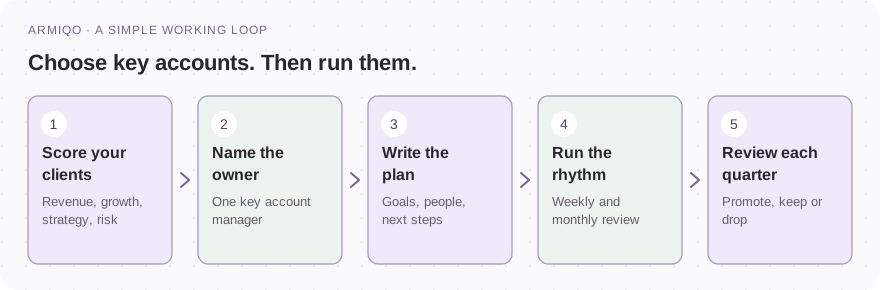
The four parts are a short list of key accounts, a named key account manager for each, a key account plan per client, and a review rhythm. Every other client keeps a lighter standard routine: a named owner, a renewal date, and a check-in schedule. That gives you an account management strategy with two layers. Layer one is the baseline for everyone. Layer two is the extra depth for the few accounts where it pays back.
Here is how the pieces connect in practice. The scoring table decides who is on the key list. The key account plan sets the direction for each of them. The weekly internal review keeps the plans alive. And the renewal routine, ideally starting about 90 days before a contract ends, protects revenue. If you already run a simple system, key account management is just a deeper version of what you do for the top clients.
- Choose the key accounts with the four-question score.
- Name a key account manager and a backup for each.
- Write or generate a key account plan, for example with the free Account plan generator.
- Add each key account to your weekly account review, so it is never forgotten.
- Review the key list and the plans every quarter.
The two guides below show how to build the baseline this sits on.
The simple account management system behind our 110-person agency ↗
Client Account Management Template: A Simple B2B Plan (With Examples) ↗
A 30-day plan to start key account management
You can set this up in a month without stopping client work. The goal is a short list, owners and a first plan, not a perfect system.
| Week | What to do | Output |
|---|---|---|
| 1 | List all clients, score them on the four questions, agree the key list | A list of key accounts with a reason for each |
| 2 | Name a key account manager and backup for each key account | One owner and one backup per account |
| 3 | Write a one-page key account plan for each, starting with the biggest | Plans with three next actions each |
| 4 | Add key accounts to the weekly review and book the first quarterly plan review | A working rhythm and dates in the calendar |
Start with only your top three accounts if the full list feels like too much. A finished plan for three clients is worth more than a half-written plan for ten. Once the habit works, extend it to the rest of the key list.
Two small habits keep the system alive. First, put the next review date inside every plan, not in a separate calendar nobody checks. Second, ask each key account manager one question at the weekly review: what has changed with this client since last week? If the answer is "nothing" three weeks in a row, that is itself worth a conversation, because quiet accounts are often drifting accounts. The single-threaded accounts guide explains one common reason why.
Key account management examples
These examples are fictional and simplified. They show how the same ideas look in practice.
Example one: a design agency has 25 clients. After scoring, three stand out: a regional retailer that brings the largest share of revenue, a software company that could add two more departments, and a small start-up whose founder introduces the agency to other clients. The agency names a key account manager for each, writes three one-page plans, and starts a monthly review. The retailer's plan focuses on protecting the renewal, the software company's on a stakeholder map and a pilot with a second team, and the start-up's on asking for referrals after a visible win.
Example two: a consultancy notices that its largest client has one contact, a director who has been there for years. The key account plan lists three actions: meet the director's manager, introduce a colleague to the finance lead, and propose a joint planning session next quarter. None of these are dramatic, but together they reduce the risk of a single point of failure.
Example three: a development shop finds that its fifth-ranked client scores lower than expected on growth because the budget is fixed and the team is small. The agency keeps it on the standard routine and puts a different client on the key list. That is a normal outcome. Being honest about who does not qualify is part of the method.
Notice what the examples have in common: a short list, a reason for each account, and a small number of concrete actions. If you want a view of how to map people at a client, see the stakeholder map guide.
Common mistakes in key account management
Most problems come from making the system too heavy, or from not making it real. These are the mistakes that show up most often.
- Too many key accounts. If half your clients are key, none of them are. Keep the list short enough that every plan gets read.
- Choosing by revenue alone. Revenue is one input. A smaller client with strong growth potential or strategic value may deserve a place.
- No named owner. "The team looks after it" means nobody is accountable. Name a person and a backup.
- Plans that never change. A key account plan should be a living document. If the date at the top is a year old, it is not working as a plan.
- Relying on one contact. One champion is a risk, not a strategy. Plan to meet at least one more person at the client each quarter.
- Confusing key account management with extra free work. Giving more attention does not mean giving away scope. Keep commercial terms and boundaries clear.
- Treating it as a sales programme. Key account management is about the whole relationship: delivery, trust, growth and renewal together.
- Forgetting to review. Without a rhythm, the best plan fades in a month.
A good test for your own system: pick any key account at random and ask three questions. Who owns it? Where is the plan? What is the next action and when is it due? If any answer takes more than a minute to find, the system needs tightening.
Start with one account this week
- Score every client on revenue, growth potential, strategic value and risk, and agree the key account list.
- Write down the reason each client is on the list.
- Name one key account manager and one backup for each key account.
- Write a one-page key account plan with three next actions, an owner and a date for each.
- Map the people at each key account and plan one new relationship per quarter.
- Add every key account to your weekly review and book a quarterly plan review.
- Keep every other client on a lighter standard routine with a named owner and renewal date.
- Review the key account list twice a year and move clients up or down honestly.
Common questions
What is key account management?
Key account management is a structured way of managing your most important clients. Each key account gets a named owner, a written plan and a regular review rhythm. The aim is to grow and protect the relationship over a long time, rather than treating every client with the same level of attention.
What is the difference between key account management and account management?
Account management covers every client at a baseline level: contact, delivery, renewals. Key account management adds depth for the few accounts that matter most, with a written plan, several relationships, senior involvement and a long-term view. Key accounts are usually a small subset of all your clients.
What does a key account manager do?
A key account manager owns the whole relationship with one or more key clients. They maintain the key account plan, build relationships with several contacts, spot growth opportunities, watch for risk and coordinate their own team. They do not replace delivery, but they make sure the commercial side has an owner.
How do I choose key accounts in a small agency?
Score every client from 1 to 5 on revenue, growth potential, strategic value and risk if they left. Add the scores, sort the list and draw a cut-off line. For many small agencies, three to ten accounts is a sensible range. Review the list twice a year and write down why each client is on it.
Is strategic account management the same as key account management?
They overlap, and different companies use the terms differently. A common distinction is that key accounts matter most to you today, while strategic accounts are those where you and the client plan the future together. Not every key account becomes strategic, and that is fine.
Do small agencies need B2B key account management?
If a few clients make up a large share of your revenue or reputation, yes. You do not need software or a team. A short list, a named owner, a one-page plan per client and a regular review are enough. Start with your top three accounts and grow from there.