CLIENT RETENTION · B2B AGENCIES
When Your Client Champion Leaves: The First 30 Days
Client champion leaving? Use this 30-day plan to meet the new owner, re-prove your value and add a second contact so the account does not drift or churn.
The email arrives on a Tuesday. Your main contact at a good client is leaving the company, and the last day is Friday. For two years this person approved your invoices, defended your retainer in budget meetings and answered your messages within the hour. Now there is a gap, and nobody on your side is quite sure who will fill it.
This is what happens when a client champion leaves. A client champion is the person inside the client's company who wants you to succeed and has the influence to make that matter. When that person goes, the account loses its internal advocate overnight, and a relationship that felt safe can become uncertain within weeks. The new owner may not know why you were hired, may have their own favourite agency, and has no reason yet to defend your fee.
This guide gives you a practical 30-day plan for the moment a client champion leaves. It is written for agency founders and account managers, and it works with a small team and no special software. You will get what to do in the first 48 hours, what to say to the successor, how to re-prove your value on one page, and how to make sure the account never depends on one person again. Templates are included so you can copy and use them today.
What a client champion is, and what changes when they leave
A client champion is not simply your day-to-day contact. Plenty of contacts are friendly but have no power, and some senior people hold the budget but never think about you. A champion sits where the two overlap: they like the work, they understand what it does for their business, and they can speak up for you when decisions are made. In some accounts this person is called the sponsor, the internal advocate or the main stakeholder. The label matters less than the role.
You can usually spot your champion by what they do when you are not in the room. They forward your reports to their boss. They ask for your input before a campaign is planned. They warn you early when something is changing. They push back when someone suggests cutting your budget. If you cannot name a person who does these things, you may already have a single-threaded account, which we cover later.
When this person leaves, three things change at once. First, you lose the voice that explained your value inside the company. Second, you lose the informal information: the early warnings, the context behind a request, the sense of what is really going on. Third, you lose the history. The champion remembers why you were chosen, which problems you solved and which promises were made. The successor starts from nothing and may only see a line on a cost report.
That does not mean the account is lost. Many clients stay through a change of contact, and some grow. But it does mean the next month matters more than most months. What you do in that window shapes the story the new owner tells about you.
Takeaway: a champion is the person who speaks for you when you are not in the room, and losing one means you must start speaking for yourself.
What breaks when a client champion leaves the company
It helps to be specific about what your champion actually did for the account, because each task now needs a new home. The table below lists the usual functions and the risk that appears when each one disappears. Use it as a quick audit: for each row, ask whether anybody else at the client could do that job today.
Most agencies find that two or three rows have no obvious answer. Those are the gaps to fix first in the 30-day plan. The table is a general guide, not a measure of your own account, so adjust the rows to fit what your champion really did.
One more point before the plan. Not every departure is the same. A champion who is promoted inside the same company may still be reachable and useful, and can even become a powerful sponsor at a higher level. A champion who moves to a competitor of your client, or who leaves after a falling-out, is a different situation. Start by finding out which of these you are dealing with, because it changes how you use the first 48 hours.
| What your champion did | What can go wrong | First question to ask |
|---|---|---|
| Explained your value to senior people | Nobody can say why the retainer exists | Who will present our results internally now? |
| Approved invoices and scope changes | Payments and approvals stall | Who signs off on spend from today? |
| Gave you early warnings | You hear about budget cuts late | Who will tell us when priorities change? |
| Remembered the history | Old decisions get questioned again | Where is the written record of what we agreed? |
| Defended you in budget talks | Your fee is compared with cheaper options | Who owns this budget line next quarter? |
| Chose to work with you | The new owner prefers a supplier they know | What does the successor want from a partner? |
Want help putting this into practice? See how we can help
Days 1 and 2: what to do in the first 48 hours
The first 48 hours are about two things: learning the facts and securing a warm introduction. Speed matters here, because the champion's goodwill is at its highest before they leave. Once their last day passes, the same request feels much heavier.
Start with a short, personal message to the departing contact. Congratulate them if the move is good news, and say honestly that you will miss working with them. Then ask for three small things: who takes over, whether they would introduce you, and whether they can leave a short handover note about the account. Most people are glad to help, because a clean handover reflects well on them.
At the same time, brief your own team. Tell them who is leaving, what the account depends on that person for, and that nobody should contact the client about contract or pricing topics until you have a plan. Well-meaning colleagues often send a casual message that leaves a bad first impression with the new owner.
Check the practical side as well. Does the departing person hold the login for a shared tool, appear as the contact on a contract or receive the reports by email? Write down every place their name appears. You will update each one in week one.
If the champion is leaving on difficult terms, or if you cannot reach them, do not wait. Go straight to the next most senior person you know at the client and ask who is covering the account in the meantime. A brief, calm message is enough.
Takeaway: in two days, find out who is next, get an introduction if you can, and list every place the old contact's name appears.
Account handover checklist: what the next owner needs ↗
- Write to the departing champion: thank them, then ask who takes over and whether they will introduce you.
- Ask for a short handover note covering goals, open decisions, approvals and anything sensitive.
- Brief your team and agree that one person leads all contact with the client for now.
- List every contract, report, tool and mailing list where the old contact's name appears.
- Ask a second client contact who is covering the account until the new owner starts.
COPY & ADAPT
Subject: Thank you, and a quick favour before you go

Hi [Name],

Thank you for the last [two] years. I have really enjoyed working with you, and I am sorry to see you leave, though I am glad about the new role.

To keep things smooth for the team, could I ask for three small things?

1. Who will take over our work, and could you introduce us by email?
2. Could you write a short note on where we are: current goals, open decisions, anything the new person should know about how you like to work with us?
3. Is there anyone else on your side who should stay in the loop during the change?

If it is easier, I can send you a few questions to answer in ten minutes.

Thank you again, and good luck with what comes next.

[Your name]
Days 3 to 7: meet the new owner and listen first
Your goal in the first week is a first meeting that the new owner finds useful, not a sales pitch. They are new, they are busy, and they are probably reading a pile of handover notes from several suppliers. The easiest way to stand out is to make their life simpler and ask good questions.
Book a 30-minute call, ideally with the departing champion's introduction. Send a short agenda in advance. Offer to prepare a one-page summary of the work so far, so that the new owner does not need to read months of email. Then keep the meeting mostly about them.
Good questions focus on the person, not on your service. What were they hired to achieve? What will they be judged on in the first six months? What do they want to keep, change or stop? How do they like to receive updates, and how often? What have they heard about the work so far, good or bad?
Listen for what they do not say. If they do not mention the work you do as part of their goals, your service may not feel central to them yet. If they ask a lot of questions about price, they may be reviewing costs. If they ask who else is involved, they may be looking for the right people to speak to. None of these is a reason to panic, but each tells you where to put your effort.
End the meeting by agreeing one small next step with a date, such as sending the one-page summary or booking a follow-up. Then send a written recap the same day, so that they have a clear record of what you discussed.
Takeaway: your first meeting should leave the new owner feeling that you made their start easier.
- Book 30 minutes and send a short agenda that focuses on their goals.
- Ask what they were hired to achieve and how they will be judged.
- Ask what they want to keep, change or stop in the way you work together.
- Agree how and how often they want to hear from you.
- Send a recap within a few hours, with one next step and a date.
COPY & ADAPT
Subject: Getting started together

Hi [Name],

Welcome to [Company], and thank you for making time. [Departing contact] spoke very highly of your team, and I am looking forward to working with you.

To make our first call useful, here is a short plan for 30 minutes:

1. Your priorities for the next six months (10 minutes)
2. A quick look at what we have been doing for you and why (10 minutes)
3. How you would like us to work with you from here (10 minutes)

I will send a one-page summary of our work beforehand so that you do not have to read the history. Please tell me if you would like anything added.

Would [day] at [time] suit you?

[Your name]
Days 8 to 14: re-prove the value of your work on one page
By now you know the new owner's priorities. In the second week, show how your work connects to them. This is the step that replaces the explanation your champion used to give for you. Without it, the new owner has to work out your value alone, and they may guess wrong.
Write a one-page account summary. Keep it plain. It should say why the client hired you, what you have done, what has changed as a result, and what you plan to do next. Use the client's own words and goals wherever possible, and use only results you can show. Do not stretch the numbers or claim credit for things you did not cause. If a result is unclear, say so and explain how you will measure it.
Then connect the summary to the new owner's goals. If they told you that reducing costs matters most this year, show how your work supports that. If they want faster reporting, offer a simple change that makes it easier. The aim is a short list of two or three proposals that fit what they said in week one, not a long wish list.
Be careful not to overcorrect. Some agencies, afraid of losing the account, immediately offer discounts or extra work. That signals weakness and can set a lower price for the future. Show value first, and only talk about commercial terms if the client raises them.
Share the summary in a short follow-up call rather than only by email. This gives the new owner a chance to react, correct anything you misunderstood and ask questions. It also tells them that you are organised and easy to work with.
Takeaway: give the new owner a one-page story they can repeat to their own boss.
How to write an account plan in 30 minutes ↗
COPY & ADAPT
ACCOUNT SUMMARY FOR [CLIENT]
Prepared for: [New owner]   Date: [date]

1. WHY YOU HIRED US
[Original goal, in the client's words]

2. WHAT WE HAVE DONE
[Three to five points: scope, key milestones, rhythm of meetings]

3. WHAT HAS CHANGED
[Results you can show, with source and date. If unclear, write: not yet measured, plan to measure by [date]]

4. WHAT YOU TOLD US MATTERS NOW
[Their priorities from the first meeting]

5. PROPOSED NEXT STEPS
[Two or three actions, each with an owner and a date]

6. DECISIONS WE NEED FROM YOU
[Anything blocked or awaiting approval]
Days 15 to 30: build a second and third relationship
The most important lesson from losing a champion is that one relationship is not enough. In the second half of the month, work on making sure the account no longer depends on a single person. In practice, that means finding two more people at the client who know your work and can speak about it.
Start by drawing a simple map of the client's organisation: who the new owner reports to, who uses your work every week, who controls the budget, and who might influence the decision to renew. You will not know everyone yet, so mark the gaps. Our stakeholder map guide shows how to do this in about ten minutes, and the free Stakeholder map generator can structure it for you.
Then ask the new owner for help. A message such as "Who else should we keep informed about the work, so that you are not the only one receiving reports?" is usually welcome, because it saves them time. Do not go around them. Contacting senior people behind the back of the new owner is the quickest way to lose their trust.
Choose a few small, low-pressure ways to build contact. Invite the users of your work to a short monthly review. Send a brief result summary to the budget holder, copying the new owner. Offer a short workshop on a topic the wider team cares about. Each of these gives a second person a reason to know your name and what you do.
Finally, reset the rhythm. Agree a regular check-in, say every two weeks for the first quarter, and put the next quarterly review in the diary. A visible schedule tells the new owner that you take the relationship seriously and that nothing will be left to chance.
Takeaway: by the end of the month, at least three people at the client should be able to explain what you do and why it matters.
Single-threaded accounts: what to do when you know only one person ↗
How to map stakeholders on a client account ↗
- Draw a simple map of the client's people: users, decision makers, budget holders and influencers.
- Ask the new owner who else should receive updates, and agree how to include them.
- Offer one low-pressure touchpoint for a second contact, such as a monthly review for users.
- Share a short results summary with the budget holder, copying the new owner.
- Set a regular check-in and book the next quarterly review.
The 30-day client champion plan at a glance
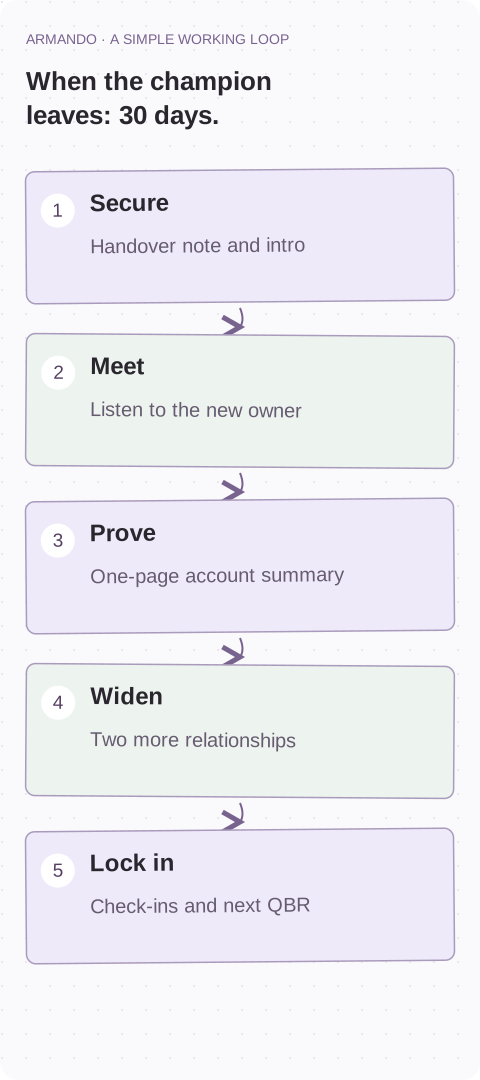
Here is the whole plan on one page. Print it, paste it into your account notes or turn it into a checklist in your project tool. The dates are a guide: if your champion gives you only two days' notice, compress the first block, and if you have a month, use the extra time for more careful listening.
Review the plan with your team at the start and at the end of the 30 days. At the start, agree who leads the account. At the end, ask three questions: Do we know the new owner's goals? Can the client repeat our value in their own words? Do we have at least two more relationships?
If the answer to any of these is no, extend the plan for another two weeks rather than closing it. A relationship rebuilt halfway is often worse than one that is left alone.
| Days | Focus | Main action | Output |
|---|---|---|---|
| 1 to 2 | Secure the handover | Write to the champion, ask for introduction and note | Name of successor, handover note, list of places to update |
| 3 to 7 | Meet and listen | 30-minute call with the new owner | Their goals, preferred rhythm, one agreed next step |
| 8 to 14 | Re-prove value | Share a one-page account summary | Summary the new owner can repeat to their boss |
| 15 to 21 | Widen the circle | Map stakeholders, ask for introductions | Stakeholder map with named gaps |
| 22 to 30 | Lock in the rhythm | Set check-ins and the next quarterly review | Calendar dates, at least three known contacts |
Client follow-up emails: after a meeting, no reply, renewal nudge ↗
Where a champion leaving fits into B2B key account management
Key account management is the practice of giving your most important clients a named owner, a plan and a regular rhythm, instead of treating every client the same. In B2B agencies it usually applies to a short list of accounts, the ones that matter most for revenue or long-term potential, and the person who looks after them is the key account manager.
A champion leaving is one of the clearest tests of that system. A good key account plan already names the main contacts at the client, shows who holds influence and records how often you speak to each of them. If your plan lists only one name, the departure will hurt. If it lists three or four, the shock is much smaller, because other people already know who you are.
Strategic account management goes a step further. It treats the client's changes in people as normal, not as emergencies, and builds relationships at several levels of the company so that no single exit can break the account. This is a useful way to think about your account management strategy as a whole: you are not protecting one relationship, you are building a network.
You can start small. Choose your five or ten most valuable accounts, and for each one write down the champion, the budget holder and one other contact. Add a line to the key account plan that says what you will do if the champion leaves. Our free Account plan generator can help you create that plan in about half an hour, and the account management system guide shows how to review all accounts in a weekly routine.
A simple account management system for agencies ↗
B2B account management plan template ↗
- List your key accounts and name one key account manager for each.
- In every key account plan, write down at least three client contacts, not one.
- Add a short "if the champion leaves" note to each plan, using the 30-day plan above.
- Review contact changes at your weekly account meeting, so you hear about departures early.
Edge cases: no successor, a hostile successor or a champion who moves on
Real situations are rarely tidy. Here are four common edge cases and a sensible way to handle each.
There is no successor yet. Sometimes the role stays empty for weeks. Keep delivering your work, keep sending your normal reports, and ask the person covering the account what they need from you in the meantime. Do not push for a new contract discussion during this period. Instead, use the time to build relationships with other people, as described in the last part of the plan.
The successor does not like your work, or prefers another supplier. This can happen, and it is not always personal. Ask what they would change, listen without defending, and offer a small trial of their preferred approach if it is realistic. If they still want to move on, handle the exit professionally. A good end to a contract often leads to a referral or a return later.
The champion moves to another company. This can be an opportunity. A person who trusted you in one company may bring you into the next. Stay in touch lightly, without asking for anything in the first months, and treat them as a long-term contact rather than a lost account.
The champion leaves suddenly. If someone is dismissed or leaves in a hurry, be careful about what you say. Do not comment on the reasons, and do not share anything the person told you privately. Focus on practical questions: who is in charge now, and what do they need from us this week?
Takeaway: in every case, stay calm, ask questions, keep delivering and avoid taking sides.
Common mistakes when a client champion leaves
Most of the damage after a champion leaves comes from a few avoidable mistakes. Check your own approach against this list.
The first mistake is waiting. Teams often assume the new person will contact them, and weeks go by in silence. By the time they speak, the new owner has formed an opinion from other sources. Move first, politely and clearly.
The second is starting with a pitch. The new owner has not asked for upsells, discounts or a list of your services. Open with questions about their goals, and keep selling for later.
The third is assuming the new owner thinks like the old one. Different people want different things: more detail or less, calls or emails, quick wins or a long-term plan. Ask, then adapt.
The fourth is skipping the written record. If the history of the account lives only in one person's head, the next departure, whether on your side or theirs, will cause the same problem. Keep a short account file with goals, decisions, contacts and key dates.
The fifth is blaming the departure for everything. If the account was already uncertain, the exit may only reveal a weakness that was there before. Use the 30 days to review the whole relationship, not only the contact. A simple client health score can show where the account really stands.
The last is stopping at day 30. The plan gives you a foundation. Keep the check-ins, keep the extra relationships alive and review the account at your next quarterly meeting.
A simple client health score for agencies ↗
- Do not wait for the new owner to contact you.
- Do not lead with a pitch, a discount or a list of services.
- Do not assume the new owner works like the old one.
- Do not leave the account history in one person's head.
- Do not stop the plan at day 30.
Start with one account this week
- Write to the departing champion and ask for a successor, an introduction and a short handover note.
- List every contract, report and tool where the old contact's name appears, and update each one.
- Agree one lead person on your side for all client contact during the change.
- Book a 30-minute listening call with the new owner within the first week.
- Send a one-page account summary in week two and agree next steps with dates.
- Map the client's stakeholders and identify at least two more people to build a relationship with.
- Set a regular check-in and book the next quarterly review before day 30.
Common questions
What should I do first when my client champion leaves?
Write to the departing champion within a day. Thank them, ask who is taking over, and request an introduction and a short handover note. In parallel, tell your team who leads the account and list every place the old contact's name appears.
How do I build a relationship with a new client contact?
Start with a short call about their goals, not your services. Ask what they were hired to achieve, how they prefer to be updated and what they would change. Follow up in writing the same day with one clear next step and a date.
How can I avoid depending on one client champion?
Build at least three relationships on every important account: the day-to-day user, the budget holder and the main sponsor. Map the stakeholders, ask for introductions, hold regular reviews with more than one person and record all contacts in your account plan.
Is a client champion leaving a reason to expect churn?
It raises the risk, but it does not make churn certain. Many accounts continue through a change of contact when the new owner understands the value of the work. The risk is highest when the account depends on one person and nobody else knows your results.
How does this relate to key account management?
Key account management gives important clients a named key account manager and a key account plan that lists several contacts. If your plan already covers more than one relationship, a champion leaving is a bump. If it covers only one, it can become a crisis.