ACCOUNT MANAGEMENT · B2B AGENCIES
Client follow-up emails: 3 templates that get replies
Write a client follow-up email after a meeting, when there is no reply, or before a renewal. Three copy-and-paste templates, timing rules and subject lines.
A client follow-up email is the message you send after something has happened or failed to happen: a meeting that ended with open questions, a proposal nobody has answered, or a renewal date that is getting close. Most agencies know they should send these. Few do it consistently, because the email always feels like it can wait until tomorrow, and tomorrow turns into the week the client goes quiet.
This guide gives you three follow-up emails you can copy and adapt: one for after a meeting, one for when a client has not replied, and one gentle renewal nudge. For each you get the timing, the wording, the subject line and what to do if the answer is still silence. There is also a table of when to follow up, a simple tracking routine, and a section on common mistakes that make clients ignore you.
Everything here is written for agency founders and account managers who write to clients every day and want a calm, professional tone that does not sound like a sales script. If you would rather not start from a blank page, the free Client follow-up email generator on this site writes a first draft in the tone you choose, and you can edit it before you send.
What makes a good client follow-up email
A follow-up email has one job: make the next step obvious and easy. That sounds simple, but most weak follow-ups fail at exactly this point. They say "just checking in" or "wanted to touch base" and leave the client to work out what you actually want. A busy marketing director reading on a phone between meetings will not do that work. They will mark the email as unread and promise themselves to come back to it.
Good follow-up emails share four traits. They are specific, which means they refer to the exact meeting, document or decision, not to a vague "our conversation". They are short, usually under 120 words, with the key point in the first two lines. They carry one question or one request, not five. And they make replying cheap: a yes or no, a date to choose, or a single link to approve.
Tone matters as much as structure. You are writing to a person who pays you, but who is also a colleague on a shared goal. Aim for friendly and direct, the way you would speak to a client you have worked with for a year. Avoid grovelling openers such as "Sorry to bother you" and avoid pressure such as "Please respond ASAP". Both make the client feel managed instead of helped.
Finally, remember that a follow-up is part of the relationship, not a chase. The client who goes quiet is not necessarily unhappy. They may be on leave, buried in a launch, or waiting for an internal approval you cannot see. Your email should give them an easy way back in, with no blame attached.
When to send a follow-up email to a client: timing rules
Timing is where most follow-ups go wrong. Too early and you look anxious. Too late and the momentum has gone, the client has forgotten the details and you have to restart the conversation. The table below gives sensible starting points. They are working rules of thumb, not benchmarks, so adjust them to the client's rhythm and the size of the decision.
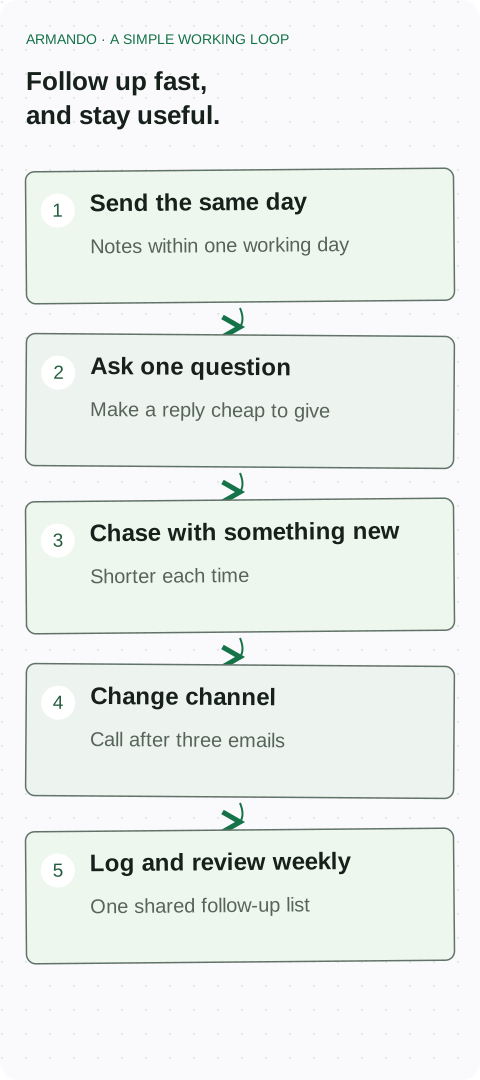
Two principles sit behind the table. First, send the meeting follow-up while the conversation is still fresh, ideally the same day and no later than the next working day. Second, space chasers out and make each one add something. A chaser that only repeats the first email teaches the client that you can be safely ignored.
Also consider the client's calendar. Avoid sending an important request late on a Friday or the night before a public holiday. If the client works in a different time zone, schedule the email so it lands early in their morning, when their inbox is calm.
| Situation | First follow-up | If there is no reply | What to add each time |
|---|---|---|---|
| After a meeting or call | Same day, at most the next working day | One reminder after three working days | The decisions, owners and dates from the meeting |
| After sending a proposal or quote | Two to three working days later | Second note after another four to five working days | A short answer to a likely question, or a call offer |
| Waiting for approval or feedback | Two working days before the deadline | One more on the day the deadline hits | What happens to the schedule if it slips |
| Unanswered email | Three to five working days | Up to two more, spaced a week apart | A new angle, a shorter question or a different channel |
| Renewal or contract end | About 90 days before the end date, longer for large accounts | Check in again at 60 and 30 days | Results delivered and a proposed plan for next period |
| Quiet client, no active request | After about three weeks without contact | Move to a call or a short video message | Something useful, such as an idea or a relevant result |
Want help putting this into practice? See how we can help
How to write a follow-up email after a meeting with a client
The follow-up email after a meeting is the most valuable one you will send, because it creates the written record. Clients rarely remember a call the way you do. If you do not write down what was agreed, each side leaves with a slightly different version, and the differences show up weeks later as scope arguments or missed deadlines.
Keep the structure fixed so that anyone on your team can write it quickly. Open with a one-line thanks that names the meeting. Then list the decisions, the actions with owners and dates, and the open questions. Close with the next meeting date or one question that moves things forward. Do not retell the whole discussion. The client was there.
Be careful with attributions. Write "we agreed" for decisions both sides made, and "you mentioned" only for things the client said. If you are unsure about a point, say so and ask them to correct it. A line such as "Please tell me if I have misunderstood anything" gives the client permission to fix an error early, when it is cheap to do so.
Send the email even when the meeting felt informal. A fifteen-minute catch-up that produced one decision still deserves a three-line note. Over a year, those notes become the history of the account, which is exactly what a new account manager needs if the relationship changes hands.
- Send the email within a day of the meeting, while memories are fresh.
- Use a subject line that names the meeting and the outcome, such as "Notes and next steps: Q4 campaign review".
- List decisions first, then actions with an owner and a date for each.
- Name any open question and who is expected to answer it.
- End with one request or the date of the next meeting.
- Add the notes to the account record so the next person can find them.
COPY & ADAPT
Subject: Notes and next steps: [meeting name], [date]

Hi [first name],

Thanks for your time today. Here is what we agreed so we are all working from the same page.

Decisions
1. [Decision one]
2. [Decision two]

Next steps
- [Action] - [owner] - by [date]
- [Action] - [owner] - by [date]

Open question
- [Question] - could you let me know by [date]?

Please tell me if I have misunderstood anything. Our next catch-up is on [date].

Best,
[Your name]
Follow-up email when there is no reply: a three-step sequence
A client who does not answer is one of the most common problems in account management, and the right response is calm persistence, not escalation. People miss emails for ordinary reasons: the message arrived on a busy morning, the question needed a decision they have not made, or the thread got buried. In most cases a short, friendly second message is all that is needed.
Plan the sequence before you send the first chaser. A simple pattern is three touches. The first is a gentle reminder that restates the question in fewer words. The second, a week later, adds something new, such as a deadline consequence or a smaller choice. The third is a short closing note that gives the client an easy way to say "not now" and tells them what you will do if you hear nothing. After that, change channel. Pick up the phone or send a short message through the tool the client already uses.
Each message should be shorter than the one before it. Put the question in the first line, so even a client who only reads the preview can answer. Avoid phrases like "As per my last email", which sound passive-aggressive, and "Just circling back", which says nothing. Replace them with something useful: "A quick yes or no on option B lets us book the shoot for the 14th."
Make it easy to answer. If you need a decision, offer two options and your recommendation. If you need a file, say exactly which one and where to find it. If you need approval, tell the client that a one-word reply is enough. The less thinking the reply requires, the more likely it is to arrive.
Know when silence is a signal. One slow reply is nothing. Several missed requests over a month, shorter answers and meetings cancelled without a new date can be early warning signs, and the renewal risk guide on this site lists them. When you see that pattern, stop sending written chasers and ask for a conversation.
Client renewal risk: warning signs and what to do ↗
- Day 0: send the original request with one clear question.
- Day 3 to 5: send a short reminder that restates the question and offers an easy answer.
- Day 10 to 12: send a second note that adds something new, such as a smaller choice or a consequence for the schedule.
- Day 17 to 19: send a closing note that offers to pause the topic and says what you will do next.
- After that, call the client or ask a different contact on the account, rather than sending a fourth email.
COPY & ADAPT
Subject: Quick question: [topic]

Hi [first name],

Following up on my note from [day]. The one thing I need is a decision on [question].

Option A: [short description]
Option B: [short description]
I would suggest [A or B] because [one reason].

A one-word reply is enough, and if it is easier we can sort it out in a ten-minute call. If I do not hear back by [date], I will [what happens, such as hold the slot or move ahead with A], so nothing is blocked on your side.

Thanks,
[Your name]
Renewal reminder email: how to nudge a client without pressure
A renewal reminder email should never feel like a surprise invoice. By the time you write it, the client should already know what you delivered, what you recommend for the next period and when the contract ends. The email is a prompt to decide, not the first mention that a decision exists.
Start earlier than feels natural. For a retainer, about three months before the end date is a sensible first touch, because it leaves time for a review, a proposal and a slow internal approval. Larger accounts with procurement or legal steps need more. The first email can be as simple as proposing a review meeting. The second, a month later, shares the proposed plan. The third, with a few weeks to go, confirms dates and paperwork.
Anchor each message in value delivered. Name two or three outcomes you achieved together, using only facts you can show, and then propose what comes next. Do not invent numbers, and do not claim results you cannot evidence. If the period was mixed, say so honestly and explain what you would change. Clients trust an honest account more than a glossy one.
If you plan a price change, do not hide it in the renewal nudge. Deal with it in its own conversation first, using the approach in the guide on raising rates with existing clients. The reminder can then refer to terms the client has already seen.
Finish with a clear date and a simple action. "Could we meet on the 12th or the 14th to agree the plan for next quarter?" is easier to answer than "Let me know your thoughts on renewal". And if the client says they need more time, ask what they need to decide, who else is involved and when the decision will be made. Those three answers tell you where the account stands.
How to raise rates with existing clients ↗
COPY & ADAPT
Subject: Planning next period together

Hi [first name],

Our current agreement runs until [end date], so I would like us to set time aside to plan what comes next.

Over the last [period] we have [outcome one] and [outcome two]. I would like to look at what worked, what we would change, and what I would recommend for the next [period].

Could we meet on [date option one] or [date option two] for 30 minutes? I will send a one-page summary beforehand so we can use the time well.

If anyone else needs to be involved in the decision, please add them to the invite.

Best,
[Your name]
Subject lines and tone for a polite follow-up email
The subject line decides whether the email is opened and whether it can be found again six months later. Be specific and plain. Include the topic, and where it helps, the action: "Decision needed by Friday: homepage design" works better than "Following up". Avoid all capitals, exclamation marks and anything that looks like a mass mailing.
Keep the subject consistent inside a thread. If you change it every time, the client's mail tool splits the conversation and your earlier context disappears. For the first email in a sequence, write a descriptive subject. For chasers, either reply on the same thread or add a short prefix such as "Quick question".
Tone depends on the relationship. With a long-standing contact, a warm and brief note is fine. With a senior sponsor you rarely speak to, be more formal, make the point faster and send less. With a new contact, introduce your role and the reason you are writing. The aim is always the same: sound like a helpful colleague who respects their time.
A few phrases are worth avoiding because they add friction. "I know you are busy" makes the point that you are about to add to their workload. "Per my last email" suggests blame. "Any update?" is vague and gives nothing to respond to. Replace them with a specific question and a reason it matters.
| Instead of | Try | Why it works |
|---|---|---|
| Just checking in | Do you have a view on option A or B? | It names a decision the client can make |
| Any update? | Could you confirm the launch date by Thursday? | It asks for one fact with a date |
| As per my last email | Resending the brief in case it got buried | It assumes a normal reason and takes no blame |
| Sorry to bother you | Quick question on the budget | It is direct without apologising for doing your job |
| Please respond ASAP | A yes or no by Friday keeps us on schedule | It gives a reason and a deadline |
A simple routine to track client follow-ups so none slip
Most missed follow-ups are not a writing problem. They are a memory problem. The email was meant to go out on Wednesday, a client call ran late, and by Friday nobody remembered. A small tracking habit fixes this better than any template.
Record every follow-up you owe as a dated line in a shared place. It can be a spreadsheet, a note in your task tool or a section of the account plan. For each line write the client, what you are waiting for, the date you sent the last message, the next planned touch and who owns it. When a reply arrives, close the line. When the date passes, send the next message or change channel.
Review the list once a week. A fifteen-minute slot on Monday morning is enough for a small agency. Sort by next touch date and deal with everything due this week. Then look at anything that has waited more than three weeks and ask whether the account needs a conversation instead of an email.
Share the list with the founder or team lead. It is easy to hide a stalled client when the only record is in one person's inbox. A visible list also makes handovers simple, because the next account manager can see what is open and what was promised. The account handover checklist on this site covers what else to pass on.
Finally, keep a few approved snippets: your standard meeting note, a no-reply chaser and a renewal opener. Do not send them unchanged. Use them as starting points that save five minutes of drafting and keep the tone consistent across the team.
Account handover checklist: what the next owner needs ↗
- Create one follow-up list with client, request, date sent, next touch and owner.
- Add a line every time you ask a client for something.
- Review the list weekly and send everything due.
- Flag anything waiting more than three weeks for a call.
- Share the list with the founder once a month.
Where follow-up emails fit into B2B key account management
Key account management is the practice of giving your most important clients a named owner, a written plan and a regular rhythm of contact. In B2B key account management, follow-up is the thread that holds the rhythm together. The plan says what should happen. The follow-up email is how it actually happens, week after week.
For a key account, the follow-up carries more weight. The key account manager is usually writing to several people at different levels: the day-to-day contact, a department head and the executive who signs the contract. Each needs a different message. The day-to-day contact wants clear actions. The department head wants progress against goals. The sponsor wants a short summary and a decision.
A key account plan should therefore list planned touches, not just goals. Include the review meetings, the follow-up after each one, the renewal sequence and the dates when you will contact each stakeholder. Pair it with a stakeholder map so you know whom each email is for. Use the free Account plan generator to draft the plan, then add a row for planned follow-ups.
Strategic account management adds one more idea: write to the client about their future, not only your delivery. A note that links last quarter's work to a goal the client has stated shows that you understand the business. That is what separates a supplier from a partner, and it is the core of any sound account management strategy. The simple account management system guide shows how to build this into a weekly routine.
A simple account management system for agencies ↗
B2B account management plan template ↗
- Pick your five to ten key accounts and name a key account manager for each.
- Add planned follow-ups to each key account plan: after meetings, at quarter end and ahead of renewal.
- Match each email to a person on the stakeholder map.
- Review the follow-up list for key accounts every week.
Common client follow-up email mistakes and how to fix them
Most follow-up problems come from a handful of habits. The first is writing without a question. An email that only says "checking in" gives the client nothing to do, so it joins the pile of messages to deal with later. Fix it by writing the question before anything else, and delete the email if you cannot.
The second is sending a chaser that repeats the original message word for word. It makes the client feel nagged and teaches them that the request is not urgent. Add something each time: a smaller choice, a consequence, a deadline or a helpful piece of information.
The third is following up only by email when the situation needs a voice. A sensitive subject, a complaint, a missed deadline or a long silence on a large account is better handled by a call. Send a short email afterwards to confirm what was said. That email is your record, and it is also a follow-up.
The fourth is copying too many people. Adding the client's boss to a chaser may feel like leverage, but it embarrasses your contact and damages trust. Escalate only when you have told your contact first, and keep the tone neutral.
The fifth is skipping the follow-up because the news is bad. A delay, an error or a change in scope is the exact moment a clear written message matters most. Say what happened, what you are doing about it and when you will update them next. Clients forgive problems far more easily than silence.
Finally, avoid inventing urgency or results. Do not claim a deadline that does not exist or an outcome you cannot show. If the client later checks, you lose credibility on every email that follows. Plain, honest and specific always works better than clever.
Start with one account this week
- Each follow-up has one clear question or request.
- The subject line names the topic and, where relevant, the action.
- Meeting follow-ups go out within one working day.
- Decisions, owners and dates are written down in the email.
- Chasers add something new and are shorter than the one before.
- Every outstanding request sits on a shared follow-up list.
- After three attempts you change channel instead of repeating.
- Renewal conversations start about three months before the end date.
- No claim, number or deadline in the email is invented.
Common questions
How do you write a follow-up email to a client?
Open with context, state what you need in the first two lines, and end with one clear question or date. Keep it under about 120 words, use a specific subject line, and make the reply easy, such as a yes or no or a choice between two options.
How long should you wait before following up with a client?
After a meeting, send the same day or the next working day. For an unanswered email, wait three to five working days. These are rules of thumb, so adjust for urgency, the client's habits and the size of the decision.
What do you say in a follow-up email when there is no reply?
Restate the question in fewer words, offer an easy answer, and add something new such as a deadline consequence or a smaller choice. Avoid blame phrases like "per my last email". After about three attempts, change channel and call instead.
How many times should you follow up with a client?
Two or three written attempts, spaced several days apart, is usually enough. Each should add value and be shorter than the last. If there is still no response, try a phone call or another contact on the account rather than sending a fourth email.
When should you send a renewal reminder email?
Start about three months before the contract ends, longer for large accounts with procurement steps. Begin by proposing a review meeting, then share a plan, then confirm dates and paperwork. The email should never be the first time the client hears about renewal.
How do follow-up emails fit into key account management?
Key account management depends on a regular rhythm of contact. A key account manager plans follow-ups after meetings, at quarter end and before renewal, matches each message to a stakeholder, and tracks them in the key account plan so no important contact is missed.