ACCOUNT MANAGEMENT · B2B AGENCIES
Client Meeting Agenda: A 30-Minute Check-In Template
Run a client meeting agenda in 30 minutes: five timed blocks, scripts for each, and a copy-and-paste check-in template for agency account managers.
A client meeting agenda is a short, written plan for a conversation: what you will cover, in what order, and for how long. Most agency account managers know they should have one. In practice, the check-in call gets squeezed between delivery work, the agenda becomes a few bullet points in a calendar invite, and the meeting turns into a status report that the client could have read in an email.
That is a missed chance. A regular client check-in is the cheapest relationship tool an agency has. It is where you hear that a priority has changed, where the quiet sponsor mentions a new boss, and where you can agree on the next step while everyone is still in the room. A meeting with no structure tends to fill with whatever is most urgent for the loudest person. A meeting with a clear agenda gives the client's priorities as much time as your update.
This guide gives you a 30-minute client meeting agenda you can reuse for any monthly or fortnightly check-in. You will get five timed blocks, what to say in each one, a copy-and-paste template, a fictional worked example, and a short follow-up routine. If you would rather start from a draft than a blank page, the free Client meeting agenda generator on this site builds one from a few details about the client and the meeting. Everything below is a working method for small agencies, not a rule, so change the timings to fit your accounts.
What a client check-in meeting is, and why it needs an agenda
A client check-in is a regular, short conversation between your team and the people who buy or use your work. It is different from a project kickoff, which sets up the work, and different from a quarterly business review, which looks back at results and ahead at the next quarter. A check-in is the routine heartbeat in between. It keeps both sides current, catches small problems while they are still small, and keeps the relationship warm when nothing dramatic is happening.
Without a client meeting agenda, check-ins drift in a predictable way. The account manager talks through what the team did since last time, the client nods, and the call ends early or runs over. Nobody asks the questions that matter: is the work still pointed at the right goal, is anything blocking the client, has anyone new joined the decision? Those questions are exactly what a structure makes room for.
An agenda also changes how the client sees you. Sending a short plan before the call signals that you respect their time and that you are running the account deliberately. It gives the client a chance to add a topic, which quietly shifts the call from your update to their conversation. Clients who are happy to add items to an agenda are usually clients who feel heard, and that is a useful early signal in itself.
Finally, an agenda is what makes the meeting repeatable. When the structure is the same every time, a colleague can cover for you, a new account manager can take over without losing the thread, and you can compare one call with the last. That consistency is the foundation for the rest of a simple account management routine.
Prepare a client meeting agenda in 10 minutes
Preparation is where most of the value comes from, and it does not have to take long. Ten minutes before you send the agenda is enough for a regular check-in. The goal is to arrive knowing what you want from the call, not to produce a polished deck.
Start by reading the notes from the last meeting. Look for the actions that were agreed, who owned them, and whether they are done. Nothing damages trust faster than a promise from the last call that nobody mentions this time. If an action slipped, say so at the start and give a new date. Clients rarely mind a late task as much as they mind finding out about it only when they ask.
Next, decide the one outcome you want from this meeting. It might be a decision on the next campaign, an introduction to a second stakeholder, or simply a clear read on how the client feels about progress. Write it as a single sentence at the top of your notes. If you cannot name one, the meeting may be better as an email, which is a perfectly good conclusion.
Finally, send the agenda at least a day ahead, with a line inviting the client to add or remove items. Keep the message short. The invitation to edit is more important than the list itself.
- Read the last meeting notes and list every open action with its owner.
- Check the work in flight: what shipped, what is late, what is waiting on the client.
- Write the one outcome you want from this call in a single sentence.
- Note any question you want to ask that you have not asked before, such as who else is involved in decisions.
- Send the agenda a day ahead and ask the client what they would like to add.
Want help putting this into practice? See how we can help
The 30-minute client meeting agenda, block by block
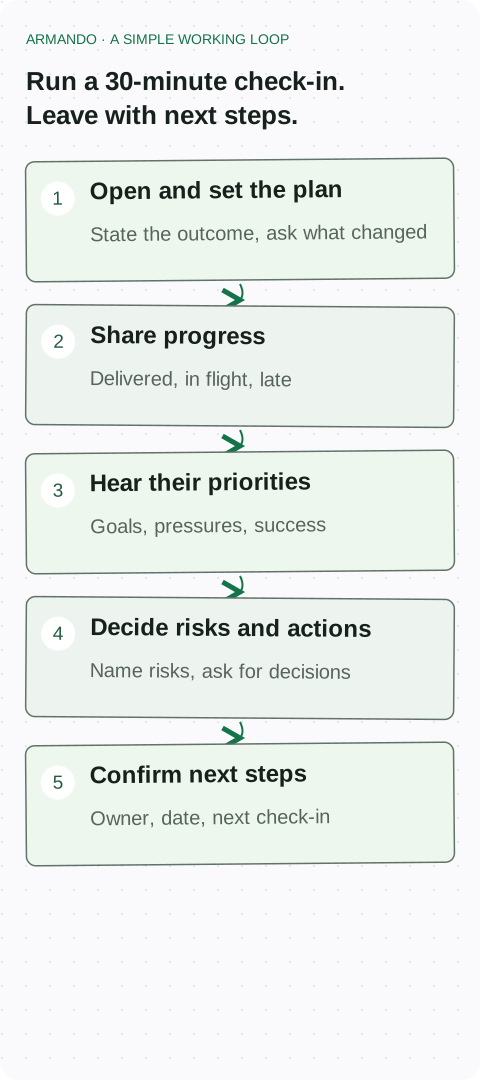
Here is the full structure. The times are working guidance for a typical monthly check-in, not benchmarks, and you should shorten or lengthen blocks depending on what the client needs. The shape matters more than the minutes: the client's priorities and the risks get more room than your own update.
Block one is the opening, two minutes. Greet people, confirm the time you have, and state the plan for the call. Say the one outcome you are aiming for, and ask whether anything has changed on their side since the last conversation. This small question often produces the most useful sentence of the whole meeting, so do not skip it to save time.
Block two is progress since last time, five minutes. Cover what was delivered, what is in flight and what is late, in that order. Keep it to the points that matter to the client's goals rather than a task list. If the numbers are good, say so plainly. If something missed, say so and give the fix. The block should end with a quick check that they agree with your picture.
Block three is the client's priorities, ten minutes. This is the centre of the meeting. Ask what is most important to them over the next month or quarter, what they are being asked about internally, and what would make the next period a success. Listen for names and pressures, not just tasks. Write down the exact words they use, because those words belong in your next report.
Block four is risks and decisions, ten minutes. Raise anything that could slow the work or change the plan: budget questions, approvals that are taking long, a deadline that looks tight. Then ask for the decisions you need. Make each decision small and specific, such as which of two options to run first, rather than a vague request for feedback.
Block five is next steps, three minutes. Read back every action with an owner and a date, including the ones that sit on the client's side. Agree when the next check-in will happen and put it in the calendar before the call ends.
| Block | Time | Purpose | Your main question |
|---|---|---|---|
| Opening | 2 min | Set the plan and the outcome | What has changed on your side since we last spoke? |
| Progress | 5 min | Share delivered, in flight and late work | Does this match how you see it? |
| Client priorities | 10 min | Understand goals and pressures | What matters most to you over the next month? |
| Risks and decisions | 10 min | Surface blockers and get decisions | What would you need from us to decide this week? |
| Next steps | 3 min | Confirm owners and dates | Is that action list right, and when do we speak next? |
- Opening (2 min): state the plan and the outcome, ask what has changed on their side.
- Progress (5 min): delivered, in flight, late. Agree you share the same picture.
- Client priorities (10 min): goals, pressures and what success looks like next period.
- Risks and decisions (10 min): name the risks, ask for specific decisions.
- Next steps (3 min): read back actions with owner and date, book the next check-in.
A copy-and-paste client meeting agenda template
Use this client meeting agenda template as your default check-in invitation. It works as the text of a calendar invite or as a short email. Replace the brackets, delete anything that does not apply, and keep it to one screen so people actually read it.
The line that matters most is the last one, which invites the client to add items. Do not treat it as a formality. When a client adds something, treat it as the first item on the call, even if it was not what you planned to cover. It tells you what is on their mind.
COPY & ADAPT
CLIENT CHECK-IN: [Client name]
Date and time: [date, time, time zone]   Length: 30 minutes
Attendees: [names and roles]
Outcome we want from this call: [one sentence]

AGENDA
1. Opening (2 min): plan for the call, anything changed on your side
2. Progress since [last meeting date] (5 min)
   - Delivered: [items]
   - In flight: [items]
   - Late or at risk: [items and new dates]
3. Your priorities for the next [month/quarter] (10 min)
   - Goals and pressures: [prompts]
   - What success looks like: [prompt]
4. Risks and decisions (10 min)
   - Risks: [list]
   - Decisions needed from you: [list]
5. Next steps (3 min): owners, dates, next check-in

OPEN ACTIONS FROM LAST TIME
- [Action] / [owner] / [status]

Is there anything you would like to add or take off this agenda? Reply before [date] and we will update it.
What to say in each block of a client check-in
Wording matters more than people expect, because a check-in is a conversation about feelings as much as facts. The lines below are examples. Adapt them to how you normally speak with the client, and never read them out like a script.
For the opening, try: "Thanks for making time. I would like to cover progress, then spend most of the call on what matters to you, then agree next steps. Before we start, has anything changed on your side since last month?" That sentence sets the structure, shows the priority, and invites news in under ten seconds.
For progress, try: "Three things shipped, two are in flight, and one is late. The late one is the landing page, because we are waiting on the final images. We can still hit the new date if we have them by Thursday." It is short, honest, and gives the client one clear thing to do. Avoid long explanations of why something slipped, because they sound defensive.
For priorities, ask open questions and then stay quiet. "What are you being asked about internally right now?" is a strong question, because it points to the pressure on your sponsor. "If we looked back in three months and called this a good quarter, what would have happened?" gets to success criteria in the client's own words. If the answer surprises you, say so and ask a follow-up before moving on.
For risks, name them yourself instead of waiting for the client to find them. "One thing I want to flag is that approvals have been taking about a week, which makes the launch date tight. Could we agree a faster route for small changes?" Raising a risk early reads as competence. Raising it late reads as an excuse.
For next steps, read the list back slowly. "So I will send the revised plan by Friday, you will confirm the budget by the 15th, and we will meet again on the 3rd. Have I missed anything?" The final question gives the client a last chance to correct the record, which prevents small misunderstandings from growing.
Worked example: a client check-in for a fictional client
The example below is fictional and exists only to show the structure in use. Imagine a small agency that runs paid search and email for a regional furniture retailer called Harbor Home. The account manager, Priya, has a monthly check-in with the marketing manager, Dan.
Before the call, Priya reads the last notes and finds two open actions: she owes Dan a revised email calendar, and Dan owes her the autumn product list. The product list is late, which affects the plan. Her outcome for the call is to agree the autumn campaign priorities. She sends the agenda two days ahead and asks Dan what he would like to add. He replies that he wants ten minutes on the new warehouse opening.
On the call, Priya opens by saying the plan and asking what has changed. Dan says his director has started asking about weekly sales numbers. That is new information about pressure on her sponsor, and Priya notes it. In the progress block she reports that the email calendar is done and that the product list is the only blocker. In the priorities block, Dan explains the warehouse opening and why the director cares.
In the risks block, Priya flags that the late product list puts the autumn launch date at risk, and asks Dan to agree a firm date. They settle on the following Wednesday. She also asks who else needs to see the weekly numbers, and learns the director's name. In next steps she reads back four actions with owners and dates, and the next check-in goes in the calendar.
Afterwards, she adds the director to her stakeholder map as unknown, and she sends a written summary within a few hours. In 30 minutes she has learned about a new pressure, a new person and a firm date, none of which would have surfaced in a plain status update.
How to adjust the client meeting agenda for different meetings
The 30-minute structure is a default, not a straitjacket. Different meetings have different jobs, and the agenda should shift to match. The table below shows how the blocks change for common situations. The timings are suggestions, so treat them as a starting point.
A rule of thumb is that the more uncertain the relationship, the more time you give to listening. If a client has gone quiet or complained, cut your progress block to two minutes and extend the priorities block. A relationship under strain does not need more reporting. It needs more conversation.
| Meeting type | Shift the time towards | Cut or shorten | Extra question to add |
|---|---|---|---|
| Routine monthly check-in | Client priorities and risks | Nothing, use the default | Who else is involved in decisions now? |
| After a delivery milestone | Progress and what it means for goals | Risks block | What would you like to see more of? |
| Client has gone quiet | Client priorities | Progress report | Is there anything we should be doing differently? |
| After a complaint | Listening and agreed fixes | Everything else | What would a good outcome look like for you? |
| Before a renewal | Value delivered and next-period goals | Routine updates | What would make renewing an easy decision? |
| New client, first weeks | Goals, people and ways of working | Detailed progress | How do you prefer to be updated? |
After the call: a 15-minute follow-up routine
The meeting is only half the work. What happens in the next day decides whether the agreed actions are carried out. A short routine after each client check-in keeps the information from evaporating.
Within an hour, write the notes while the conversation is fresh. Record the decisions, the actions with owners and dates, anything you learned about the client's goals or people, and your honest read of how the client felt. Keep the facts separate from your opinion. Next, send a summary to the client the same day. Three to five lines is enough, and it should list the actions and dates. This is also the moment to thank them and confirm the next meeting.
Then update your own records. Add new people to the stakeholder map, adjust the health rating if something changed, and put your own actions in the task list with dates. If the meeting revealed a risk, add it to the account plan so it is visible at the next internal review.
Client follow-up emails: 3 templates that get replies ↗
Account Plan Template: How to Write One in 30 Minutes ↗
- Write the notes within an hour: decisions, actions, new information, your read of the mood.
- Send the client a short summary the same day with actions, owners and dates.
- Update the stakeholder map and the account plan with anything new.
- Put your own actions in the calendar and flag any risk to the weekly internal review.
Where a client meeting agenda fits into B2B key account management
Key account management is the practice of giving your most valuable clients a named owner, a written plan and a regular rhythm, instead of treating every relationship the same way. In a B2B agency, that usually means a small group of accounts, chosen for revenue or long-term potential, gets more deliberate attention from a key account manager. The client meeting agenda is the regular mechanism that makes that attention real.
A key account plan says where the relationship should go. The check-in is where you test that plan against what the client is actually thinking. Each call is a small piece of evidence: are the goals in the plan still the goals, are the right people involved, are the risks still the ones you listed? If the answers change, the plan changes. Without the meeting, a key account plan becomes a document nobody checks.
For B2B key account management, you can add two extra items to the default agenda. The first is a stakeholder question, such as who else has a say in this work. The second is a longer-term question, such as what the client wants to achieve in the next year and how your work connects to it. These two items move a routine check-in towards strategic account management, because they pull the conversation from this month's tasks to the client's wider plans.
This is also where B2B account management becomes an account management strategy rather than a collection of calls. Name the key accounts, give each a plan, and run the same agenda on a fixed rhythm: monthly for the most important, every six weeks or quarterly for the rest. The free Account plan generator on this site can draft the plan, and the guides below show how to organise the rest of the system.
A simple account management system for agencies ↗
B2B account management plan template ↗
- Choose your most valuable accounts and name a key account manager for each.
- Write a key account plan for each one and keep it to a single page.
- Run the 30-minute agenda on a fixed rhythm, with the stakeholder and long-term questions added.
- After each call, update the plan and record anything that changes the account management strategy.
Common client meeting agenda mistakes and how to fix them
The first mistake is treating the meeting as a status report. If the call is mostly you reading out a list of finished tasks, the client can do that in an email. Move the report into a written update sent beforehand, and use the call for conversation.
The second mistake is overloading the agenda. Eight topics in thirty minutes means nothing gets proper attention. Three to five items is plenty. If more come up, put them on a parking list and decide afterwards which deserve their own conversation.
The third mistake is never hearing the client's agenda. Some account managers send a rigid plan and never ask for additions. Always ask, and always take at least one item from the client when they offer it.
The fourth mistake is skipping the next steps block when time runs short. If you only have three minutes left, spend them on actions. A meeting without agreed actions and dates is a conversation that will be forgotten.
The fifth mistake is making things up to fill the silence. If you do not know the answer to a client's question, say you will find out and give a date. Inventing an answer to look prepared is a much bigger risk than a short pause.
The sixth mistake is not writing anything down. Memory is unreliable across a busy week and impossible across a handover. Notes are what let the next person, or the next meeting, pick up exactly where you left off.
Start with one account this week
- I read the last meeting notes and listed every open action with its owner.
- I wrote one sentence describing the outcome I want from this call.
- I sent the agenda at least a day ahead and invited the client to add items.
- The agenda has no more than five blocks and fits in 30 minutes.
- The client's priorities get at least as much time as my progress update.
- I prepared one stakeholder question and one question about the client's longer-term goals.
- I will read back every action with an owner and a date before the call ends.
- I will send a written summary the same day.
- I will update the account plan and stakeholder map after the call.
- The next check-in is in the calendar before we hang up.
Common questions
What should be on a client meeting agenda?
A short client meeting agenda should show the outcome you want, the topics in order with time for each, any open actions from last time, and an invitation for the client to add items. Five blocks in 30 minutes is a good default: opening, progress, client priorities, risks and decisions, and next steps.
How long should a client check-in meeting be?
Thirty minutes works for most monthly or fortnightly check-ins with small and mid-sized agency clients. Go shorter, around 15 minutes, for a stable account with little change. Go longer only for planning sessions, quarterly reviews or when you are repairing a strained relationship.
How often should you have check-in meetings with clients?
Match the rhythm to the account. Your most valuable clients may need a monthly call, others every six weeks or each quarter. Add extra calls when something changes, such as a new sponsor, a complaint or an upcoming renewal. Fixed dates in the calendar matter more than a perfect frequency.
Should you send the agenda before the client meeting?
Yes. Send it a day or two ahead with a line asking the client to add or remove items. It shows respect for their time, lets them prepare, and surfaces what is on their mind before the call. If a client adds a topic, make it the first item.
What is the difference between a check-in and a QBR?
A check-in is a short, regular conversation to keep both sides current. A quarterly business review looks back at results over a longer period and plans the next quarter, so it takes more time and preparation. Many agencies run monthly check-ins and a quarterly review for key accounts.
How does a client meeting agenda support key account management?
It turns a key account plan into a living routine. Each call tests the plan against what the client says now, and adding stakeholder and long-term questions moves the conversation towards strategic account management. A key account manager can then update the plan after every meeting.