ACCOUNT MANAGEMENT · B2B AGENCIES
Scope Creep With Clients: How to Say No to Extra Work
Scope creep with clients: how to spot it early, answer extra requests with four options, price the work and say no kindly. Includes scripts and a template.
Scope creep with clients rarely starts with a big, rude request. It starts with a friendly one. Could you also look at this deck? Can we add one more version? Could someone join that extra call on Thursday? Each favour takes an hour or two, each one feels too small to mention, and every one of them is easy to say yes to. Three months later the retainer is stretched, the team is tired and you quietly resent a client you used to enjoy working with.
This guide is for agency founders and account managers who want to handle that moment well. You will see what scope creep with clients really is, why it grows even faster on retainers than on projects, and how to spot it while it is still small. You will get four ways to answer any extra request, word-for-word scripts, a one-page change request you can copy, a monthly review routine and a list of common mistakes.
The aim is not to win an argument or to squeeze every hour out of the client. The aim is to protect the quality of the work and the relationship at the same time. A client who knows where the edges are, and who is offered a clear choice when they ask for more, usually respects you more, not less.
What scope creep with clients is, and what it is not
Scope creep is the slow growth of work beyond what was agreed, without a matching change in time, budget or price. In project management it is a classic problem: the project has a start, an end and a plan, and new requests pile up in the middle. With clients you already serve, the pattern is the same, but the edges are blurrier because the work does not end. A retainer simply continues, and so does the stream of small requests.
It helps to separate scope creep from a few things that look similar. A genuine change of priorities is not creep. If the client says the campaign they asked for last month no longer matters and they want something else, that is a swap, and you can usually handle it inside the same budget. A mistake on your side is not creep either. If you missed a requirement that was clearly in the brief, fixing it is your job. And a deliberate, agreed expansion, where both sides say we want to do more and here is the price, is growth. It is the outcome you want.
Scope creep is the version where nobody decides anything. The work grows because it is easier to say yes in the moment than to have a conversation. That is why the real problem is rarely money. It is that nobody wrote down what the deal covered, so nobody can say when a request is part of it and when it is a favour.
The client is usually not trying to take advantage. They see you as a partner and ask for help the way they would ask a colleague. Your job is to give them the same warmth together with a clear way to say yes, with a price or a trade, so that you can both keep enjoying the relationship.
Why scope creep grows faster on retainers than on projects
On a fixed project, the end date forces the conversation. When the deadline gets closer and the list is longer, someone has to say that something needs to move. On a retainer there is no such forcing moment. The month rolls into the next month, the invoice stays the same, and the extra work disappears into the general feeling that the account is going well.
Three habits make this worse. The first is a vague retainer description. Phrases such as ongoing support, strategic guidance or general updates cannot be measured, so any request can be argued to fit. The second is the wish to be seen as helpful. Account managers are rewarded for being responsive, so saying no, or not yet, feels like a failure even when it is the sensible answer. The third is that the person who agrees to the extra work is often not the person who does it. The account manager says sure, and the designer or developer pays for it with their evenings.
There is also a quiet link to renewal. When extra work is free for long enough, it becomes the baseline. The client starts to treat it as part of the price they pay, and a later attempt to charge for it feels like a price increase. If you want to see how that conversation works, our guide on how to raise rates with an existing client covers the preparation and the wording. It is far easier to prevent that moment than to repair it.
Finally, scope creep hides inside your numbers. If the account is billed at a fixed monthly fee and the team spends more and more hours on it, the margin shrinks without any single bad decision. That is why a simple monthly look at hours in and hours out, covered later in this guide, catches the problem before it reaches your profit margin.
Want help putting this into practice? See how we can help
How to spot scope creep early: common scope creep examples
The earliest warning sign is the sentence the team says out loud: it is only a small thing. Treat that phrase as a trigger. Small is not the same as free, and a series of small things is exactly how scope creep grows. A second early sign is that you cannot answer the question, is this in the retainer? If two people on your team would give two different answers, the scope is not written down clearly enough.
The table below lists scope creep examples that agencies commonly meet. They are patterns rather than customer data, so adjust them to your own services. For each one it shows what the request sounds like, how to tell whether it is really creep, and a sensible first move.
Notice that the first move is almost never a flat no. It is a question or a pause. That gives you time to check the scope, talk to the team and choose an answer on purpose rather than by reflex.
| Pattern | What it sounds like | Is it creep? | First move |
|---|---|---|---|
| Extra versions | Could we see one more option, just to compare? | Yes, if the retainer includes a set number of rounds | Check the round count, then offer a trade or a small priced add-on |
| New channel or format | Could you also make this for LinkedIn and the newsletter? | Often yes, because a new format is new work | Ask what the goal is, then scope the new format as a short change request |
| Extra meetings and calls | Can someone join our weekly sales sync? | Depends on the hours the retainer covers | Agree a meeting allowance and say when you will review it |
| Quick fixes outside the brief | While you are in there, could you also fix our old landing page? | Yes, if it was not in the agreed work | Say yes once, name it as a favour, and write it down |
| Faster turnaround | We need this by tomorrow instead of Friday. | Yes, because speed changes capacity and cost | Offer a rush option with a clear price, or move something else back |
Four ways to handle scope creep when a client asks for more
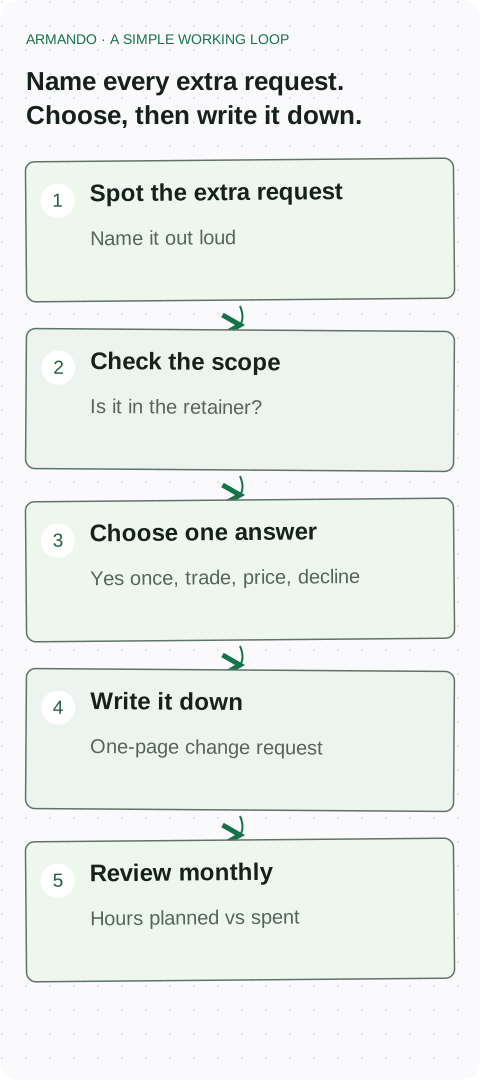
When an extra request arrives, you have four honest answers. The skill is choosing one on purpose, saying the choice out loud, and writing it down. The worst option is the fifth one that nobody names: do it quietly and hope nobody notices.
Once you have these four options in your head, the conversation becomes much easier. You are no longer deciding whether to be generous or difficult. You are choosing the answer that fits the client, the request and your capacity.
- Say yes once. Do the work and call it a favour: 'Happy to do this one as a thank-you. Next time we would scope it.' Use this for genuinely small requests from a client in good standing, and always name it so it does not become the new normal.
- Trade it. Offer to swap the new request for something already planned: 'We can do this if we move the newsletter redesign to next month. Which matters more?' This keeps the budget flat and makes the client choose priorities.
- Price it. Treat the request as new work with its own estimate: 'That is outside the current plan. Here is what it would take and what it would cost.' Use this when the work is larger than a favour, is repeatable or clearly needs extra hours.
- Decline it. Say no kindly when the request does not fit your services, your capacity or the goals you agreed: 'That is not something we do well, but here is who might help.' A clear no protects the quality of the work you do promise.
What to say when a client asks for extra work
The wording matters, because the same decision can sound helpful or cold. Good scripts have three parts: acknowledge the request, state the boundary in neutral terms, and offer a next step. Avoid apologies and avoid blaming the contract. You are not asking permission to have a boundary.
Here is a script for a request that is probably a favour: 'Thanks for flagging this. It is a bit outside what we planned this month, but I can fit it in this once. I will note it as an extra so that we can decide together how to handle similar requests in future.' The last sentence is the important one. It plants the idea that extras are tracked without making the client feel judged.
Here is a script for a request that needs pricing: 'That is a good idea, and I can see why it matters. It is outside the current plan, so let me work out what it would take and come back to you with a short estimate by Thursday. Then you can decide whether it is worth it next to the rest of the work.' This keeps the tone positive, buys you time to check with the team and puts the decision in the client's hands.
Here is a script for a trade: 'We have a full month with the website updates and the monthly report. If we add this, something needs to move. Would you rather keep the report on time and start this next month, or move the report?' Offering two clear options usually gets a quicker answer than a general discussion.
And here is a script for a kind no: 'I want to be honest with you. This is not something we do well, and I would prefer not to do it badly. If it helps, I can suggest someone who specialises in it, and we can stay focused on the results we agreed.' People tend to appreciate that, because it shows you care about their outcome more than about taking on any work you can.
Whichever script you use, follow up by email within a day. A short note such as 'To confirm: we will do X as a one-off, and we will scope similar requests going forward' removes any doubt later. Our guide to client follow-up emails has templates for this kind of message, and the Client follow-up email generator can draft one in a few minutes.
Client follow-up emails: after a meeting, no reply, renewal nudge ↗
How to price extra work and use a scope change request
A change request is a short, written record of a request to change the work. It does not need to be formal or legal. One page is enough: what is being asked, what it would take, what it would cost or what it would replace, and who approved it. The point is to make the decision visible. When the request is written down, both sides think about it more carefully, and the quiet drift stops.
To price extra work, start with the hours the team would really spend, including review, communication and any rework. Multiply by the rate you already use for similar work and keep the logic simple enough to explain in one sentence. If the client has a retainer, show the extra as a separate line rather than quietly adjusting the monthly fee. If the work could repeat, say so, and offer a monthly add-on instead of a series of one-off prices.
Offer options when you can. A small, medium and large version of a request gives the client a sense of control and often leads to a middle choice that you can deliver comfortably. Keep the language practical. Talk about the outcome the client wants, not about your hourly rate.
Here is a template you can copy and adapt. It works as an email, a shared document or a short form in your project tool.
COPY & ADAPT
Scope change request: [client]
Date: [date]
Requested by: [name] on [date]
What is being asked: [one or two sentences]
Why it matters to the client: [goal or deadline]
In the current scope? [yes / no / partly]
What it would take: [hours, people, dates]
Option 1 (price it): [cost and delivery date]
Option 2 (trade it): [what moves or is dropped]
Option 3 (decline or defer): [reason and alternative]
Decision: [chosen option]
Approved by: [client name] on [date]
Recorded by: [account owner]
Hard scope creep situations: sponsors, emergencies and goodwill
Some requests do not fit neatly into four options. The first hard case is a senior sponsor who asks directly. When a senior person at the client asks for something outside the plan, it is tempting to say yes immediately. A better move is to agree to look into it, check the impact with your team, and reply quickly with options. Speed shows respect, and the written options protect the team. Involve your usual contact so that they are not surprised.
The second case is a genuine emergency. A launch is tomorrow, something broke and the client needs help now. Help first, and talk about scope afterwards. Say clearly that you are treating it as an exception, then note it. Clients remember the agency that showed up in a crisis, and a later conversation about an emergency allowance is much easier than an argument at the moment of stress.
The third case is goodwill. Sometimes you want to do extra work to build trust, show what is possible or make up for a mistake. That is a fine choice, as long as it is deliberate and visible. Tell the client that this is a gift, say what it would normally cost, and note it in your records. Hidden goodwill gets forgotten, while visible goodwill is remembered.
The fourth case is a client who pushes back on your boundary. Stay calm and return to the shared goal. You might say: 'I understand it feels like a small change. My concern is that if we take it on without adjusting anything, the quality of the main work will suffer. Can we look at the options together?' If the pattern continues, raise it as a pattern in a calm conversation about how you work together, rather than responding to each request separately.
Finally, remember that some scope creep is a signal of opportunity. If a client keeps asking for the same kind of help, they may be telling you what they would pay for. Turn that pattern into a proposal for a new service or a larger retainer. Our guide to B2B account expansion shows how to do that without pushing.
How to prevent scope creep with a simple monthly routine
Prevention starts before the first request. Write the scope in plain language, with numbers where you can: how many rounds, how many meetings, which channels, which response times, and what is explicitly not included. A short list of exclusions often prevents more arguments than a long list of inclusions. Share it with the client at kickoff, and repeat it in your quarterly review.
Then add a light routine. Each month, take fifteen minutes with the team that works on the account. Compare the hours planned with the hours spent, list any extras you said yes to, and decide what to do about each. This is the same idea as the weekly internal account review, only focused on scope. Small drift becomes a normal agenda item, not an awkward surprise.
Our guide to billing for account management explains how to include a clear allowance for account management time, and our simple account management system for agencies shows where a scope check fits in your regular rhythm. If you work from a written plan, the Account plan generator helps you record what is included, what is not and what you will review.
Use this routine every month.
How to bill for account management ↗
How to write an account plan in 30 minutes ↗
- Week one: confirm what is included this month and what is explicitly not included.
- During the month: log every extra request in a shared note with the date, the person who asked and the answer you gave.
- Last week: compare hours planned with hours spent, and mark each extra as favour, trade, priced or declined.
- Month end: choose one pattern to raise with the client in the next conversation, and update the scope wording if needed.
- Quarter end: bring the pattern to the review and agree what the next quarter includes.
Where scope creep fits into B2B key account management
Key account management is the practice of giving your most important clients a named owner, a written plan and a regular rhythm. In B2B key account management, scope is one of the first things the key account manager protects, because the largest accounts tend to attract the most requests and the biggest risk of margin loss.
A key account plan is the natural home for scope. It describes what you do now, what the client wants next and how you will review progress. Add a short section called what is included and what is not, and a line for how extras are handled. Then every extra request has somewhere to go, and the plan shows where scope creep is turning into a real opportunity.
Strategic account management looks beyond the next month. When a client keeps asking for help in one area, that is information about their priorities. A good key account manager treats repeated extras as a signal and brings a proposal in the next account review. This is how B2B account management moves from reacting to requests to shaping an account management strategy.
For a small agency, the practical version is simple. Pick your five or ten most valuable clients, name one owner for each, record the scope in the plan, and review extras monthly. The free Account plan generator helps you build the plan quickly, and the two guides linked below show how to fit this into your routine.
A simple account management system for agencies ↗
B2B account management plan template ↗
- Choose your most valuable clients and name a key account manager for each.
- Add a what-is-included and what-is-not section to each key account plan.
- Log every extra request and review the log monthly.
- Turn repeated extras into a proposal at the next account review.
Common mistakes when handling scope creep with clients
The first mistake is waiting until you are frustrated. By the time resentment is strong, the conversation sounds like a complaint. Raise the pattern when it is still small and friendly. The second is saying yes without saying that you are saying yes. An unlabelled yes becomes a precedent, while a labelled yes becomes a favour.
The third mistake is negotiating by email in the heat of the moment. If a request lands at five in the evening and you reply with a long defensive message, you will probably regret it. Reply with a short holding line, check the scope the next morning and then answer with options. The fourth mistake is hiding behind the contract. Quoting clauses makes you sound distant. Talk about goals and capacity, and keep the document for the record.
The fifth mistake is making the account manager the only person who knows the scope. Delivery teams should see the same plan, the same exclusions and the same log. The sixth is treating every request the same way. A small favour for a loyal client and a large new deliverable from a new one are different situations, and your answers should be different.
The last mistake is never using scope creep as information. A pattern of extras tells you what the client values, where your offer is incomplete and where your pricing may need to change. Review the log, and treat it as a map of the next conversation.
Start with one account this week
- Write down what each retainer includes, with numbers, and what it explicitly does not include.
- Agree a simple way to log extra requests in one shared place.
- Choose one of four answers for each request: yes once, trade, price or decline.
- Confirm every decision in writing within one day.
- Review hours planned versus hours spent for each key account every month.
- Turn repeated extras into a proposal at the next account review.
Common questions
What is scope creep with clients?
Scope creep with clients is the gradual growth of work beyond what was agreed, without a matching change in time, budget or price. It usually comes from small, friendly requests that nobody names or writes down, which is why a clear written scope and a simple change process matter.
How do you handle scope creep without upsetting the client?
Acknowledge the request, state the boundary in neutral terms and offer options. Say yes once and name it as a favour, trade it for something planned, price it as new work, or decline kindly. Confirm the choice in writing so both sides remember it.
How do you prevent scope creep on a retainer?
Write the scope in plain language with numbers, list what is excluded, share it at kickoff and repeat it in reviews. Log every extra request and compare hours planned with hours spent each month, so small drift is discussed before it becomes a habit.
Should you charge for small extra requests?
Not always. A small favour for a client in good standing can be a deliberate gift, as long as you name it and write it down. Charge or trade when the work is larger, repeatable or needs real extra hours.
How does scope creep relate to key account management?
In key account management, scope is part of the key account plan. The key account manager records what is included, logs extras and turns repeated requests into proposals during account reviews. This protects margin while strengthening the client relationship.