CLIENT MEETINGS · B2B AGENCIES
QBR Action Plan: Turn Your Review Into a Next-Quarter Plan
Turn a quarterly business review into a QBR action plan in 5 steps: decisions, owners, dates and a 90-day plan the client agrees to. Includes templates.
The QBR went well. The client smiled, nodded at your slides and said "great work, let's keep going". Two weeks later nothing has changed, and nobody can say who was supposed to do what.
This is the most common way a quarterly business review fails. The meeting is fine. What happens after it is missing. This guide shows how to build a QBR action plan: a short, dated plan for the next 90 days that comes straight out of the review and that the client has confirmed in writing.
It is written for agency founders and account managers who already run QBRs, or who are about to. If you still need the meeting itself, start with our 30-minute client meeting agenda and come back. Here we only cover the part most teams skip: the 48 hours after the review and the 90 days that follow.
What is a QBR action plan?
A QBR action plan is a one-page list of what you and the client agreed to do in the next quarter, who owns each item and when it is due. It sits between two meetings. The quarterly business review looks back and decides. The action plan makes sure the decisions turn into work.
It is not the same as a QBR template, which is the structure of the meeting itself. It is not a full account plan either. Think of it as the bridge: the QBR gives you facts and decisions, the action plan turns them into a 90-day commitment, and the account plan holds the longer view for the year.
A good action plan has four parts. The first is the decisions made in the meeting, written as sentences. The second is three priorities for the next quarter. The third is a table of actions with owners and dates. The fourth is a review rhythm: when you will check progress and what happens if something slips.
Takeaway: the plan is what the client can hold you to, and what you can hold them to.
Why most QBRs end with no plan
Most reviews end the same way. People are tired, the hour is up, and someone says "we'll send notes". The notes arrive five days later, or never. By then the client has gone back to their own priorities.
There are four usual causes. The first is that the meeting ran out of time, so the decision part was squeezed into the last two minutes. The second is that nobody was named as owner, so everyone assumed someone else would send the follow-up. The third is that the list of ideas was too long, ten items with equal weight, so none moved. The fourth is that the plan was written by you alone and never confirmed by the client, so it has no authority.
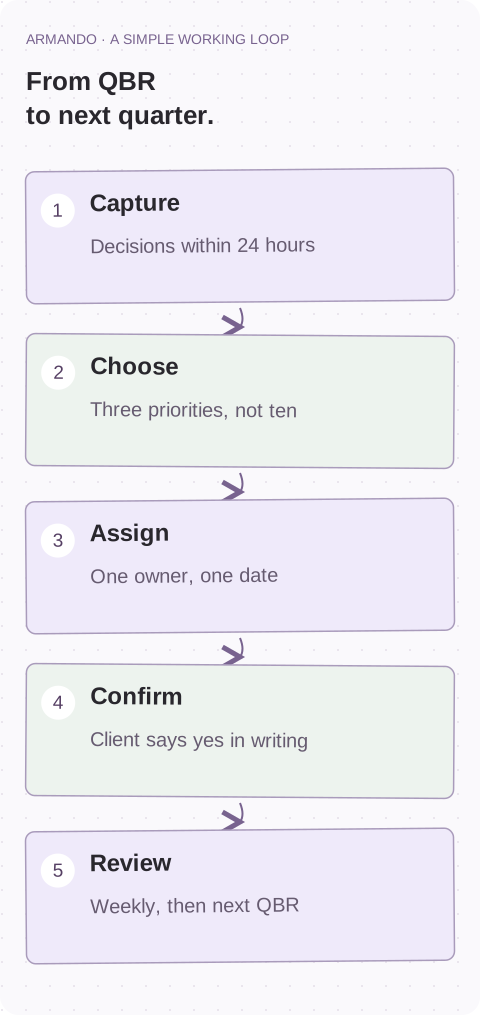
Each cause has a simple fix, and the rest of this guide covers them in order. The principle behind all of them is this: a QBR is only finished when the client has confirmed the next quarter in writing.
Takeaway: the meeting is not the deliverable; the confirmed plan is.
Want help putting this into practice? See how we can help
Step 1: Capture decisions within 24 hours
Write the notes the same day, while the room is still fresh in people's heads. Do not write minutes of everything that was said. Capture only four things.
- Decisions: what was agreed, in one sentence each.
- Open questions: things nobody could answer in the room, with a name against each.
- Risks: anything the client said that could hurt the account, in their words.
- Requests: what the client asked you for, and what you asked of them.
| Capture | Leave out |
|---|---|
| Decisions, in one sentence each | A full transcript of the discussion |
| Risks, in the client's own words | Your guess about what they really meant |
| Requests from both sides | Ideas nobody committed to |
| Named owners and dates | "We should look at this soon" |
If someone from your team took notes during the meeting, ask for them the same evening. If you ran the meeting alone, spend fifteen minutes straight after it writing down what you remember. Fifteen minutes today saves an hour next week.
Pay special attention to anything that sounded like a signal. A sudden question about contract terms, a new person in the room or a change of tone can matter more than any slide. Our guide to renewal risk warning signs lists what to listen for.
Takeaway: decisions, open questions, risks, requests. Nothing else.
Step 2: Pick three priorities for next quarter
A QBR usually produces a long wish list: more reporting, a new campaign, a process fix, an extra channel, a pricing discussion. If you put all of it in the plan, the plan will fail.
Choose three priorities. Three is a practical limit for most teams; if you run a very small team or a very large account, your number may differ, but it should always be small enough that everyone can name them from memory.
Use a simple filter. A priority makes the list only if it passes at least two of these tests:
- It is tied to something the client said matters this quarter.
- It moves a number or removes a risk you can point to.
- It can be finished, or clearly started, in 90 days.
- It needs a decision or action from both sides, not only from you.
Everything else goes into a "parked" list. Parked does not mean ignored. It means: we heard it, we wrote it down and we will look at it at the next review. Clients usually accept this if you say it out loud.
A useful sentence for the meeting is: "We can do these three well this quarter. The other two we'll park and revisit in January. Does that work?" If they disagree, you have just learned which one is really a priority.
Takeaway: three priorities, one parked list, no silent extras.
Step 3: Turn each priority into dated actions
A priority is a direction. An action is something a named person can finish. Break each of the three priorities into two to five actions, and give each action one owner and one due date.
Here is the rule that matters most: one owner, not two. If the line says "Anna and Tom", it will not happen. Pick one name. The other person can help, but one person is accountable.
Use this template for the action table. Copy it into an email, a shared document or your account tool.
COPY & ADAPT
QBR ACTION PLAN
Client: [name]
Quarter: [dates]
Prepared by: [account lead]   Date sent: [date]
Confirm by: [date, 3 working days after sending]

DECISIONS MADE IN THE QBR
1. [Decision in one sentence]
2. [Decision in one sentence]
3. [Decision in one sentence]

THREE PRIORITIES FOR NEXT QUARTER
P1. [Priority, tied to a client goal]
P2. [Priority]
P3. [Priority]

ACTIONS
Priority | Action | Owner | Due date | Status
P1 | [Action] | [One name] | [Date] | Open
P1 | [Action] | [One name] | [Date] | Open
P2 | [Action] | [One name] | [Date] | Open
P3 | [Action] | [One name] | [Date] | Open

PARKED FOR THE NEXT REVIEW
- [Idea] - reason parked - revisit [date]

RISKS WE WILL WATCH
- [Risk] - signal - owner

REVIEW RHYTHM
Internal check: every [day]. Client check-in: [date]. Next QBR: [date].
A few rules make the table work. Dates are calendar dates, not "next week" or "soon". Actions start with a verb: send, approve, book, test, publish, decide. Client-side actions belong in the table too. If the client owes you access, copy or a decision, put it in with their name and a date. Otherwise your plan hides the real reason work is blocked.
Takeaway: each action has a verb, one owner and a calendar date.
A filled example (fictional)
This example uses a fictional agency, Northbeam Studio, and a fictional client, Harbor Logistics. The numbers and names are made up to show the format. Use your own facts.
In the QBR, Harbor's marketing director said two things: she wants more qualified leads from the website before the spring trade season, and she is worried that reports arrive too late to act on. The agency admitted that the pricing page redesign slipped by three weeks.
The next-day plan might look like this.
| Priority | Action | Owner | Due | Status |
|---|---|---|---|---|
| P1 Qualified leads | Approve final pricing page copy | Harbor marketing director | 15 Nov | Open |
| P1 Qualified leads | Launch the redesigned pricing page | Northbeam project lead | 29 Nov | Open |
| P1 Qualified leads | Fix the two form errors found in the review | Northbeam developer | 22 Nov | Open |
| P2 Faster reporting | Agree the three numbers Harbor wants every Monday | Northbeam account lead | 12 Nov | Open |
| P2 Faster reporting | Send the first Monday report | Northbeam analyst | 17 Nov | Open |
| P3 Process | Legal reviews copy in week one of every project | Harbor legal contact | 1 Dec | Open |
The parked list holds a request for a new language version of the site. The risk list holds one line: the sponsor mentioned a budget review in January, so the account lead will book a sponsor check-in for 10 December.
Notice what the plan does not contain: no promises about results. It lists work and decisions, not outcomes you cannot guarantee.
Takeaway: a good plan is small, specific and honest about who owes what.
Step 4: Get the client to confirm it
Send the plan within 24 hours. A short email is enough, and you can adapt the wording below.
COPY & ADAPT
Subject: [Client] - QBR action plan for [quarter]

Hi [Name],

Thank you for the time yesterday. Below is the plan we agreed for the next quarter:
three priorities, who owns each action and when it is due.

Could you check three things by [date]?
1. Do the three priorities match what you want from us this quarter?
2. Are the owners and dates on your side realistic?
3. Is anything on the parked list more urgent than we thought?

If you reply "confirmed", we will treat this as the plan and start on [first action].
If something is wrong, tell us which line and we will fix it today.

Our next check-in is [date]. The next QBR is [date].

[Your name]
Why the confirmation matters: a plan the client has not seen is your internal to-do list. A plan they confirmed is a shared commitment, and it changes how they behave. They notice when their own action is late, and you can point to it without blame because they agreed to the date.
If the client does not reply in three working days, send one short reminder. If there is still no answer, ask for five minutes on a call to go through the three priorities. Silence after a QBR is information. It can mean the client is busy, but it can also be an early sign that the relationship is cooling, so log it. Our guide to client follow-up emails has more wording for the no-reply case.
Takeaway: "confirmed" in writing is what turns your notes into a plan.
Step 5: Run the 90 days with a weekly rhythm
A plan that nobody opens will drift. Give it a small, fixed rhythm so it stays alive without becoming a burden.
| When | What | Who |
|---|---|---|
| Day 1 | Send the plan; log it in your account tool | Account lead |
| Day 3 | Reminder if the client has not confirmed | Account lead |
| Every week | 15-minute internal check: what is done, blocked or late | Account lead and delivery |
| Week 4 | Short check-in with the client sponsor on the three priorities | Account lead |
| Week 6 | Update the account plan and the health score | Account lead |
| Week 10 | Draft the next QBR scorecard from the plan | Account lead |
| Week 12 | Run the next QBR; review last quarter's plan first | Both sides |
The weekly internal check should take fifteen minutes. Open the table and ask only three questions: what finished, what is blocked and what needs a decision from the client. If a client action is late, do not wait for the next meeting. Send a friendly note with the date they agreed to and ask whether it is still realistic.
When an action slips on your side, say so early and say what you will do. The same honesty you showed in the QBR applies here. A quiet delay is a small breach of trust; a flagged delay with a new date is just normal work.
At the start of the next QBR, open last quarter's action plan first. Go through it line by line: done, moved or dropped, and why. This one habit does more for credibility than any slide. It shows the client that the plan is real and that you track it.
Takeaway: fifteen minutes a week keeps ninety days on track.
Connect the action plan to your health score and account plan
The QBR action plan should not live alone. It feeds two other things you already keep, or should keep: the account plan and the client health score.
After every QBR, update the account plan with what you learned: changed priorities, new stakeholders, a risk that appeared. The account plan template shows how to do it in about thirty minutes. Then adjust the client health score if the meeting changed your view of the account, for example if attendance dropped or the sponsor skipped the meeting.
Use the plan itself as a health signal. If most client-side actions are done on time, engagement is probably good. If client actions keep slipping and nobody explains why, treat that as a warning, not an annoyance. These are working assumptions rather than a formula, so judge each account on its own facts.
The free QBR template builder on Armando can prepare the review itself, including an agenda and a scorecard, and the Account plan generator can turn the outcome into a yearly plan. Use the QBR for the quarter and the account plan for the year, and make sure the first never contradicts the second.
Takeaway: the action plan updates the account plan and the health score every quarter.
Where the QBR action plan fits into B2B key account management
In B2B key account management, the QBR is where your key account plan meets the client's reality, and the action plan is how the QBR changes what happens next. Key account management means giving your most important clients structured, senior attention instead of reacting to them. A key account manager (sometimes the founder, sometimes a senior account lead) owns the relationship, the plan and the review rhythm.
Strategic account management is the same idea at a longer horizon: a few accounts that matter most get a multi-year view, an executive sponsor on each side and a plan that is reviewed at least every quarter. The QBR action plan is the quarterly slice of that plan. Without it, the longer plan stays a document nobody opens.
For a small agency, B2B account management does not need heavy tools or a large team. It needs a clear account management strategy: which clients get a QBR, who owns each one, what the plan contains and when it is reviewed. Start with two or three key accounts. Run the five steps above after every review. After two quarters you will have a habit, and a record of what you promised and delivered.
To set up the whole system around this, read our guide to a simple account management system for agencies and the B2B account management plan template. Then use the free Account plan generator to draft the yearly plan that each QBR action plan feeds.
Takeaway: the key account plan sets the direction; the QBR action plan delivers each quarter of it.
The simple account management system behind our 110-person agency ↗
Client Account Management Template: A Simple B2B Plan (With Examples) ↗
Scripts: what to say in the three hard moments
Plans fail in conversations, not in tables. Here are three moments and the wording that helps.
The first is the end of the QBR, when time is short. Say: "We have five minutes left. Before we finish, let's agree three things for next quarter and who owns them. I'll send it tomorrow for you to confirm." This tells the client what will happen and gives you permission to follow up.
The second is when the client wants everything. Say: "All of these are good ideas. If we do all five, we do none of them well. Which three matter most before the end of the quarter? We'll keep the other two on the parked list and bring them back in January." Then stop talking and let them choose.
The third is when a client action is late. Say: "On the 15th we agreed that the pricing copy would come to us. We're now blocked on the launch date. Is the 22nd still realistic, or should we move the launch?" This is neutral, specific and focused on the shared goal, not on blame.
If you want practice, rehearse these three with a colleague for ten minutes before your next QBR. It sounds small, and it is the difference between a plan that is discussed and one that is owned.
Takeaway: write down the sentence before the hard moment arrives.
Use AI to draft your QBR action plan
AI is good at turning rough notes into a clean structure. It is bad at deciding what the client really meant. Give it your real notes and ask it to flag gaps instead of filling them.
COPY & ADAPT
You are an account manager writing a QBR action plan for one B2B client.

Client: [name]
Quarter: [dates]
QBR notes: [paste your notes: decisions, risks, requests, open questions]
Client priorities in their own words: [paste]
What slipped last quarter: [honest list]

Produce:
1. A list of decisions made, one sentence each.
2. Three proposed priorities for the next quarter, each tied to something the client said.
3. An action table with columns: priority, action (starting with a verb), one owner, due date, status.
4. A parked list with a reason for each item.
5. Risks to watch and a short confirmation email for the client.

Rules: use only facts from my notes. If an owner or a date is missing, write "Owner needed" or
"Date needed" instead of guessing. Do not promise results. Keep the email under 150 words.
Read the output as a draft. Check every date and every owner with your team before you send it. The free QBR template builder includes a prompt like this, ready to copy.
Takeaway: AI drafts the structure; you confirm the facts.
Common mistakes
Most of these are easy to avoid once you know them.
- Waiting a week to send the plan, when the meeting has already faded.
- Listing ten priorities because nobody wanted to say no.
- Putting two owners on one action, so nobody owns it.
- Writing "soon" or "next month" instead of a date.
- Leaving the client's own actions out of the table.
- Skipping the confirmation, then treating the plan as agreed.
- Promising outcomes in the plan instead of work and decisions.
- Never opening last quarter's plan at the next QBR.
- Treating the plan as paperwork rather than a tool for the weekly check.
If you recognise three or more, pick the one that costs you most (usually the missing confirmation) and fix that first. Do not try to change everything at once.
Your next step
Pick the last QBR you ran, or the next one on your calendar. Within the next 48 hours, write the decisions, choose three priorities and build the action table. Send it to the client with a date to confirm.
If you do only one thing from this guide, make it the confirmation email. A plan the client has said yes to is a different kind of document.
Start with one account this week
- Write down decisions, open questions, risks and requests the same day as the QBR.
- Choose three priorities for the next quarter and park the rest with a reason.
- Break each priority into two to five actions that start with a verb.
- Give every action one owner and one calendar date.
- Include the client's own actions in the table.
- Send the plan within 24 hours and ask for written confirmation by a set date.
- Send one reminder after three working days if there is no reply.
- Hold a 15-minute internal check every week.
- Update the account plan and the health score after the meeting.
- Open last quarter's plan first at the next QBR.
Common questions
What is a QBR action plan?
A QBR action plan is a short document, sent within a day of a quarterly business review, listing the decisions made, three priorities for the next quarter and a table of actions with one owner and one due date each. The client confirms it in writing.
How do you follow up after a QBR?
Send the action plan within 24 hours, ask the client to confirm it by a set date and send one reminder if they do not reply. Then run a weekly internal check and a client check-in around week four.
How many priorities should a QBR plan have?
Three is a good default. It is small enough for everyone to remember and large enough to matter. Park the rest on a visible list and revisit it at the next review instead of quietly dropping it.
Who should own the actions in a QBR plan?
Each action needs exactly one owner with a name, not a team. Include client-side actions with a client owner. The account lead owns the plan as a whole, sends it and tracks it weekly.
What is the difference between a QBR and an account plan?
A QBR is a quarterly meeting that looks back and decides. An account plan is a longer document, usually yearly, that sets goals, stakeholders and risks. The QBR action plan connects them: it turns the meeting into 90 days of work and feeds back into the account plan.
How does a QBR fit into key account management?
In key account management, the QBR is the regular checkpoint for your most important clients. The key account manager uses it to review the key account plan, agree the next quarter's actions and spot risk early. It is the quarterly rhythm of strategic account management.