ACCOUNT MANAGEMENT · B2B AGENCIES
How to raise rates with existing clients: a 6-step plan
Learn how to raise rates with existing clients: when to do it, what to say, a price increase letter template and B2B key account management tips.
Knowing how to raise rates with existing clients is one of the most uncomfortable skills in agency life. Costs go up, your team gets better, the scope quietly grows, and yet the retainer you agreed two years ago stays exactly the same because nobody wants to start the conversation.
The discomfort is understandable. A long-term client is worth a lot, and a badly handled price increase can damage a relationship that took years to build. But leaving rates untouched has a cost too. Margins shrink, the team does more for less, and the account slowly becomes the one everybody resents.
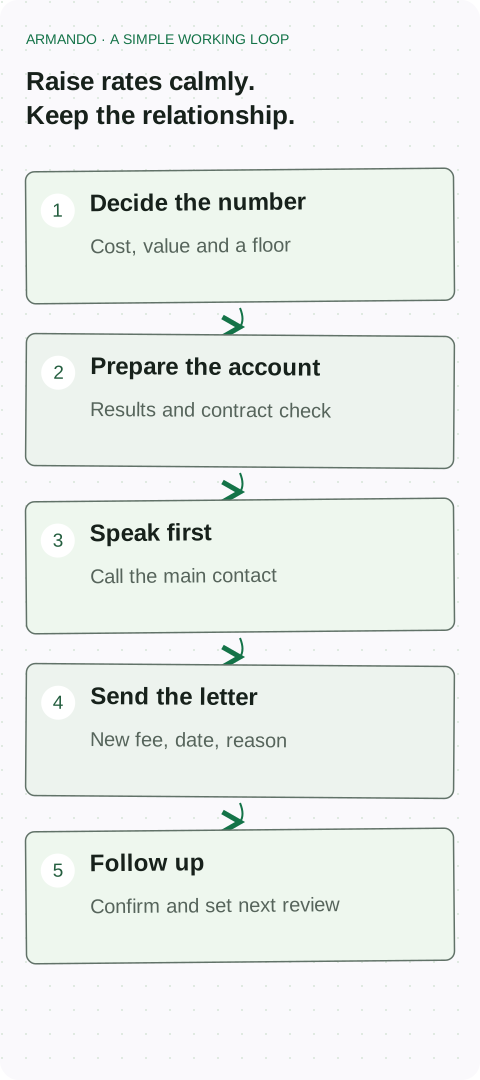
This guide gives you a calm, repeatable way to do it. You will see when a rate increase makes sense, how to decide the size of it, what a good price increase letter contains, what to say on the call, how to answer pushback, and where the whole exercise fits into B2B key account management. It is written for agency founders and account managers, and it uses plain wording you can adapt to your own clients.
Why and when to raise rates with existing clients
There are three honest reasons to raise rates. The first is cost: salaries, tools, contractors and overheads move over time, and a price that worked in a previous year may no longer cover the work. The second is value: your team may now deliver more, faster or with better results than when the contract was signed. The third is scope: small extras were added one by one and the retainer never caught up.
A fourth reason is fairness between clients. New clients are often quoted current prices, while long-standing clients stay on old ones. Over time that creates a gap that is hard to explain and hard to defend. A planned, modest correction is easier than a large jump after several years of silence.
Timing matters as much as the reason. The most natural moments are a contract renewal, the start of a new financial year, the end of a project phase, or a clear change in scope. These moments give you a neutral reason to talk about numbers. The worst moments are straight after a mistake, in the middle of a dispute, or in the final weeks before the client's own budget closes.
Before you decide, look at the account honestly. If the relationship is thin or the client is already showing signs of leaving, a price rise needs more care. Our guide to client renewal risk warning signs explains what to check first, because a rate conversation and a renewal conversation are often the same conversation.
Client renewal risk: 7 warning signs to spot 90 days out ↗
- List the clients whose rates have not changed for 12 months or more.
- Write one honest reason for each: cost, value, scope, or fairness.
- Mark the next natural moment to talk, such as a renewal date or phase end.
- Flag any account that already looks at risk, and handle it separately.
How much should you raise rates for an existing client?
There is no universal percentage that is right for every agency, and anyone who gives you one is guessing. The right number comes from three inputs: what the work now costs you to deliver, what a new client would pay today for the same scope, and how much the client values the result. Use all three, not just the one that feels safest.
Start with the cost side. Work out the real monthly cost of delivering the account, including the time of the people involved, the tools they use and a fair share of overhead. If you are not sure how to do that, the guide on how to bill for account management walks through it. Then compare the current fee to that cost and see what margin is left. If the margin is thin, a correction is not greed; it is maintenance.
Next, look at your current price list. If a new client with the same scope would be quoted noticeably more, you have a gap to close. You do not have to close all of it at once. Many agencies split a large gap into two steps, one now and one at the next renewal, so the client sees a predictable path instead of a shock.
Here is a worked example with made-up numbers, for illustration only. A client pays 4,000 per month. Delivery cost has risen and a new client would be quoted 4,600 for the same scope. You decide on a 7 percent increase now, which is 280, bringing the fee to 4,280, and plan a second review at the next renewal. The client sees a modest change, and you keep a visible route to the current price.
Finally, decide what you are willing to negotiate. Settle your minimum acceptable fee and your preferred structure before the first conversation, so you are not inventing a position under pressure. Knowing your floor also makes it easier to stay calm.
How to bill for account management ↗
How to improve agency profit margins ↗
- Calculate the real monthly cost of delivering the account.
- Compare the current fee with what a new client would pay for the same scope.
- Choose a figure, or two steps over two dates, and write down your minimum.
- Decide in advance what you can offer in return, such as clearer reporting or a fixed price for a longer term.
Want help putting this into practice? See how we can help
Prepare the account before you raise your rates
A price increase lands better when the client has recently seen what you have done for them. That means preparation, not a sales pitch. Spend an hour with the account before you write a single sentence about money.
Start by collecting results the client has acknowledged: a goal reached, a problem solved, a launch delivered on time, a process that now runs without them. Use their own words where you can. Avoid inventing numbers or stretching claims. If you cannot point to anything concrete, that is useful information; fix the value story first and raise the rate afterwards.
Then check the relationship. Who approves the budget? Who uses your work every day? When did you last speak to each of them? If your only contact is a day-to-day coordinator and the budget holder barely knows you, a letter that arrives out of nowhere will feel colder than it should. An introductory call or a short value summary sent a few weeks earlier can change the tone completely.
Finally, check the contract. Look for the notice period, any clause on fee changes, and the renewal date. This is not legal advice, and contract terms vary, so when in doubt ask someone qualified. But knowing what you agreed stops you from promising a date you cannot keep or sending a notice that conflicts with the paperwork.
From our own agency: when our founder ran a rate increase, the project manager and the head of account management prepared it first. They worked out the approach, checked what was happening on the project and which roles did what, and drafted a first proposal of the new rates. Then the founder, who owned the relationship with that client and had a good one, held the conversation. Everything was based on facts and framed as a win for every side, so the increase looked logical to the client. Prepared by the team, delivered by the person with the relationship.
How to build B2B client relationships ↗
- Collect two or three results the client has acknowledged, in their words.
- Identify the budget holder and the day-to-day contact, and note your last conversation with each.
- Read the contract for notice periods, fee-change clauses and renewal dates.
- Send a short value summary a few weeks before the price conversation.
What a price increase letter to clients should include
A good price increase letter, whether it is sent as an email or a PDF, is short, specific and kind. It should be possible to read in under a minute and understand three things: what is changing, when, and what happens next. Everything else is decoration.
Lead with the relationship and the results, in a sentence or two. Then state the new price and the effective date plainly, without apology and without burying it in the third paragraph. Give a short reason, because people accept changes more easily when they understand them. Finish by offering a conversation and saying what you will do to make the transition easy.
How much notice you give depends on your contract and the client's budget cycle, so check both. A common approach is to give enough time for the client to plan, and to send the letter after you have already spoken to the main contact, so the letter confirms a conversation rather than replacing it.
You do not need to start from a blank page. The free Price increase letter generator on this site produces a respectful letter, talking points for the call and a follow-up plan, and you can edit it before you send anything. Use the template below as a starting point, and replace every bracket with specifics.
| Approach | How it works | Best used when |
|---|---|---|
| Single increase | One new fee from a stated date | The gap is small and the relationship is strong |
| Two-step increase | A smaller rise now and a second at the next renewal | A large gap to your current price list |
| Scope-linked change | Keep the fee but reduce scope, or add scope at a new fee | The client is price sensitive and the scope has grown |
| Longer-term lock | Offer a fixed price for a longer commitment in return for the new rate | You want stability and the client values predictability |
How to transition to agency retainers ↗
- Speak to the main contact first, then send the letter the same day or the next.
- State the new price, the effective date and what it applies to in one clear sentence.
- Give one honest reason and one or two results from the past year.
- Offer a call, and name a date by which you would like to hear back.
COPY & ADAPT
Subject: Our fees from [effective date]

Hi [name],

Thank you for the work we have done together over the past [period]. [One or two specific results the client has acknowledged.]

From [effective date], our monthly fee for [scope] will change from [current fee] to [new fee]. This reflects [honest reason: rising delivery costs / an expanded scope / the added work we now do for you].

Everything else about how we work together stays the same, and your current fee applies until [effective date]. If it would help to talk it through, I would be glad to find 20 minutes this week or next.

Thank you for being a valued client.

Best,
[your name]
What to say when you tell a client you are raising your rates
The letter is the record; the conversation is the relationship. Wherever possible, speak to the main contact before they see anything in writing. A ten-minute call with a clear opening does more than a perfectly drafted email.
A simple structure works well. First, thank them and name a result. Second, say plainly that you are updating your fees and give the number and the date. Third, explain the reason in one sentence. Fourth, stop talking and listen. Silence after the number feels long, but it is where the client processes the news. Resist the urge to fill it with discounts or apologies.
Here is wording you can adapt: "I wanted to talk to you before anything lands in your inbox. Over the last year we have [result]. As part of that, we are updating our fees from [date], and your monthly fee will move from [current] to [new]. I would rather you hear it from me and have time to plan. How does that sit with you?"
Avoid hedging phrases such as "I'm so sorry" or "I hope this is okay". They signal that you do not believe in the number. Warm and firm is the tone you want: appreciative of the relationship, clear about the decision, open to questions about how it will work in practice.
Who should say it? In our experience, the person the client trusts most. Let the team build the case, and let the person with the relationship have the conversation.
- Open with thanks and one specific result.
- State the new fee and the date in a single sentence.
- Give one short reason, then pause and let the client respond.
- Agree what happens next, and confirm it in writing the same day.
COPY & ADAPT
Call notes: price conversation with [client]
Date / attendees: [details]
Result I opened with: [result]
New fee and effective date: [numbers]
Client's first reaction: [their words]
Questions raised: [list]
Options discussed: [list]
Agreed next step: [action] by [date], owner [name]
How to handle pushback when you raise rates with existing clients
Most clients react calmly to a clear, early, respectful message. Some push back, and that is normal. The goal is not to win an argument; it is to understand what the objection really is and respond to that.
Usually the objection is about budget, about value, or about surprise. A budget objection means the client has a number they must stay inside, and you can explore structure: a two-step increase, a scope change, or a longer term. A value objection means they cannot clearly see what they get, and you should go back to results and the plan for next quarter. A surprise objection means you were too late or too abrupt, and the honest answer is to acknowledge it and offer more time.
If a client says they will have to look at other options, take that seriously without panicking. Ask what they would compare you with, and what would make the new fee feel fair. Sometimes the answer is a smaller scope. Sometimes it is a firm no, and you will decide whether the account is still worth keeping at the old rate. Having your minimum written down in advance makes this a decision instead of a reaction.
| What the client says | What it may mean | A useful response |
|---|---|---|
| "That is a big jump." | Surprise or a tight budget | Offer a two-step increase or more notice, and confirm the reason |
| "What are we actually getting?" | The value is not visible | Share two acknowledged results and the plan for next quarter |
| "Can you keep the old rate?" | Budget pressure | Explain what scope you could adjust at the old rate |
| "We will have to review other options." | Testing the firmness of the decision | Ask what they would compare, and what would feel fair |
| "Let me speak to my boss." | They are not the budget holder | Offer to join the conversation and provide a one-page summary |
- Listen to the full objection before responding.
- Name the type: budget, value or surprise.
- Answer that specific concern, not a general one.
- Close by confirming what you both agree and the next date.
A 90-day timeline for raising rates with existing clients
Treating a rate change as a small project removes much of the anxiety. A simple timeline gives each step a place and keeps you from leaving the hard part until the last week.
At around 90 days before the effective date, decide the figure and the structure, and check the contract. At around 60 days, send a short value summary and arrange the call. At around 45 days, speak to the main contact and send the letter. In the weeks after, answer questions, confirm anything agreed in writing, and update your records. After the date passes, check in once to see how the new arrangement feels.
These numbers are a working rule, not a benchmark. If your contracts require longer notice or your clients plan budgets early, move everything earlier. The principle is the same: no one should hear about a change to their fees for the first time shortly before it takes effect.
| When | What to do | Output |
|---|---|---|
| About 90 days before | Decide the figure, structure and minimum; check the contract | A one-page decision note |
| About 60 days before | Send a value summary and book the call | Summary sent and call scheduled |
| About 45 days before | Speak to the main contact, then send the letter | Conversation held and letter sent |
| The weeks after | Answer questions and confirm any agreement in writing | Agreed terms recorded |
| After the effective date | Check in once on how it feels | Account note updated |
Where raising rates fits into B2B key account management
Key account management is the practice of giving your most important clients a named owner, a written plan and a regular rhythm. In B2B account management, a rate change is not a separate event. It belongs inside that plan, because it affects the value story, the relationship and the commercial terms all at once.
A key account manager is usually the right person to lead the conversation. They know the client's goals, the stakeholders and the history, so they can place the number in context. A key account plan should therefore include a line for commercial terms: when the fee was last reviewed, what a fair next step looks like, and when you will raise it. The free Account plan generator can help you build that plan quickly.
Strategic account management goes a step further. It treats pricing as part of growth, not just recovery. A client who is growing with you may accept a rate increase more easily if it comes with a clearer plan, a broader scope or a new service. An account management strategy that only ever talks to clients about money at renewal time makes every price conversation feel defensive.
In practice, do this on your most valuable accounts first. Review the fee annually at the same point in the account plan, make the reason visible, and keep notes on how each conversation went. That habit turns a once-in-several-years crisis into a routine adjustment.
A simple account management system for agencies ↗
B2B account management plan template ↗
- Add a commercial review line to each key account plan, with a date.
- Name a key account manager who leads the conversation.
- Link the fee review to the value summary and the next-quarter plan.
- Record the outcome so the next review starts from facts.
Common mistakes when you raise rates with existing clients
The first mistake is waiting too long. Years of unchanged fees turn a small correction into a large jump, and the client feels ambushed. Smaller, regular adjustments are easier on everyone.
The second is leading with an apology. Over-explaining and apologising signals that you doubt the number, and clients often respond to doubt by negotiating. State it calmly, give one reason, and listen.
The third is sending a letter with no conversation. For a long-term client, an unexpected email about money feels impersonal. Speak first, write second.
The fourth is changing the fee without looking at scope. If the scope has crept, fix both together, or the client will reasonably ask why they are paying more for the same thing. The fifth is treating every client identically. A key account with a strong relationship and a small gap needs a different approach from a smaller account with a large gap, and the right answer is sometimes to adjust scope instead of price.
The last mistake is forgetting to follow up. After the effective date, check once that the new arrangement works, record the result, and set the next review date. That is how the next increase becomes routine.
Start with one account this week
- List the clients whose fees have not changed for 12 months or more.
- Write one honest reason for each increase: cost, value, scope or fairness.
- Calculate the cost of delivery and compare the current fee with your price list.
- Check the contract for notice periods and fee-change clauses.
- Collect two or three results the client has acknowledged.
- Speak to the main contact first, then send the price increase letter.
- Record the outcome and set the next fee review date.
Common questions
How do you raise rates with existing clients?
Decide the new fee from your costs and the value delivered, check the contract, and speak to the main contact before sending a short letter. State the new price and date clearly, give one honest reason, and offer a call. Follow up in writing.
How much notice should I give before a price increase?
It depends on your contract and the client's budget cycle. Check the notice terms first, then give enough time for the client to plan. Many agencies start the conversation around 60 to 90 days before the effective date, which is a working rule, not a standard.
What should a price increase letter to clients say?
It should thank the client, mention one or two real results, state the new fee and effective date plainly, give a brief reason, and offer a conversation. Keep it short enough to read in a minute, and avoid apologising for the decision.
What if a client refuses a rate increase?
Ask what the real concern is: budget, value or surprise. Then respond to that, perhaps with a two-step increase, a scope change or more notice. Decide your minimum acceptable fee beforehand so you can choose calmly whether to keep the account.
How does a rate increase fit into key account management?
In key account management, the fee review belongs inside the key account plan. The key account manager reviews commercial terms on a set date, links the change to results and next-quarter goals, and records the outcome, so pricing becomes a routine part of the relationship.