CLIENT RETENTION · B2B AGENCIES
Client Complaint: Handle It Without Losing the Account
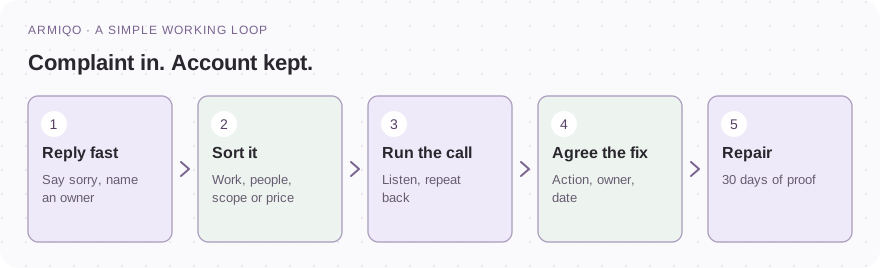
How to handle a client complaint and keep the account: sort the complaint, reply within hours, run the call, agree the fix and follow a 30-day repair plan.
A client complaint lands in your inbox at 4:40 on a Friday afternoon. The subject line is polite. The first sentence is not. Your stomach drops, and within a minute you are drafting a reply in your head that explains why it is not really your fault.
Stop. That reply is the first mistake, and it is the one that costs accounts. This guide shows how to handle a client complaint in a B2B agency or consultancy without losing the account: how to sort what the complaint is really about, what to say in the first reply, how to run the call, what to offer, and how to rebuild trust over the next 30 days.
It is written for agency founders and account managers who look after a small number of long-term clients. A complaint on one of those accounts is not a customer service ticket. It is a moment where the relationship either gets thinner or gets stronger, and what you do in the first 48 hours decides which.
What a client complaint really tells you
Most people assume a complaint means the account is in danger. Often it means the opposite. A client who writes to you, or picks up the phone, still wants the relationship to work. They are spending effort on you. The clients who should worry you more are the ones who go quiet, stop replying to emails, and start asking who else could do the work.
That does not make a complaint pleasant, and it does not mean every complaint is safe. A complaint can be a warning sign or a cry for attention, and sometimes both. What matters is that it gives you information you rarely get for free: what the client noticed, what they care about, and how much patience they have left.
It helps to separate three things that are easy to mix up. A complaint is something the client says out loud about a specific problem. A concern is something they feel but have not said, which you may only pick up in tone or in what they stop mentioning. A risk is your own assessment that the account may not renew. A complaint can come with a concern and a risk, or with neither. If you want the quiet signals, read our guide to client renewal risk warning signs. This guide covers what to do once the client has said it out loud.
The goal is simple. You are not trying to win the argument or to prove that the team did its best. You are trying to leave the client feeling heard, to fix what can be fixed, and to show over time that the problem will not come back. Treat the complaint as a request for evidence that you are paying attention.
Takeaway: a complaint is a client still investing in the relationship. Spend it well.
Sort the client complaint before you answer
Before you reply, take ten minutes to work out what kind of complaint you have. The right response depends on it, and the wrong response to the right complaint is how small problems grow. Most client complaints in a B2B service business fall into one of four types, and many contain more than one.
| Type | What it sounds like | What sits underneath | First move |
|---|---|---|---|
| Work quality or delivery | "The report was late again." "This is not what we asked for." | A missed commitment, a gap between expectation and result | Check the facts, own what is yours, offer a fix and a date |
| People and communication | "We never hear from you." "Nobody told us." | Thin contact, unclear owner, a missed handover | Name one owner, agree how and when you will update them |
| Scope and money | "Why is this extra?" "We thought this was included." | Unclear scope, surprise invoices | Show what was agreed in writing, then decide what is fair |
| Value and results | "I do not see what we are getting." | Weak reporting, unclear goals, a new sponsor | Go back to their goals and show the evidence |
Also ask two sorting questions. First, is this a one-off or a pattern? If the client says "again", "as usual" or "still", you are not dealing with an event. You are dealing with a story the client has been telling themselves for a while, and a single apology will not change it. Second, who is complaining, and who else knows? A complaint from your day-to-day contact is different from a complaint copied to their boss, and different again from a message that mentions the contract.
Write the answers down in two lines before you do anything else: type, one-off or pattern, who is involved, what they probably want. This takes five minutes and stops you from answering the tone of the message instead of the substance.
If the complaint involves money, a legal issue, security, data or a major outage, bring in a senior person immediately. Do not try to handle those alone, and do not wait until you have the full story.
Takeaway: the same words can hide four different problems. Sort first, then reply.
Want help putting this into practice? See how we can help
The first reply: acknowledge the client complaint within hours
Speed matters more than polish in the first reply. Silence is the most damaging response, because the client fills it with their own story: you are ignoring them, you do not care, you are hiding something. Aim to acknowledge within two to four working hours, even if you cannot yet explain what happened.
The first reply has three jobs. Say sorry for the experience, name the person who owns the problem, and say when the client will hear from you again. It has no other jobs. It should not explain, defend, offer a solution you have not checked, or blame anyone.
COPY & ADAPT
Hi [name],

Thank you for telling me. I am sorry this happened, and I understand why it is frustrating.

I am looking into it now. I will come back to you by [time and date] with what happened and what we propose to do about it.

If anything is urgent before then, call me on [number].

[Your name]
A few small choices make a big difference. Reply to the person who complained, in the channel they used. If they wrote by email, reply by email, and offer a call only after you have acknowledged. Do not copy half the company. Do not use phrases like "we regret any inconvenience", which read like a form letter. And do not write "I understand", then follow it with three paragraphs that show you do not.
There is a difference between apologising for the experience and accepting blame for the cause. "I am sorry this was frustrating" is true whatever happened. "We made a mistake" may be true, but you do not know yet, so wait until you have checked. You can show you care without conceding facts you have not verified.
If you want wording for the messages that follow, our guide to client follow-up emails has examples, and the free Client follow-up email generator can draft them from your notes.
Takeaway: sorry, owner, time. Nothing else in the first reply.
Run the call: listen first, then repeat back
For anything beyond a small issue, a call beats email for the second step. Email makes people harder. A call lets you hear how upset the client is, what they leave out, and what they really need. If the client is far away or prefers writing, a video call still works better than a long thread.
Prepare for thirty minutes. Before the call, check your internal facts: what was agreed, what was delivered, what the record shows. Look at the account history. Has anything like this happened before? Who else at the client is involved? Do not go in with a defence. Go in with the facts and an open question.
Steps for the call:
- Open with one sentence that sets the tone: "Thank you for making time. I would like to hear it from you first, then I will tell you what I found."
- Let the client explain the problem in their words. Do not interrupt, even if they are wrong about a detail. Take notes.
- Ask open questions: "What was the impact for you?" "What did you expect to see instead?" "Who else is affected?" "What would a good outcome look like?"
- Repeat back what you heard: "So the main issue is X, it affected Y, and what you need is Z. Is that right?" Wait for a yes.
- Share what you found, briefly, in plain words. Own the part that is yours. State any facts that differ from the client's view gently, without scoring points.
- Propose next steps, or tell them when you will propose them. Do not promise on the call what you cannot check.
- End by saying what happens next and when they will hear from you.
The sentence that does the most work on this call is "What would a good outcome look like for you?" It tells you what the client is actually asking for. Often it is much smaller than you feared. A client who is furious about a late report may only want a named backup person and a firm delivery date. A client who is angry about an invoice may only want to understand it. You cannot know until you ask, and offering a big concession before you ask is expensive and sometimes unnecessary.
Watch for two traps. The first is the explanation spiral, where you give reason after reason for what happened. Reasons are fine, but give them once, after the client has felt heard. The second is the early fix, where you jump to a solution to make the discomfort stop. A fix offered before the client has said what hurt tends to miss the point.
Takeaway: listen first, repeat back, and ask what a good outcome looks like before you offer anything.
Agree the fix: what to offer and what to avoid
Once you understand the problem, propose a remedy that has three parts: fix the issue, reduce the impact, and prevent a repeat. Each part needs an owner and a date. A fix without an owner is a wish.
| Option | When it fits | Watch out for |
|---|---|---|
| Redo or correct the work | The result missed the brief | Agree what "done" looks like first |
| Extra attention for a set period | Communication or pace was the problem | Do not promise more than the team can sustain |
| Process change | The cause was a gap in how you work | Name one change, not a long list |
| Change of owner or added support | The relationship with one person is strained | Decide this carefully, and tell the client why |
| Credit, discount or refund | The client lost real money or time | Agree it with leadership first; it is a decision, not a reflex |
A concession is not the same as a fix. A discount without a fix tells the client you would rather pay than change. A fix without a concession, when the client has genuinely lost out, can feel cold. Decide in advance who in your company can approve a credit and what the limit is, so the account manager is not improvising on the call.
Be careful with phrases like "it will not happen again". You cannot guarantee that, and clients remember when it does. Say what you are changing instead: "From now on, the export runs automatically and a second person checks the file the day before." A specific change is more believable than a promise.
Write the plan down and send it. Keep it short.
COPY & ADAPT
Client complaint response plan

Client: [name]   Raised by: [name, role]   Date: [date]
Channel: [email / call / meeting]   Owner on our side: [name]

What the client said (in their words):
[one or two sentences]

What we found:
[facts, two or three sentences, no blame]

Impact on the client:
[time, money, reputation, who is affected]

What the client wants:
[their outcome, as confirmed on the call]

What we will do:
1. Fix: [action]   Owner: [name]   Date: [date]
2. Reduce the impact: [action]   Owner: [name]   Date: [date]
3. Prevent a repeat: [one change]   Owner: [name]   Date: [date]

Concession, if any: [what, approved by whom]

Check-in with the client: [date]
Closed when: [what the client confirms]
Send the client the "found, will do, will change" part, and keep the internal part for yourself. Ask them directly: "Does this plan work for you?" If it does not, adjust it before you start.
Takeaway: fix, reduce the impact, prevent a repeat. Owner and date on each, and no promises you cannot keep.
The 30-day repair plan after a client complaint
Solving the problem is not the same as repairing the relationship. The client may accept your fix and still carry a quiet doubt about whether you are reliable. The next 30 days are about replacing that doubt with evidence. Think of the complaint as the first day of a repair period, not the end of an incident.
A simple timeline works well:
- Day 0 to 2: acknowledge the complaint, sort it, run the call and send the plan.
- Day 3 to 7: deliver the fix on the agreed date and confirm it with the client in writing: "Is this resolved for you? Is there anything we missed?"
- Day 8 to 14: add a short extra touchpoint, for example a ten-minute call or a written update, so the client sees the change in practice.
- Day 15 to 21: do an internal review. Find the root cause, check whether the same thing could affect other clients, and make the one process change you promised.
- Day 22 to 30: tell the client what changed because of them, and ask how things feel now. Then return to the normal rhythm.
The last step matters most. When you close the loop with "you told us X, we changed Y, here is the result", you turn a complaint into proof that you listen. Many teams skip it because the incident feels finished. The client has not forgotten it, though, and hearing that something changed on your side is what rebuilds confidence.
During the repair period, avoid two opposite mistakes. Do not disappear, because the client is watching closely and silence will look like relief that the problem is over. And do not over-contact, with daily check-ins that put pressure on the relationship. A few well-chosen touchpoints, each with something concrete, are enough.
Also use the period to widen the relationship. If only one person at the client has been unhappy, find out who else is affected and whether they agree. If you are mostly talking to one contact, this is a natural time to meet a second one. Our guide to single-threaded accounts explains why this protects you.
Takeaway: repair is a 30-day habit. Fix it, show it, say what changed.
When the client complaint is really about a person, price or scope
Not every complaint can be solved with a better process. Some need a harder conversation. Here are the cases that tend to catch teams out.
When the complaint is about a person on your team, listen without agreeing or defending. Do not blame the person in front of the client, and do not promise their removal on the spot. Say you will look into it, then speak to your colleague privately and fairly. If a change of owner is right, present it as a decision to serve the client, not as punishment.
When the complaint is about scope or price, go back to what was agreed in writing. If the client expected something that was never part of the deal, say so kindly and early, and offer a way forward: add it to the scope with a price, or agree a smaller version. Our guide to scope creep gives wording for these conversations. If you did create the confusion, for example by being vague in a proposal, own that and fix the document.
When the complaint is about results, do not argue with the client's feeling. Return to the goals you set together. If the goals have changed, or were never clear, that is the real issue. Agree what success looks like now and how you will show it.
When the complaint arrives because your main contact has left, the new person may be using the complaint to set a new tone. Treat it as an introduction. Our guide on what to do when your client champion leaves covers the first 30 days with a new sponsor.
When the client is simply difficult, and complaints arrive every week, stay calm and consistent. Keep a record, keep to agreements in writing, and do not let a single person's tone set the standard for how you treat the account. If the pattern does not change, it may be time to discuss whether the account is still a good fit, but that is a decision for the leadership team and not a reaction to one hard week.
And what if the client is wrong? Share the facts gently, with evidence, and focus on what to do next. You can be right and still lose the account. Being right is not the goal.
Takeaway: match your response to what the complaint is really about, and keep scope and price conversations tied to what was agreed.
Where client complaints fit into B2B key account management
Key account management means giving your most important clients a named owner, a plan and a regular rhythm. In B2B key account management, a complaint is not a separate event outside that system. It is an input to it.
When a complaint comes in, the key account manager should update the key account plan. Record the issue, the risk it creates, the fix and the next review date. If the same type of complaint appears twice, the plan should include a change in how the team works with that client. This is strategic account management in a small way: you use what the client tells you to adjust the direction, not just the response.
Complaints also belong in your regular rhythm. Put each open complaint on the agenda of your weekly account review, so no fix is forgotten, and add serious or repeated complaints to your client health score. A client with two unresolved complaints and no meeting booked should not look green on the dashboard.
For a small agency, the practical B2B account management routine is short. Name an owner for each key account. Write a one-page key account plan, and the free Account plan generator can draft one in about half an hour, and how to write an account plan in 30 minutes shows the steps. Review complaints weekly, and review the account strategy each quarter. A clear account management strategy makes complaints less frequent, because you hear problems earlier, and less dangerous, because you already know how to respond. To see how this fits together, read the simple account management system for agencies and the B2B account management plan template.
Takeaway: treat every complaint as input to the key account plan, not as a one-off incident.
Weekly Account Review: A 30-Minute Internal Meeting Plan ↗
Client health score for agencies: a simple 5-factor model ↗
Account Plan Template: How to Write One in 30 Minutes ↗
The simple account management system behind our 110-person agency ↗
Client Account Management Template: A Simple B2B Plan (With Examples) ↗
A worked example (fictional)
A fictional agency, Northbeam Studio, runs paid search for a fictional client, Harbor Logistics. On a Friday, the marketing director writes: "The monthly report is late again and the numbers do not match what the board saw. I am not happy."
Within two hours, the account manager replies. She says sorry for the frustration, names herself as owner and promises a full answer by Monday at noon. She does not explain yet.
Over the weekend she sorts the complaint. It is about delivery, and it is a pattern: this is the second late report. She checks internally and finds the report depends on a manual data export that one colleague runs. The mismatch came from a different date range being used in the board pack.
On Monday morning she calls the director. She asks what the impact was, and learns that the board meeting used the older numbers. She asks what a good outcome would look like. The answer is smaller than she feared: a reliable date each month, and numbers they can trust. She repeats it back and the director agrees.
She sends a short plan. The report will go out on the third working day of each month. A second person will check the file. A short note will state the date range used. She also offers a ten-minute walk-through of the next report. There is no discount, because the client did not ask for one and lost no money.
Two weeks later she tells the director that the export is now automated, and asks whether the last report looked right. At day 30 she says what changed because of the complaint and asks whether the monthly rhythm feels right. The director replies that it does, and adds that she wants to look at the following quarter's budget with the team.
Nothing here is dramatic. The client got a fast reply, an owner, a real fix and a message when it was done. That is what keeps an account.
Takeaway: a fast reply, a real fix and a message at the end do most of the work.
Common mistakes when handling a client complaint
Most of these are easy to fix once you can see them.
- Waiting for the full answer before replying at all.
- Defending the team before listening to the client.
- Explaining the cause in the first message.
- Offering a discount before understanding the problem.
- Promising "it will not happen again" without changing anything.
- Blaming a colleague, a supplier or the client.
- Fixing the symptom and ignoring the root cause.
- Closing the issue without asking the client if it is resolved.
- Not recording the complaint, so the same one returns in three months.
- Escalating to a senior person too late.
If you recognise two or three of these, do not rewrite everything. Pick the one that hurts most and change it this month. For example, agree with your team that every complaint gets an acknowledgement within four working hours, with a named owner. That single habit prevents most of the damage.
Finally, give yourself a way to see patterns. A simple log with the date, client, type, root cause, fix and owner is enough. Review it monthly in your account review. If the same issue appears three times, fix the process, not the person. The wider habits that stop clients leaving are covered in our guide to reducing B2B client churn.
Your next step: in the next 48 hours, open your last three client messages that felt like a complaint. Check whether each one got an acknowledgement within a few hours, a named owner, a fix with a date, and a message when it was closed. Then pick one gap and fix it. If you do nothing else, write the acknowledgement template above into your team notes so the next reply takes two minutes instead of two hours.
Takeaway: one new habit beats a perfect policy nobody follows.
How to reduce B2B client churn: a weekly retention routine ↗
Start with one account this week
- Acknowledge the complaint within two to four working hours.
- Name an owner and say when the client will hear back.
- Sort the complaint: work, people, scope or price, one-off or pattern.
- Check the facts before you explain or defend anything.
- Run a call: listen, repeat back and ask what a good outcome looks like.
- Agree a fix, a way to reduce the impact and one change to prevent a repeat.
- Put an owner and a date on every action.
- Agree any credit or discount with leadership first.
- Deliver on time and ask the client if it is resolved.
- Add one extra touchpoint in the next two weeks.
- Log the complaint, root cause and fix.
- Tell the client what changed, around day 30.
- Update the key account plan and the client health score.
Common questions
How do you handle a client complaint?
Acknowledge it within a few working hours, then find out what happened and what the client needs. Agree a fix with an owner and a date, deliver it, and confirm with the client that it worked. Finally log the complaint, find the root cause and tell the client what changed.
How do you respond to a client complaint by email?
Keep the first reply short: say sorry for the experience, name who owns it, and say when you will reply in full. Do not explain, defend or promise a result yet. Follow up with the facts, the fix, an owner and a date once you have checked.
How do you keep a client after a complaint?
Fix the problem quickly, then show the change over the next 30 days. Confirm the fix worked, add a short extra touchpoint, and tell the client what you changed because of their feedback. Trust returns through consistent proof, not through one apology or a discount.
Should you offer a discount when a client complains?
Only if the client lost real money or time and your leadership agrees it is fair. Fix the problem first and ask what a good outcome looks like. A discount without a fix rarely repairs trust, and it can teach clients that complaints are rewarded.
How fast should you respond to a client complaint?
Acknowledge within two to four working hours, even if you only say that you are looking into it and when they will hear back. Give a fuller answer within one or two days. If the issue is serious, involve a senior person straight away.
How do client complaints fit into key account management?
In key account management, a complaint is data for the key account plan. The key account manager records the issue, the risk, the fix and the review date, and watches for patterns across accounts. Open complaints also belong in the weekly review and the client health score.