ACCOUNT MANAGEMENT · B2B AGENCIES
Account handover checklist: what the next owner needs
Use this account handover checklist to pass a client to a new owner without losing context: 10 things to hand over, a template and a 30-day plan.
An account handover is the moment a client moves from one owner to another, and it is where a surprising amount of knowledge disappears. The previous owner knows which stakeholder is sceptical, which invoice was disputed last spring, and why a certain report is sent on a Thursday. The new owner knows none of it, and the client assumes they do.
This account handover checklist gives you a simple way to pass a client account to the next owner so nothing important is lost. It covers what to hand over, a template you can copy, how to introduce the new owner to the client, and what the first 30 days should look like. It is written for agency founders and account managers who want a repeatable handover, not a long project.
You do not need special software. A shared document, a short meeting and a clear list of who owns what are enough. The hard part is doing it every time, including when the handover is rushed because someone is leaving, going on leave, or moving to a bigger account.
What an account handover checklist is and why it matters
An account handover checklist is a written list of everything the next owner of a client account needs to know and have access to. It turns the knowledge in one person's head into something the whole team can use. A good one covers the client's goals, the people involved, the commercial terms, the work in progress, the risks, and the history that explains why things are the way they are.
The reason it matters is simple. Clients do not experience your agency as individual people. They experience it as one relationship. When the owner changes and the new person asks questions the client has already answered, or misses a promise made months ago, the client does not think "a new account manager is settling in". They think "this agency does not know my business". That is a retention problem, not an admin problem.
A handover is also different from onboarding a new client. Onboarding starts from a blank page. A handover starts from a long history, with commitments already made and opinions already formed on both sides. The new owner has to inherit that history without repeating mistakes or reopening settled decisions.
Finally, a handover checklist is not a transfer of responsibility on paper. A document alone does not hand over a relationship. It supports a conversation, an introduction and a short period of shared ownership. Treat the checklist as the backbone of that process, not a replacement for it.
When you need an account handover (and how early to start)
Most handovers fall into one of three kinds. A planned handover happens when you know the date in advance, for example a promotion, a team restructure, or an account manager moving to a larger client. A sudden handover happens when someone resigns with short notice, becomes unavailable, or is removed from an account after a problem. A temporary handover covers leave, such as a holiday, parental leave or a long illness, where the original owner is expected to return.
Each kind needs a slightly different level of care, and the table below shows how. The common thread is that you should start earlier than feels necessary. If you know a change is coming, begin documenting the account while the current owner still has time to answer questions. If the change is sudden, capture as much as you can in the first two days, because memory fades quickly and the person leaving is usually busy with other things.
One more trigger is easy to miss: a handover that is not caused by people. When a client moves from one service line to another, or when an account grows large enough to need a senior owner, the same rules apply. Any time the person who answers the client's emails changes, you need a handover.
| Handover type | Typical trigger | What matters most | Suggested overlap |
|---|---|---|---|
| Planned | Promotion, restructure or move to a larger account | A full written document, a briefing meeting and a joint client call | Two to four weeks of shared ownership where possible |
| Sudden | Resignation with short notice or an unplanned absence | The top ten facts captured quickly, then gaps filled from email, CRM and the team | Whatever time exists, plus a named person to ask questions |
| Temporary | Holiday, parental leave or long absence | A short cover note, clear decision limits and a way to reach the owner in a real emergency | One handover meeting before leave and one on return |
- Decide which kind of handover this is: planned, sudden or temporary.
- Set the handover date and the date of the client introduction.
- Book the briefing meeting between the old and new owner before anything else.
- Agree how long the previous owner stays reachable, even if only for questions.
Want help putting this into practice? See how we can help
The account handover checklist: 10 things the next owner needs
Here is the account handover checklist in the order a new owner will need it. Use it as written, or trim it for small accounts. The first four items tell the new owner what the account is for. The next four tell them how the account runs. The last two tell them what could go wrong.
Do not worry if some answers are "unknown". Writing "unknown" is better than leaving a gap, because it shows the new owner exactly where to ask first. An honest blank is useful. A confident but wrong answer is not.
The ten items are: the client goals and what success looks like to them; the account plan and current priorities; the stakeholder list with roles and how each person likes to communicate; the commercial terms, including fee, renewal date and notice period; the scope and the work currently in progress; the communication rhythm, including meetings and reports; the promises made but not yet delivered; the risks and open issues; the history and context that explains past decisions; and the access, files and tools the new owner needs.
Read through each item with the previous owner, not just alongside them. The conversation will surface things nobody wrote down, such as a manager who prefers a phone call to an email or a project the client quietly regards as a failure.
B2B account management plan template ↗
- Goals: write down what the client wants from you in their own words, and how they measure it.
- Plan: attach the current account plan, or write one paragraph on this quarter's priorities.
- People: list each stakeholder, their role, what they care about and the last time you spoke.
- Commercial: record the fee, billing date, renewal date, notice period and any pending price discussion.
- Scope: list what you deliver each month and what is explicitly outside scope.
- Rhythm: note the meetings, reports and approval steps, with dates of the next ones.
- Promises: list anything you have agreed to do that is not yet done, with the date the client expects it.
- Risks: note anything that could hurt the account, such as a thinning relationship or an unhappy stakeholder.
- History: capture the three or four events that explain how the account got here.
- Access: confirm logins, shared folders, reporting dashboards and tools, and who administers each.
An account handover template you can copy
The template below is an account handover document in plain text. Paste it into a shared document, fill it in together with the previous owner, and keep one copy per client. It is deliberately short. If a section needs more than a few lines, link to the longer document instead of pasting it in.
Fill it in over a conversation, not alone. The previous owner can draft it, but the new owner should read it aloud, ask questions and add what they still do not understand. That process is what transfers the knowledge. The document is just the record.
Keep the template where the whole team can find it, and update it after the handover. The new owner usually discovers gaps in the first two weeks, and those corrections make the next handover better. Over time you will have a living account record that makes any future change of owner easier.
COPY & ADAPT
ACCOUNT HANDOVER: [client name]
Previous owner: [name]   New owner: [name]   Handover date: [date]
Client introduction date: [date]   Previous owner reachable until: [date]

1. GOALS
What the client wants from us: [in their words]
How they measure success: [metric or description]

2. PLAN AND PRIORITIES
Current priorities this quarter: [list]
Account plan link: [link]

3. PEOPLE
[Name, role, what they care about, preferred channel, last contact]
Real decision-maker: [name]   Budget holder: [name]

4. COMMERCIAL
Fee: [amount and frequency]   Renewal date: [date]   Notice period: [period]
Pending price or scope discussion: [yes/no, details]

5. SCOPE AND WORK IN PROGRESS
Delivered each month: [list]
Out of scope: [list]
Open work: [item, owner, due date]

6. COMMUNICATION RHYTHM
Meetings: [type, day, attendees]
Reports: [type, due date]
Approvals: [who approves what]

7. PROMISES NOT YET DELIVERED
[Item, what the client expects, date]

8. RISKS AND OPEN ISSUES
[Risk, evidence, suggested first step]

9. HISTORY AND CONTEXT
[Three or four events that explain the account today]

10. ACCESS
[Tool or folder, who administers, confirmed working Y/N]

Questions the new owner still has: [list]
Signed off by: [previous owner] [new owner] [manager] [date]
How to introduce the new account owner to the client
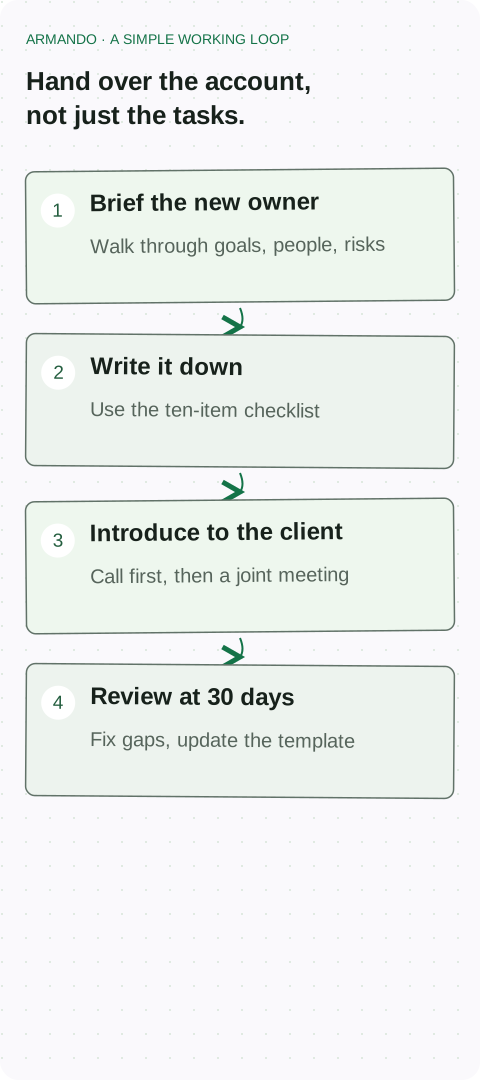
The introduction is the part of an account handover the client actually sees, so it deserves as much care as the document. A good introduction does three things. It tells the client what is changing and why, it shows that the new owner is already informed, and it makes it easy for the client to say what matters to them.
The best introductions happen in two steps. First, the previous owner tells the main contact by phone or in a short call, before any email. Clients dislike hearing about changes in a mass message. Second, a joint email or meeting follows, with both owners present, where the previous owner explicitly passes the baton and the new owner shows they have done their homework.
Avoid two common traps. Do not imply the client was handed over because they are less important, even when the new owner is more junior. And do not ask the client to explain the whole relationship again. Instead, say what you already understand and ask them to correct it. "I have read the history and understand the main goal is X and the Q4 priority is Y. Is that still right?" is much better than "Can you tell me about your business?"
If the change is sudden, be honest and brief. You do not need to explain why a colleague has left. Say who the new owner is, who the client can contact today, and what will happen in the next few days. Calm, specific reassurance beats a long apology.
- Call the main contact before sending any written announcement.
- Send a short introduction email that names the new owner and the date of the change.
- Hold a joint call or meeting where the previous owner introduces the new owner.
- Within a week, have the new owner share the priorities they have understood and ask for corrections.
COPY & ADAPT
Subject: Your new account lead from [date]

Hi [client name],

As we discussed on the phone, [previous owner] will be moving to [new role / other work] from [date], and [new owner] will be your main contact from then.

[New owner] has been through the account history, your goals for [priority] and the plan for this quarter, so you will not need to start from scratch. [Previous owner] will remain available for questions until [date].

Would [day or time] work for a 30-minute call with both of us? We will use it to confirm priorities and make sure nothing falls through the gaps.

Thank you for the trust you have placed in us.

[Previous owner]
The first 30 days after the handover
A handover is not finished when the document is signed. The first 30 days decide whether the client feels continuity or disruption. The new owner should have a simple plan for those weeks, and the previous owner should know what is expected of them while they remain available.
In week one, the aim is to avoid surprises. The new owner confirms every open deadline, attends the first client interaction alongside the previous owner, and checks that every login and report still works. In weeks two and three, the aim is to learn. They hold one-to-one conversations with the key stakeholders, read through recent emails and meeting notes, and update the handover document with what they find. In week four, the aim is to lead. They review the account plan with the client and propose any changes.
Keep a short list of questions for the previous owner and ask them in batches, so you respect their time while they transition to other work. Agree in advance that after the overlap period ends, questions go to the account manager's line manager or to the shared document.
| Period | Focus | What the new owner does | What the previous owner does |
|---|---|---|---|
| Days 1 to 3 | Avoid surprises | Confirms deadlines, access, and promises made but not delivered | Is present for the first client interaction and answers questions the same day |
| Days 4 to 10 | Listen | Reads recent emails and notes, and books a short call with each key stakeholder | Reviews the handover document and corrects gaps |
| Days 11 to 20 | Learn | Updates the document, sends the first status update in their own voice | Remains available for batched questions |
| Days 21 to 30 | Lead | Reviews the account plan with the client and agrees next priorities | Confirms the handover is complete and steps back |
Where account handover fits into B2B key account management
Key account management is the practice of giving your most important clients a named owner, a written plan and a regular rhythm. An account handover is the point where that practice is tested. If the knowledge lives only in a key account manager's head, the account is exposed every time that person changes role, takes leave or leaves the agency. If it lives in a key account plan, the account survives the change.
In B2B account management, this is why the handover document should not be a separate artefact. It should be a view of the account plan, the stakeholder map and the renewal calendar. When the plan is kept up to date, a handover becomes a short review rather than a rescue. The free Account plan generator can help you build the plan that a future owner will rely on.
Strategic account management adds one more consideration. For accounts that matter most, the relationship should not depend on one person at all. Introduce a second internal contact early, share the senior relationship between a founder and the account owner, and make sure at least two people on your side know the client's goals. Then a change of owner is a planned transition, not a risk.
A good account management strategy treats handovers as a normal part of how accounts run. Decide in advance who prepares the handover document, who approves it, and how long the previous owner stays available. Then every key account manager knows what is expected of them, and every client receives the same quality of transition.
A simple account management system for agencies ↗
B2B account management plan template ↗
- Keep a current account plan for every key account so a handover starts from facts.
- Name a second internal contact on each key account.
- Review the handover template once a year and update it with what you learned.
- Add a handover check to the renewal review for accounts that have changed owner.
Common account handover mistakes and how to avoid them
The most common mistake is leaving the handover to the last day. When it happens on a person's final afternoon, the previous owner is distracted, the new owner has no time to ask questions, and the client hears about the change from an automatic reply. Build the handover into the notice period, or into the first two days of a sudden change.
The second is handing over the tasks but not the relationship. A list of open work tells the new owner what to do, but not whom to talk to or how. Include the stakeholder list and a joint introduction, and ask the previous owner to speak to the main contact before the announcement.
The third is silence about risk. If the account is already wobbling, because a sponsor has gone quiet, a renewal is close or an invoice is disputed, say so plainly. The new owner who inherits a risk they did not know about will look careless in front of the client. Link the handover to your renewal risk review so warning signs travel with the account.
The fourth is no follow-up. Without a check at day 30, handovers quietly fade. Put a review in the calendar when the handover starts, ask the new owner what was missing, and fix the template. A handover that improves every time becomes a real asset.
Client renewal risk: 7 warning signs to spot 90 days out ↗
- Start the handover during the notice period, not on the last day.
- Pass on people and context, not only tasks.
- State known risks openly in the document.
- Hold a 30-day review and update the template.
Start with one account this week
- Decide whether the handover is planned, sudden or temporary.
- Set the handover date, the client introduction date and the end of the overlap period.
- Hold a briefing meeting between the previous and new owner.
- Complete the handover document using the ten-item checklist.
- Record the real decision-maker, the budget holder and every key stakeholder.
- List promises made but not yet delivered, with dates.
- State known risks and open issues plainly.
- Confirm that every login, folder and dashboard works for the new owner.
- Call the main client contact before sending any written announcement.
- Hold a joint introduction call or meeting.
- Book a 30-day review and update the template with what you learned.
Common questions
What should be in an account handover checklist?
Include the client's goals, the account plan, stakeholders with roles, commercial terms and renewal date, scope and open work, communication rhythm, promises not yet delivered, risks, history, and access to tools and files. Add honest blanks where you do not know the answer.
How long should an account handover take?
For a planned change, allow two to four weeks of shared ownership where you can. For a sudden change, capture the essentials in the first two days and keep the previous owner reachable. Temporary cover needs only a short note and a clear escalation route.
How do you introduce a new account manager to a client?
Call the main contact first, then send a short email naming the new owner and the date. Hold a joint call where the previous owner passes the baton. Show what the new owner already understands and ask the client to correct it.
What is the difference between account handover and client onboarding?
Onboarding starts a new client relationship from a blank page. Handover moves an existing relationship to a new owner, with history, promises and opinions already in place. The new owner must inherit that context without making the client repeat everything.
How does an account handover fit into key account management?
In key account management, the key account plan is what makes handover safe. When the plan, stakeholder map and renewal dates are current, the key account manager can change without disrupting the client. Strategic accounts should also have a second internal contact.