ACCOUNT MANAGEMENT · B2B AGENCIES
Weekly Account Review: A 30-Minute Internal Meeting Plan
Run a weekly account review in 30 minutes: agenda, scripts and a template to catch client risks early, assign next steps and keep every account owned.
Most agencies talk about their clients all day, yet very few have a set time to look at all of them together. Problems come up in a hallway chat or a Slack thread, someone says they will follow up, and a week later nobody remembers who. Then a client goes quiet, a renewal sneaks up, or a contact leaves and the team hears about it from a stranger on LinkedIn.
A weekly account review fixes this with a small habit. It is a 30-minute internal meeting, with no client present, where the people who look after your accounts go through them in a fixed order, decide what needs attention and leave with clear owners and dates. It is cheap, it needs no software, and it works for a team of three as well as a team of thirty.
This guide shows you how to run a weekly account review step by step. You will get a timed agenda, a copyable meeting template, a table of what to cover for each type of account, scripts for the awkward moments, and a list of common mistakes. If you have ever wished your team had a calm, repeatable way to stay on top of its clients, this is it.
What a weekly account review is, and what it is not
A weekly account review is a short, recurring internal meeting about your client portfolio. The team looks at each account that matters, asks what has changed since last week, and decides the next step. The output is not a discussion. The output is a list of actions with an owner and a date next to each one.
It is easy to confuse this meeting with others that already exist. It is not a client meeting, so you can speak openly about risk, price and people. It is not a project stand-up, which covers tasks and deadlines inside the work. It is not a financial review, although a few numbers may appear. And it is not a status round where everyone reads out what they did. The focus is the health of the relationship and the commercial direction of each account.
Why weekly? A month is long enough for a quiet client to become a lost one. A single week is short enough that most changes are still fresh, and short enough that you can keep the meeting to half an hour. If your team is very small, you can run it every two weeks, but weekly gives you the habit and the fast feedback loop.
Takeaway: the weekly account review exists to answer one question for every important client: what do we need to do this week to keep this account healthy and growing?
Why a weekly account review beats ad hoc check-ins
Without a fixed review, attention goes to whoever shouts loudest. The client with an urgent request gets time, while the quiet client with a leaving contact gets none. A shared weekly look gives every account a chance to be seen, including the ones nobody has complained about.
It also spreads knowledge. In many small agencies one person holds the whole picture of a client in their head. If that person is ill or on holiday, nobody else knows what was promised. A written weekly record means the picture belongs to the team and not to one memory.
Finally, it changes behaviour before the meeting even starts. When people know that every account will be discussed on Monday, they notice things during the week: a slow reply, a new name on an email, a question about the invoice. They bring those small signals to the review, which is exactly where you want them.
None of this needs special tools. A shared document or a simple spreadsheet is enough to begin. What matters is that the meeting happens at the same time every week and that the notes are kept in one place.
Want help putting this into practice? See how we can help
Who should attend and which accounts to review
Keep the room small. The people who own client relationships should attend: account managers, client partners, and the founder or head of delivery if they still look after accounts. Add a delivery lead when the work itself is part of the story. Four to six people is a good size. Beyond that, the meeting turns into a presentation and the half hour disappears.
Choose one person to run the meeting. This person watches the clock, moves things along, and makes sure each action gets a name and a date. They do not need to be the most senior. Rotating the role every month works well because everyone learns the structure.
You do not need to discuss every client every week. Split your accounts into tiers. Your top accounts, the ones that matter most for revenue or long-term potential, appear every week. Mid-sized accounts appear every second or third week unless something flags them. Small or low-touch accounts only appear when the team raises a concern. This tiering is what makes 30 minutes realistic.
A practical rule: if an account has a renewal in the next 90 days, a recent contact change, a payment issue or an open complaint, it goes on this week's list whatever its size.
- List all client accounts and mark your top accounts, the ones that get a slot every week.
- Mark mid-sized accounts for a rotation, for example every second week.
- Agree the triggers that pull any account onto the list: renewal in 90 days, contact change, complaint, late payment, scope dispute.
- Name the person who runs the meeting for this month.
The 30-minute weekly account review agenda, minute by minute
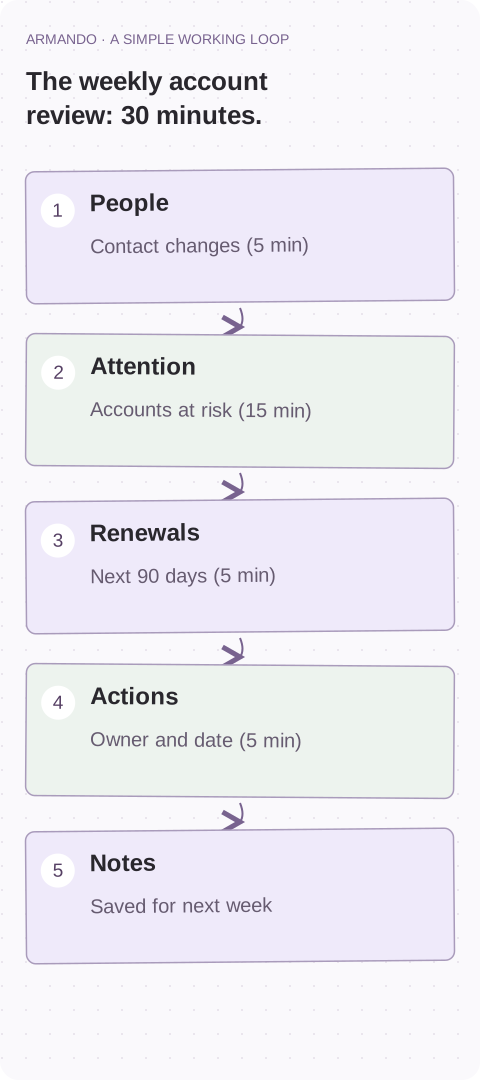
The strength of this meeting is its fixed shape. People know what is coming, so they prepare in five minutes and the discussion stays on track. The agenda below fits into 30 minutes and has five parts.
Minutes 0 to 5: people and contact changes. Did anyone join, leave or change role at a client? Did a sponsor move? Did anyone on our side change an account owner? These are the cheapest early warnings you have, so they come first. If a champion left, jump to the plan in our guide on what to do when a client champion leaves.
Minutes 5 to 20: accounts that need attention. This is the main block. Walk through the accounts on this week's list in order of risk, not alphabetically. For each one, the owner gives a single sentence on what has changed, the group says whether the account is green, amber or red, and the next step is named. Aim for about two minutes per account, so a list of six to seven accounts fits in fifteen minutes. If an account needs more, park it for a separate follow-up after the meeting.
Minutes 20 to 25: opportunities and renewals. Look ahead 90 days. Which renewals are coming? Where is there a natural chance to add scope, introduce a new service or ask for a referral? Only the accounts with something live are mentioned here.
Minutes 25 to 30: confirm the actions. The meeting leader reads back every action with its owner and date. Anything without both is either fixed on the spot or dropped. Then the notes are saved in the shared document, so the list is ready to review next week.
- 0 to 5 minutes: people changes at the client and on your side.
- 5 to 20 minutes: the accounts that need attention, about two minutes each.
- 20 to 25 minutes: renewals and opportunities in the next 90 days.
- 25 to 30 minutes: read back actions with owner and date, then save the notes.
What to check for each account in your account review
A good account review needs a short, consistent set of questions. If every owner answers the same questions, the team can compare accounts and spot patterns. The table below gives a simple set you can start with. Change the wording to suit your business.
Notice that the questions are about the relationship and the next step, not about the work in progress. Project details belong in your delivery meeting. If you want a numeric view, you can use a simple client health score for agencies and show it as green, amber or red in the review. If you only keep one column, keep the last one: the next step.
| Area | Question to ask | Signal that needs action |
|---|---|---|
| People | Has anyone at the client joined, left or changed role? | Your main contact is new, silent or leaving |
| Communication | When did we last speak to the main contact, and what was it about? | Longer than usual with no contact, or only reactive messages |
| Value | What did we deliver this month that the client noticed? | No clear result to point to |
| Money | Are invoices paid on time and is scope still within the agreement? | Late payment, unbilled extra work or a scope dispute |
| Risk | Has the client questioned the price, the results or the plan? | Any complaint, hint of comparison or cut in budget |
| Renewal | When does the contract end and who decides? | Renewal within 90 days and no plan |
| Growth | Is there a need we have not offered to help with? | A new problem mentioned but not followed up |
| Next step | What is the one action this week, who owns it, and by when? | Action has no owner or date |
A copyable weekly account review template
You do not need a tool to start. Copy the template below into a shared document, make one page per week, and fill it in during the meeting. Keeping the same layout every week makes it easy to compare this week with last week and to see which actions keep getting pushed back.
Use short sentences. If the notes become long, the meeting is probably doing work that belongs elsewhere, such as planning a campaign or writing a proposal. The review decides what to do and who does it. The doing happens after the meeting.
COPY & ADAPT
Weekly account review: [date]
Run by: [name]   Attendees: [names]

1. People changes (5 min)
- Client side: [who joined, left or changed role]
- Our side: [owner changes, holidays, workload]

2. Accounts that need attention (15 min)
Account: [name]   Owner: [name]   Status: [green / amber / red]
- What changed since last week: [one sentence]
- Risk or concern: [one sentence, or none]
- Next step: [action]   Owner: [name]   Due: [date]

Account: [name]   Owner: [name]   Status: [green / amber / red]
- What changed since last week: [one sentence]
- Risk or concern: [one sentence, or none]
- Next step: [action]   Owner: [name]   Due: [date]

3. Renewals and opportunities in the next 90 days (5 min)
- [Account]: [renewal date or opportunity]   Next step: [action]   Owner: [name]

4. Action read-back (5 min)
- [Action]   [Owner]   [Due date]
- [Action]   [Owner]   [Due date]

Carried over from last week and still open: [list]
Park for a separate conversation: [topic and who]
What to say: scripts that keep the account review on track
A short meeting depends on a few phrases that the person running it can use again and again. Here are the ones that help most. They are written for a calm, friendly team, and you can adjust the tone to fit yours.
To start: "We have thirty minutes, five parts, and everyone gets a turn. Let's begin with any changes in people at our clients." This sets the pace and reminds everyone of the order.
To keep an account update short: "Give us the one change, the status and the next step." Most people want to tell the whole story. This phrase gives them a form to follow, and the details can come after the meeting.
To park a long discussion: "This needs more time than we have. Can [name] and [name] take it offline today and report back at the next review?" The key is to name the people and the time, otherwise parked topics are quietly forgotten.
To challenge a vague status: "What would make this account red?" Teams often call an account green because nothing has gone wrong, not because anything has gone right. This question makes people look for the real risk.
To close an action: "Who owns this, and by when?" Say it every time. Within a few weeks the team starts to answer before you ask, and that is the sign the habit has taken hold.
Where the weekly review fits into B2B key account management
Key account management is the practice of giving your most important clients a named owner, a plan and a regular rhythm, instead of treating every client the same. In B2B agencies it usually applies to a short list of accounts, and the person who looks after each one is the key account manager.
The weekly account review is the rhythm part. A key account plan describes where you want an account to go, but a plan on its own sits in a folder. The weekly review is where the plan meets real life: someone says the sponsor has been quiet, someone else remembers the renewal date, and the team decides what to do about both. In that sense it is the smallest working unit of B2B key account management.
Strategic account management adds a longer view. Alongside the weekly check, you ask once a quarter whether the account is still the right size, whether the plan still fits and whether you have relationships at enough levels. The weekly meeting feeds that longer conversation with a steady stream of short notes.
To begin, take your five or ten most valuable accounts and give each one a key account manager and a one-page key account plan. Our free Account plan generator can help you draft that plan in about half an hour. Then use the weekly review to keep each plan alive. You can read how this fits into B2B account management as a whole in the simple account management system guide and the B2B account management plan template.
A simple account management system for agencies ↗
B2B account management plan template ↗
How to write an account plan in 30 minutes ↗
- List your key accounts and name one key account manager for each.
- Write a one-page key account plan for each, using the Account plan generator if you want a quick start.
- Put the key accounts on the agenda every week.
- Each quarter, use the notes from the weekly reviews to update the plan.
How to start your weekly account review and keep it going
The first few sessions will feel clumsy, and that is normal. People will not have the information at hand, the list will be too long, and someone will want to turn it into a project meeting. Expect that and keep going. A rough weekly meeting is far more useful than a perfect one that never happens.
A simple four-week start works well. In week one, run the meeting with only your top accounts and use the template as it is. In week two, add the trigger rules, so any account with a renewal in 90 days or a contact change appears automatically. In week three, begin to track how many actions from last week were done, and read that number out at the start. In week four, ask the team what to change: the time, the length, the questions, the format.
Pick a slot that does not move. Monday morning is popular because it sets the week, but Thursday afternoon also works if your team prefers to prepare on Wednesday. What matters is that it is fixed and protected. If the meeting is cancelled whenever work gets busy, you will lose it exactly when you need it most.
Finally, review the review. Once a quarter, spend ten minutes asking whether the meeting still earns its half hour. Are risks being found earlier? Are fewer things falling through the gaps? If the answer is no, change the structure. If the answer is yes, leave it alone.
How to assign managers to client accounts ↗
- Week 1: run the meeting for your top accounts only, using the template.
- Week 2: add the trigger rules for renewals and contact changes.
- Week 3: report how many of last week's actions were completed.
- Week 4: ask the team what to change, then keep the slot fixed.
Common mistakes in a weekly account review
Turning it into a status read-out. If everyone takes five minutes to say what they did, the half hour is gone and nothing has been decided. Ask for one change, one status and one next step.
Reviewing only the loud accounts. The clients who send urgent emails are not always the ones at risk. Use the tiers and triggers so quiet accounts with a renewal or a contact change still get seen. Our guide to client renewal risk warning signs lists what to watch for.
Leaving actions without owners. An action that belongs to the team belongs to nobody. Read back every action with a name and a date at the end.
Letting it grow. Meetings expand to fill the time they are given. If you find yourself at 45 minutes, cut the list, not the agenda. Park long topics for a separate conversation.
Not writing it down. If the notes live in people's heads, you have a chat, not a review. Save the page every week and open last week's page at the start.
Treating green as good. An account can be green because the team has not looked hard. Ask what would turn it red, and check that you know more than one person at the client. If you only know one, read our guide on single-threaded accounts.
Client renewal risk: 7 warning signs to spot 90 days out ↗
Single-threaded accounts: what to do when you know only one person ↗
Start with one account this week
- Pick a fixed weekly slot of 30 minutes and protect it from cancellations.
- Name the person who runs the meeting and rotate the role monthly.
- Tier your accounts so top accounts appear weekly and others by rotation or trigger.
- Use the same five-part agenda: people, attention, opportunities, read-back, notes.
- Give every account a status of green, amber or red and one next step.
- Read back each action with an owner and a due date before the meeting ends.
- Save the notes in one shared place and open last week's page at the start.
- Review the meeting itself once a quarter and change what is not working.
Common questions
What is a weekly account review?
A weekly account review is a short internal meeting, usually 30 minutes, where the team goes through its important client accounts. It covers contact changes, risks, renewals and opportunities, and ends with named actions, owners and due dates for the week.
How long should an account review meeting take?
Thirty minutes is enough for most small and mid-sized agencies if the agenda is fixed and the list is tiered. If the meeting regularly runs longer, shorten the list of accounts rather than the agenda, and move long discussions into a separate follow-up.
Who should attend a weekly account review?
The people who own client relationships should attend: account managers, client partners and the founder or head of delivery if they look after accounts. Add a delivery lead when needed. Four to six people works best, with one person running the clock.
How many accounts can you review in 30 minutes?
Plan on about two minutes per account in the attention block, so six or seven accounts fit in fifteen minutes. Review top accounts every week and others by rotation or trigger, such as a renewal in 90 days or a contact change.
How does a weekly account review relate to key account management?
Key account management gives important clients a named key account manager and a key account plan. The weekly review is the rhythm that keeps those plans alive, because it checks risks, people and next steps on every key account each week. It supports strategic account management over time.
What is the difference between an account review and a QBR?
A weekly account review is internal and short, and it asks what the team should do now. A quarterly business review is held with the client and looks back at results and forward at goals. The weekly notes help you prepare a better quarterly review.