ACCOUNT MANAGEMENT · B2B AGENCIES
Stakeholder map for client accounts: a 6-step method
Build a stakeholder map for a client account in 30 minutes: roles, a power and interest grid, relationship ratings, a template to copy and next actions.
A stakeholder map is a one-page picture of the people who decide whether a client keeps working with you. Most agencies carry this picture in the account manager's head. It works until that person goes on holiday, changes job, or simply misses the fact that the budget owner has stopped reading the reports. Then a renewal that looked safe turns out to rest on one contact who has no power to sign.
This guide shows you how to build a stakeholder map for a client account in about 30 minutes. You will list the people involved, tag their roles, place them on a power and interest grid, rate your relationship with each one, and turn every gap into a small, dated action. There is a table of roles, a worked example with a fictional client, a template you can copy, and a quarterly routine that keeps the map honest.
You do not need a CRM, an org chart tool or any special software. Agencies sell services, so the people that matter are usually a handful of names you already know, plus two or three you have never met. If you would rather skip the blank page, the free Stakeholder map generator on this site structures the list for you and shows where the gaps are.
What a client stakeholder map is, and when you can skip it
A client stakeholder map lists every person who has a stake in your work for one client, and records three things about each: what role they play, how much influence they have, and how strong your relationship with them is. You will also hear it called stakeholder mapping, a stakeholder analysis, an account map or a buying committee map. The names differ, but the job is the same: make the people side of an account visible, so you can see it and talk about it as a team.
It is different from a project stakeholder map. On a project you map people to manage a launch, a change or a risk. On a client account you map people to protect and grow a relationship over many months. The same person can matter for different reasons: a finance director may have no interest in your creative work but full power over the renewal.
Here is when a map earns its time. Use it for every account that carries meaningful revenue, for any account where you only know one or two people, before a renewal, before a price rise, and when a new account manager takes over. Skip the full exercise for very small, one-off projects where there is one contact who is also the buyer and the user. A five-line note is enough there.
The map is a working document, not a trophy. If nobody opens it after the day you build it, it has failed. Keep it short enough that an account manager can read it in two minutes before a call.
The roles to look for when you map stakeholders on an account
Job titles are a poor guide to who matters. A marketing coordinator can be the person who decides whether your reports are read, and a managing director can be someone who has not opened your deck in a year. So tag people by the role they play in the account, not by their title. One person can hold several roles, and the roles change over time.
Start with the sponsor, also called the economic buyer. This is the person who owns the budget and can cancel it. Then the decision maker for day-to-day choices, who is often a different person. The champion is someone inside the client who actively speaks well of you when you are not in the room. Users are the people who work with your output every week. Influencers are people whose opinion carries weight without a formal say, such as a trusted adviser, a procurement lead or an internal expert. Gatekeepers control access to others, like an executive assistant. And sceptics, sometimes called blockers, are people who doubt the value of the work or prefer another supplier.
Every account has most of these roles, even if you cannot name the person yet. An empty role is useful information. If you cannot name the sponsor, that is the first gap on the map. If you can name only a champion, you are probably relying on one friendly person, and that is a risk you can see and plan for.
Use the table below as a starting list and rename the roles to match your own accounts. Keep the descriptions short. The point is that everyone on your team uses the same words.
| Role | What they do for the account | What they usually care about | What they need from you |
|---|---|---|---|
| Sponsor (budget owner) | Approves spend and renewal | Return on spend, risk, how the work reflects on them | Short, honest progress against their goals, twice a year at least |
| Decision maker | Makes day-to-day choices about scope and priorities | Speed, clarity, no surprises | Clear options and a recommendation, not a menu |
| Champion | Advocates for you inside the client | Looking good to their own boss | Material they can forward, early notice of problems |
| User | Works with your output every week | Ease of use, fewer errors, less work for them | Fast answers and training that fits their time |
| Influencer | Shapes opinion without a formal vote | Quality, reputation, fit with their own area | A fair hearing and context they can trust |
| Gatekeeper | Controls access to calendars and information | Protecting their executive's time | Respect, advance notice and short requests |
| Sceptic or blocker | Doubts the value or prefers another route | Evidence, past disappointments, internal politics | Listening first, then proof that answers their specific concern |
Want help putting this into practice? See how we can help
How to build a stakeholder map for a client account in six steps
Block 30 minutes and bring the account manager plus one person who has worked on the account, if you can. Two views catch more than one. Have the contact list, the last three meeting notes and the contract open, because the contract usually names the signatory and the notice period.
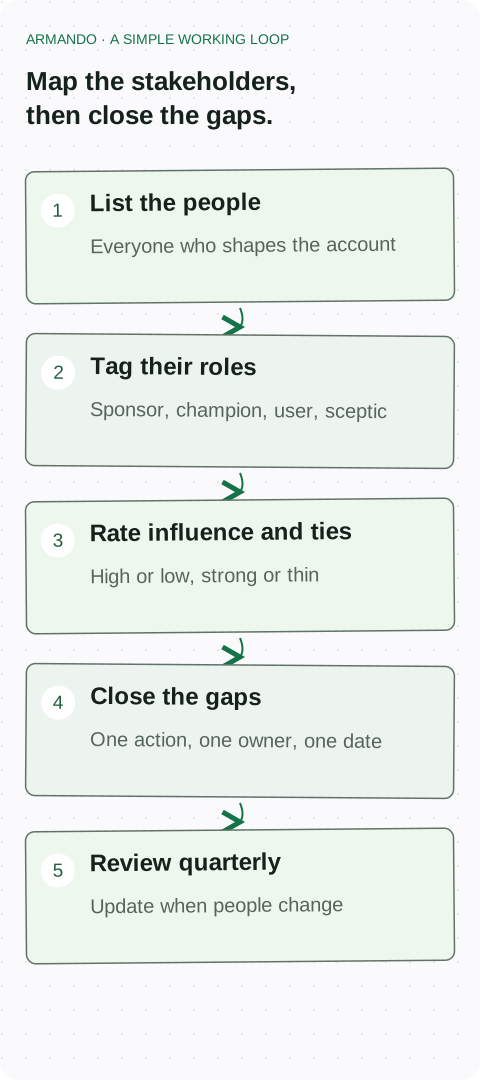
Work through the steps in order. Do not try to be perfect. A map with eight names and four honest question marks is far more useful than a map with twenty names that nobody trusts. Mark anything you are guessing with a question mark so the team can see what is fact and what is assumption.
When you finish, read the map aloud as if you were briefing a new colleague. If a sentence sounds wrong, such as "the sponsor is probably happy", change it to what you actually know: "we have not spoken to the sponsor since March". That one change is often the whole value of the exercise.
The template below is a plain text version you can paste into a document, a spreadsheet or your account plan. The free Stakeholder map generator turns the same fields into a formatted one-page map.
B2B account management plan template ↗
- List every person you have dealt with in the last six months, then add the people you know exist but have never met.
- Tag each person with one or more roles: sponsor, decision maker, champion, user, influencer, gatekeeper or sceptic.
- Rate each person's influence over the account and their interest in your work, high or low.
- Rate your relationship with each person as strong, thin or none, and mark their stance as supporter, neutral, sceptic or unknown.
- Circle the gaps: empty roles, high-influence people you barely know, and sceptics nobody is handling.
- Write one action for each gap, with an owner and a date, and store the map in the account plan.
COPY & ADAPT
Stakeholder map: [client]
Updated: [date]    Account owner: [name]
Contract end / notice date: [date]

Person: [name], [title]
Role(s): [sponsor / decision maker / champion / user / influencer / gatekeeper / sceptic]
Influence: [high / low]    Interest in our work: [high / low]
Our relationship: [strong / thin / none]    Last real contact: [date]
Stance: [supporter / neutral / sceptic / unknown]
What they care about: [one line]
Our owner for this person: [name]
Next action: [what] by [date]

(Repeat for each person.)

Gaps to close this quarter:
1. [role or person] - action: [what] - owner: [name] - date: [date]
2. [role or person] - action: [what] - owner: [name] - date: [date]
Stakeholder analysis: the power and interest grid for client accounts
The most common tool in stakeholder analysis is a two-by-two grid with power (or influence) on one axis and interest on the other. It sorts people into four groups and tells you how much effort each deserves. It is also called an influence and interest matrix. You do not need to draw it; two ratings per person, high or low, are enough.
For client work, read "power" as influence over whether the account stays, grows or shrinks, and "interest" as how much the person cares about what you deliver. High power with high interest are your key players: sponsors and close decision makers. They get your best time, direct contact and early news. High power with low interest are the people who can end the contract but rarely look at your work, often a finance lead or a senior executive. Keep them informed with short, sparing updates on outcomes and money, and do not wait for a crisis to introduce yourself.
Low power with high interest are your users and many champions. They are valuable because they notice problems first and carry your reputation into meetings you will never attend. Keep them involved and give them what they need to do their job. Low power with low interest need only light monitoring: a copy on a report or an occasional hello.
One caution. The grid is a snapshot, and people move. A user who gets promoted becomes a decision maker. An executive who sees a bad invoice becomes interested overnight. Re-rate whenever something changes, and always rate the influence you have seen, not the influence the org chart suggests.
| Group | Influence / interest | Typical people | How to engage |
|---|---|---|---|
| Key players | High / high | Sponsor, senior decision maker | Direct contact, regular reviews, early news, a joint plan |
| Keep satisfied | High / low | Finance lead, senior executive | Brief outcome and cost updates, an introduction before you need one |
| Keep involved | Low / high | Users, champions, project leads | Frequent working contact, training, quick answers, material to forward |
| Monitor | Low / low | Peripheral teams, occasional approvers | Light touch: copy on reports and an occasional check-in |
- Give each person a high or low rating for influence over the account.
- Give each person a high or low rating for interest in your work.
- Place them in one of the four groups and write the engagement approach next to their name.
- Check that every high-influence person has an owner on your team and a contact date in the diary.
Rate relationship strength and stance, not just influence
Influence and interest describe the client's side. A useful stakeholder map also describes yours. For each person, record how strong your relationship is and where they stand on you and your work. These two ratings are what turn a list of names into a plan.
Relationship strength has three levels. Strong means you have spoken in the last 60 days, you know what they care about, and they would take your call. Thin means you have met, but contact is rare or only formal. None means you have never had a real conversation. Be strict. A name on an email thread is not a relationship.
Stance has four values: supporter, neutral, sceptic and unknown. Unknown is a legitimate answer and often the most important one. The danger is not the sceptic you know about, it is the person you assumed was neutral. If you have not heard them say anything about the work, write unknown.
Now the map shows where the risk is. A high-influence person with a thin relationship and an unknown stance is a gap to close this month. A sceptic with a strong relationship is a conversation to have, because you can hear the objection directly. A champion who is the only strong relationship on the account is a single point of failure.
Here is a short worked example with a fictional client, to show how the ratings read together. It is invented to show the method and is not real client data.
| Person (fictional) | Role | Influence / interest | Relationship and stance | Next action |
|---|---|---|---|---|
| Head of Marketing | Decision maker, champion | High / high | Strong, supporter | Ask for an introduction to the finance director |
| Finance Director | Sponsor | High / low | None, unknown | Request a 20-minute outcomes briefing before renewal |
| Marketing Manager | User | Low / high | Strong, supporter | Agree a monthly working session |
| Procurement Lead | Influencer | High / low | Thin, neutral | Send contract terms and a plain pricing summary early |
| Sales Director | Sceptic | High / high | Thin, sceptic | Book a call to hear the objection and offer proof |
How to find the stakeholders you have not met yet
Every honest first draft of a stakeholder map has blanks. The sponsor is a title without a name, or a name without a conversation. Closing those blanks is the most valuable part of the work, and it usually does not need a clever tactic. It needs a direct, polite question.
Ask your champion. A good champion will tell you who else matters if you ask it plainly: "Who else should we make sure we are keeping informed on this?" or "Who signs off on the budget for this work?" Frame the question as protecting their project, not as going around them. Most people are happy to help when they understand you are trying to serve the account better.
Ask in meetings. At the start of a review, invite attendees to introduce their role and what they hope to get from the session. Look at who else is copied on invoices, contracts and escalations. Read the signature blocks on forwarded emails and check who the contract names. These sources turn up a surprising number of quiet influencers.
Ask in a structured way. Kick-off calls and review meetings are natural places to ask: "Who else is affected by this work? Who will see the results? Who would you want us to brief?" Write down the names as they come, even if the answer is vague.
Respect the client's structure. Do not skip your main contact to reach a more senior person without a good reason and a heads-up. Ask for the introduction, explain what you want to share, and keep it short. If the champion hesitates, ask what concern is behind it. That answer is itself a piece of the map.
- Ask your champion who else needs to be informed or approves the budget.
- Check the contract, the invoices and the email copy lists for names you do not have.
- Add a "who else should be in this room" question to your next review meeting.
- Request one introduction per quarter to a high-influence person you barely know.
COPY & ADAPT
Hi [name],
I would like to make sure we are keeping the right people informed about [project/results]. Who else on your side should see the progress, and who signs off on the budget for this work? If it is helpful, I can send you a short summary you could forward, or join a 15-minute call to brief them directly.
Thanks,
[your name]
Turn the stakeholder map into an engagement plan
A map without actions is a poster. Once the ratings are on the page, convert every gap into one small action, and keep each action specific enough that someone can tick it off. This is your stakeholder engagement plan, and it should fit on the same page as the map.
Match the action to the gap. For a sponsor you barely know, ask for a 20-minute outcomes briefing and send a one-page summary of results beforehand. For a user who is a strong supporter, give them something to share upward, such as a short win written in their language. For a sceptic, start by listening. Ask what they would need to see to feel confident, then answer that and only that. For a gatekeeper, make requests short and give notice.
Use plain wording when you speak to people. You do not need to say you are mapping them. Say what is true: "I want to make sure the right people see the results." Never share the map itself with the client, and never write opinions about individuals that you would not be comfortable seeing on a screen in the room.
Limit yourself to three to five actions per account per quarter. Anything more will not happen. Assign each to a named person on your team, and put the dates in the shared calendar. Then add a line to the account plan so the actions get reviewed with everything else.
How to build B2B client relationships ↗
- Choose the three to five most important gaps on the map.
- Write one action per gap, with an owner and a date.
- Prepare the one-page summary or the talking points for each conversation.
- Add the actions to the account plan and review them in the weekly account meeting.
COPY & ADAPT
Request for an outcomes briefing
Hi [name],
I work with [champion] on [project]. Over the last [period] we have [one-line result]. I would like to give you a 20-minute summary of what has changed and what we plan next, so that you have the full picture when you review [budget/renewal]. Would [day] or [day] work?
Best,
[your name]
Keep the stakeholder map current: a quarterly routine and a privacy check
A stakeholder map goes stale faster than most documents because people change roles, leave and join. Set a routine so that it is checked at the moments when it matters, and not only when someone remembers.
Review it quarterly for key accounts and twice a year for the rest. Review it immediately when something changes: a contact leaves, a new executive arrives, the client is acquired, a complaint comes in, a renewal date moves, or a handover happens. During the review, ask four questions. Who is new? Who has left or changed role? Has anyone moved on the stance rating? Are all the actions done, and if not, why not?
Treat the map as a handover document. When a new account owner takes over, the stakeholder map is the fastest way to bring them up to speed. It shows who to call first and what to avoid. Pair it with your account handover checklist so nothing is lost.
On privacy: keep the map to business facts. Record names, roles, contact history, working preferences and the stance on the work. Do not record sensitive personal information, health details, family details or anything you would be uncomfortable showing the person. Store the map only in systems your team already uses for client data, restrict access to people who need it, and follow your own data protection policy. If you are unsure what to hold, ask your data protection lead.
Account handover checklist: what the next owner needs ↗
- Put a quarterly stakeholder review in the calendar for each key account.
- Update the map after any change of contact, role or ownership.
- Check the four review questions and close or re-date any open actions.
- Keep the map to business facts and restrict who can edit it.
Where a stakeholder map fits into B2B key account management
Key account management is the practice of giving your most important clients a named owner, a written plan and a regular rhythm of reviews. In B2B account management, a small number of accounts usually carry a large share of revenue, so they deserve more deliberate attention than the rest. The person responsible is the key account manager.
The stakeholder map is the people layer of a key account plan. A plan says where you want the account to go. The map shows who can take it there, who can stop it and who you do not yet know. Without the map, a plan quietly assumes the sponsor is on side. With it, you can see the assumption and test it.
Strategic account management goes beyond the next renewal. It looks at the client's wider goals, the other teams you could help, and the people you need across the organisation to do that. Your account management strategy therefore needs relationships at several levels, not only one friendly contact. A key account with one strong relationship and four question marks is exposed, whatever the revenue says.
You do not need a large team to start. Map your five to ten key accounts first. Use the free Account plan generator to give each one a written plan, and link every gap on the stakeholder map to an action in that plan. The simple account management system guide on this site shows how the map, the health score and the plan fit together.
A simple account management system for agencies ↗
B2B account management plan template ↗
- Pick your five to ten key accounts by revenue, strategic value or growth potential.
- Give each a named key account manager and a stakeholder map.
- Link each gap on the map to an action in the key account plan.
- Review the maps for all key accounts with the founder once a quarter.
Common mistakes when you map stakeholders on a client account
Mapping only the people you like. It is natural to list the friendly contacts first. The map needs the sceptics, the quiet approvers and the people who never reply. If everyone on your map is a supporter, you have not finished.
Trusting titles. A director who has no budget is not a sponsor, and an analyst who writes the recommendation might be the real decision maker. Test titles against what you have seen happen, such as who approved the last invoice or who changed the last brief.
Treating the map as secret gossip. The map is a professional tool. Write only what you would be comfortable with the person reading, and keep it to roles, influence, relationship and stance. Opinions about character and personal life do not belong on it.
Mapping once and forgetting it. A map dated a year ago is worse than none, because it feels like knowledge. Put the review in the calendar and check the date when you open the file.
Relying on a single champion. If your only strong relationship leaves, you start again. Aim for at least two strong relationships on every key account, and one at sponsor level.
Collecting names without actions. Every gap needs an owner and a date. If you cannot think of an action, write the question you would need to answer first, such as "find out who signs the renewal".
Using the map to go around people. The map is for understanding, not for bypassing your main contact. Ask for introductions openly, and remember that trust takes years to build and one avoided conversation to damage.
Start with one account this week
- List everyone you have dealt with in the last six months, plus the people you know exist but have not met.
- Tag each person with one or more roles.
- Name the sponsor, or write "unknown" and make it the first action.
- Rate influence and interest as high or low for each person.
- Rate your relationship as strong, thin or none, using the 60-day contact rule.
- Mark stance as supporter, neutral, sceptic or unknown, and use unknown honestly.
- Check that at least two people have a strong relationship with you, one at sponsor level.
- Write one action with an owner and a date for each gap.
- Keep the map to business facts and restrict who can edit it.
- Add the map and its actions to the account plan and set a quarterly review.
Common questions
What is a stakeholder map?
A stakeholder map is a one-page picture of the people who have a stake in an account or project. For each person it records their role, their influence, their interest and the strength of your relationship, so you can see who matters and where the gaps are.
How do you map stakeholders on a client account?
List everyone involved, tag their roles, rate influence and interest as high or low, rate your relationship and their stance, then write one action for each gap. A first version takes about 30 minutes and should be reviewed every quarter.
What is the difference between stakeholder mapping and stakeholder analysis?
Stakeholder mapping is the visual part: who the people are and how they relate to the account. Stakeholder analysis is the thinking behind it: assessing each person's influence, interest and stance. You do both when you build a map and rate the people on it.
How often should you update a stakeholder map?
Review the map every quarter for key accounts and twice a year for others. Update it straight away when a contact leaves, a new executive arrives, the client is acquired, a complaint is raised or the account changes hands.
What is the best way to find the real decision maker?
Ask your champion who signs off the budget, then check the contract, invoices and email copy lists. Test titles against behaviour, such as who approved the last invoice or changed the last brief. If you still cannot tell, request an introduction.
How does a stakeholder map help with key account management?
In key account management, the stakeholder map shows the people behind a key account plan. It reveals single-threaded relationships, missing sponsors and unhandled sceptics, so the key account manager can build the multi-level relationships that strategic account management relies on.