RETENTION · B2B AGENCIES
Client Retention Strategies for Agencies: 9 That Work with B2B Accounts
Nine client retention strategies for agencies and service firms, each with what to do, a table to prioritise them and an AI prompt. Built for B2B key accounts.
Be honest: if your biggest client sent a "let's talk" email tomorrow, would you be surprised? :)
Most agencies lose clients the same quiet way. Nothing explodes. The results stay fine, the calls get shorter, the sponsor changes jobs, and one day the budget goes somewhere else.
This guide covers nine client retention strategies for agencies and service firms, written for B2B key accounts, not shops and subscriptions. Each one comes with what to do, where it fits, a table to help you choose and a prompt for your AI assistant. We built a software agency from zero to 110 people and exited, so this guide is written from the agency side.
The client we kept the longest and grew the most was a large US client, one of the Big Four. We worked with them for more than two years and grew from 3 people to about 10, then got stuck, because we only talked when there was code to discuss.
What changed it was account management. We flew to the US to meet them face to face. After that we met regularly: founders, project managers and sales. We gave value beyond code, and even sent a bottle of wine now and then. Almost 30 people ended up working on that account, and the client proposed the expansion himself.
And the one we lost? Everything was delivered, and nobody talked about their business. Budget cuts surprised us. Six to twelve months of conversation would have given us time for a recovery plan.
What is client retention?
Client retention is how many of your clients stay with you over a period of time. For an agency it also includes how much of their spend you keep, which is why it connects to metrics like retention rate and net revenue retention.
Search for the term and you'll find mostly advice for shops, apps and subscriptions: loyalty programmes, discounts, email flows. That doesn't help when you have twenty clients, a retainer and one decision-maker. B2B retention is about relationships, results and timing.
If you want the numbers first, read churn rate vs retention rate for agencies and net revenue retention for agencies. This page is about what to do.
Takeaway: B2B retention is relationships, results and timing.
Churn Rate vs Retention Rate for Agencies: Formulas ↗
Net Revenue Retention for Agencies: Formula + Example ↗
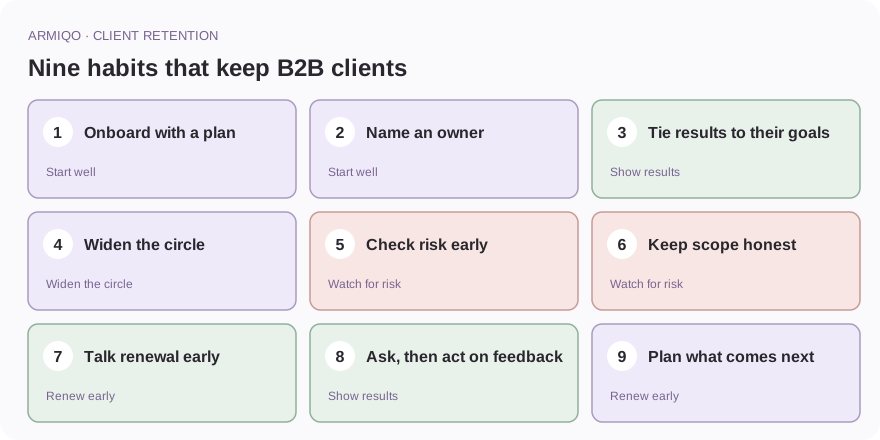
The nine strategies at a glance
| # | Strategy | When it matters most | First step |
|---|---|---|---|
| 1 | Onboard with a plan | First 90 days | Agree goals and a 30-day review |
| 2 | Name an owner for every account | Always | One person, one backup |
| 3 | Tie results to their goals | Every month | Report against their priorities |
| 4 | Widen the circle | Single contact | Meet a second stakeholder |
| 5 | Check risk early | Quarterly | Score your top ten accounts |
| 6 | Keep scope honest | Retainers | Write what is included |
| 7 | Talk renewal early | 90-120 days before | Book the conversation now |
| 8 | Ask for feedback and act | Twice a year | Ask one useful question |
| 9 | Plan what comes next | Every quarter | Propose one next step |
Takeaway: pick the strategies that fit your weakest accounts, not all nine at once.
Want help putting this into practice? See how we can help
1. Onboard with a plan
The first 30 days set the tone. A client who sees an early win and knows what happens next is much less likely to wander.
- Agree goals in the client's words.
- Agree how you will measure success.
- Book the 30-day review before the work starts.
Our client onboarding checklist and the guide to B2B client onboarding give you the steps.
Takeaway: onboarding is the cheapest retention you'll ever do.
B2B client onboarding: a practical first-90-days checklist ↗
2. Name an owner for every account
Accounts without an owner drift. Everyone assumes someone else is watching.
- One account lead for each key client, with a named backup.
- Their job: goals, health, renewal date and next step.
- When the lead leaves, run a proper handover, not a forwarded inbox.
If you don't have an owner model yet, see how to assign managers to client accounts.
Takeaway: if everyone owns the client, nobody does.
Should you assign a PM to a client account? Product vs project roles ↗
3. Tie results to their goals
Clients don't renew deliverables. They renew progress against their own priorities.
- Report against the goals they told you, not the tasks you did.
- Show one number per goal, one sentence of meaning and one next step.
- Be honest about what slipped, early, with a fix.
A QBR is the best place to do this every quarter.
Takeaway: report on their goals, not your tasks.
4. Widen the circle
If one person is your whole relationship, one resignation can end the account.
- Map who decides, who uses the work, who pays and who can block.
- Aim for at least two real relationships per key account.
- Add the second contact to the regular meeting rhythm, not just to the CC line.
The stakeholder map and the guide to single-threaded accounts show how.
Takeaway: two relationships beat one, every time.
5. Check risk early
Don't wait for the cancellation email. Look at the signals while you can still act.
- Score each key account on a few simple signals: results, contact frequency, sponsor stability, payment, feedback.
- Look at your top ten every month.
- For each amber or red account, write one next step with an owner and a date.
Use the client health score and the list of renewal risk warning signs. Signals are probabilities, not verdicts. Use them to pick a conversation, not to make a prediction.
Takeaway: look for risk monthly, while it's still cheap to fix.
6. Keep scope honest
Unchecked scope growth makes good clients expensive and good people resentful.
- Write down what each retainer includes.
- Name extra requests out loud and choose: say yes once, trade, price or decline.
- Review hours in and hours out every month.
Our guide to scope creep with existing clients has scripts you can use.
Takeaway: a fair scope protects the relationship and the margin.
7. Talk renewal early
By the time a renewal date is close, the decision is mostly made. The conversation that matters happens months earlier.
- Put the renewal date in the account plan with a reminder at 120 and 90 days.
- Ask: "What would make this an easy yes next year?"
- Bring a proposal for what comes next, not just a repeat of this year.
Our proposal template for consulting services shows how to structure it.
Takeaway: talk about renewal before the client has to.
Proposal Template for Consulting Services: Pilot, Expansion, Renewal ↗
8. Ask for feedback and act on it
Feedback only helps when something changes after you ask.
- Ask one useful question twice a year, not a long survey once.
- Share what you heard and what you'll change.
- Follow up on the change in your next meeting.
A good question: "What's one thing we could do that would make this work better for you?"
Takeaway: ask, listen, change one thing, and say so.
9. Plan what comes next
Accounts that stand still feel like they're ending. Clients stay when the work keeps getting more useful.
- Propose one next step each quarter, tied to a goal.
- Keep a list of ideas in the account plan, not in your head.
- Expand only where the account is healthy.
See B2B account expansion for how to do it without pushing.
Takeaway: a clear next step is the best reason to stay.
B2B account expansion: grow agency clients without pushing an upsell ↗
Which two to start with
| If you see this | Start with |
|---|---|
| One contact controls everything | 4 (widen the circle) and 2 (name an owner) |
| Good work, but the client seems distant | 3 (tie results) and 8 (feedback) |
| Hours keep growing, margin is shrinking | 6 (scope) |
| Renewals arrive as a surprise | 7 (renewal) and 5 (risk) |
| New clients churn in the first year | 1 (onboarding) |
| Everything is fine but growth is flat | 9 (what comes next) |
You don't need a big programme. Two habits, done every month, beat nine done once.
Takeaway: two habits, every month.
A 30-minute monthly retention review
You don't need a dashboard. You need a list and thirty minutes.
COPY & ADAPT
Client | Owner | Health (green/amber/red) | Renewal date | Biggest risk | Next step | Due
- List your top ten clients by revenue.
- Fill each row from your notes and the latest health signals.
- Mark amber and red accounts.
- For each, write one next step, an owner and a date.
- Check last month's steps: done, moved or dropped?
Takeaway: ten accounts, thirty minutes, one next step each.
Use AI to plan your retention work
AI helps you organise and phrase. It cannot know your clients, so give it facts and ask it to flag gaps.
COPY & ADAPT
You are an account management lead at a B2B agency.
Here are my top accounts: [client | monthly revenue | owner | renewal date | main contact(s) |
last result shown | known risks | last conversation date].
For each account: (1) give a health rating (green/amber/red) with the reason from my facts only,
(2) suggest one retention step from this list: onboarding fix, name an owner, tie results to goals,
widen the circle, risk check, scope reset, renewal talk, feedback, next step,
(3) write a one-line message I could send this week.
Then list the three accounts I should call first and why.
Do not invent facts or numbers. Mark anything unclear as "To confirm".
Check the output against your own notes before acting. The free customer health score builder uses the same approach.
Takeaway: AI organises, you decide.
Where retention fits into B2B key account management
In B2B key account management, retention is the result of everything else: a good plan, a clear owner, the right stakeholders, honest scope and regular proof. Each key account should have a goal, an owner, a renewal date and a next conversation.
Treat retention as a monthly routine, not a rescue mission. The account plan is where these habits live. If you want to go deeper on relationships, see how to build B2B client relationships.
Takeaway: retention is a routine, not a rescue.
Account Plan Template: How to Write One in 30 Minutes ↗
Build B2B client relationships: become useful beyond the status call ↗
Common mistakes
Most of these are easy to fix before the next review.
- Offering a discount before understanding the problem.
- Talking about renewal only in the last month.
- Relying on a single contact.
- Reporting tasks instead of results.
- Running a long survey nobody reads.
- Treating all clients the same.
- Expanding an account that is already shaky.
Your next step
Write down your top ten clients. For each, answer one question: who else at the client knows our work? Where the answer is "nobody", you've found your first retention task.
Which of the nine is your weakest habit? :)
Start with one account this week
- List your top ten clients with owner and renewal date.
- Agree goals and success measures in the client's words.
- Name an owner and a backup for each key account.
- Report results against the client's priorities.
- Meet a second stakeholder at every key account.
- Score account health monthly and act on amber and red.
- Write down what each retainer includes.
- Book the renewal conversation 90 to 120 days ahead.
- Ask for feedback twice a year and change one thing.
- Propose one next step each quarter.
Common questions
What are the best client retention strategies for agencies?
Start well with a clean onboarding, name an owner, tie results to the client's goals, widen the circle of contacts, check risk early, keep scope honest, talk renewal early, ask for feedback and plan what comes next.
How do you calculate client retention?
Divide the number of clients you kept by the number you had at the start of the period. For revenue, use gross and net revenue retention. See our guides on churn and NRR for the formulas.
How early should we talk about renewal?
Put the first renewal conversation 90 to 120 days before the date, and earlier for large or complex accounts.
How often should we review client health?
Check your top ten accounts monthly and the rest quarterly.
Is discounting a good retention strategy?
Rarely. A discount treats the symptom. First find out why the client is unhappy. If it's price, discuss value and scope before the number.
What if my only contact leaves the client?
Ask for an introduction before they go, meet the new owner quickly and restate goals and results from scratch. Prevent the problem by widening the circle early.