PROPOSALS · B2B AGENCIES
Proposal Template for Consulting Services: Pilot, Expansion, Renewal
A consulting services proposal template for clients you already work with. Copy the one-page structure, see pilot, expansion and renewal examples, and use the AI prompt.
Most proposal templates are written for strangers. They open with company history, a list of credentials and a long explanation of why you are qualified. That makes sense when the reader has never met you. It makes much less sense when the reader has worked with you for a year and is now deciding whether to give you a bit more work, a trial of something new or another twelve months.
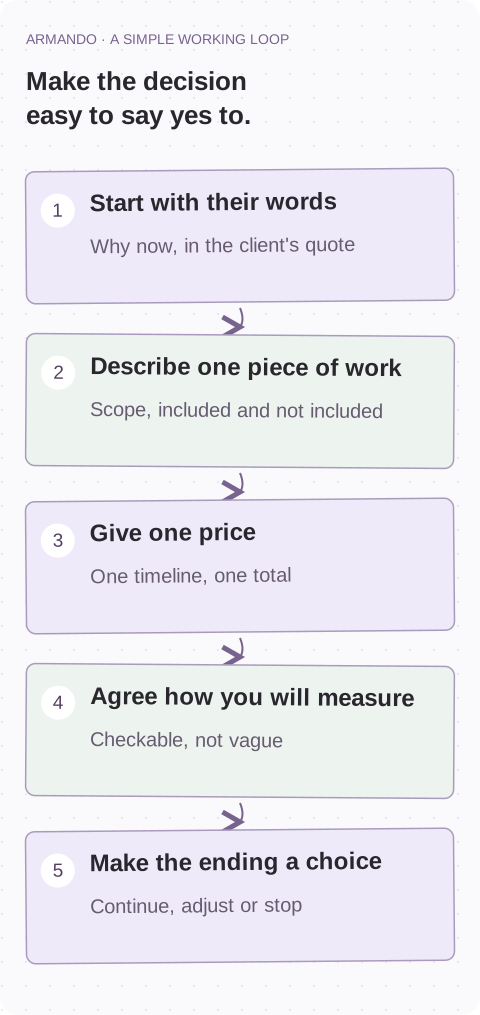
A consulting services proposal for an existing client does a different job. The client already trusts you enough to take your calls. What they lack is a clear, low-risk decision to make. Your proposal should name the problem in their words, describe the next piece of work, state the price once, say how you will both know it worked, and make the ending a choice rather than a surprise.
This guide gives you a proposal template for consulting services that fits on one or two pages, and shows how to adapt it for the three situations that come up most often with long-term clients: a pilot, an expansion and a renewal. You will find a copyable template, a fictional worked example, a table of what to emphasise in each case, an AI prompt for drafting, and a list of mistakes to avoid. If you would rather not start from a blank page, the free Client proposal generator on this site fills the structure from your facts.
What is different about a proposal for an existing client
A proposal for an existing client is a short document that offers more work, a trial or a renewal to someone who already knows your team. Because the relationship exists, the proposal can skip the introduction and spend its words on the decision: what you propose, what it costs, and how the client will judge it.
New-business proposals have to establish credibility. Existing-client proposals have to protect it. A long, formal document sent to someone you speak with every week can feel like a step backwards. It makes the relationship look like a procurement exercise. A short, direct one reads as a continuation of the conversation you were already having.
Two other differences matter. First, you have evidence the client has seen for themselves, so you can refer to results they confirmed instead of making claims. Second, you have a history, which means you also have a record of things that went badly. A good proposal for a long-term client acknowledges what was learned and shows what is different this time. Pretending the past year was flawless makes the document less believable.
It also helps to separate a proposal from a statement of work. A proposal asks for a decision. A statement of work is the more detailed document that follows once the client says yes: deliverables, acceptance criteria, payment terms and legal wording. If you try to make one document do both jobs, it becomes too long to read and too vague to enforce.
The eight parts of a consulting proposal
Every existing-client proposal can be built from the same eight parts. The order matters, because it follows the questions the decision maker is asking in their head.
Close the document with one next step and a date. A proposal without a date for the reply tends to sit in an inbox until someone else's priority pushes it out.
The sections that most often get skipped are the last three, and they are the ones that make a proposal safe to say yes to. Success measures turn a vague hope into something you can check. The ending removes the fear of being locked in. The list of what you need from the client prevents the most common reason that pilots stall: nobody on their side was told they had a task.
| Part | The question it answers | Typical length |
|---|---|---|
| Why now | Why are we talking about this today? | 3 to 5 sentences |
| What we will do | What exactly is being proposed? | 3 to 6 bullets |
| Included and not included | Where are the edges? | Two short lists |
| Plan and timeline | When does it start, when do we check, when does it end? | 1 short paragraph or table |
| Investment | What does it cost and what does that cover? | 2 to 4 sentences |
| Success measures | How will we know it worked? | 3 bullets |
| What happens at the end | What can we decide next? | 2 to 3 sentences |
| What we need from you | What must the client provide? | 2 to 4 bullets |
Want help putting this into practice? See how we can help
A copyable consulting services proposal template
Copy this template into a document or email, replace everything in square brackets, and delete any line you cannot fill truthfully. If a line is missing information, write "To confirm" rather than guessing.
The quote in "Why now" is the most valuable line in the document. It shows that you listened, it frames the work as the client's idea rather than your sales pitch, and it gives the decision maker their own words to forward to a budget holder. If you do not have a real quote, go back to the last two calls and look for one before you write anything else.
COPY & ADAPT
[Pilot / Expansion / Renewal] proposal: [Client name]
Prepared by [your company] for [decision maker], [date]

WHY NOW
[One or two results the client has confirmed, with dates.]
You told us: "[a real quote about the problem or goal]"

WHAT WE WILL DO
- [Activity 1]
- [Activity 2]
- [Activity 3]

INCLUDED
[What the price covers]
NOT INCLUDED
- [Item 1]
- [Item 2]

PLAN AND TIMELINE
Start: [date]. Checkpoint: [date]. End: [date].

INVESTMENT
[Price] for [period]. This covers [included items]. Payment: [terms].

HOW WE WILL MEASURE SUCCESS
- [Measure 1 that someone outside the meeting could check]
- [Measure 2]
- [Measure 3]

WHAT HAPPENS AT THE END
We review the results together and choose: continue, adjust or stop.

WHAT WE NEED FROM YOU
- [Owner on your side]
- [Access, data or approvals, with a date]

NEXT STEP
Please reply by [date] if you would like to go ahead. We will then send
the start date and a shared plan within [two] working days.
How to adapt the template for a pilot, an expansion or a renewal
The structure stays the same across the three situations. What changes is where you put the weight.
A pilot proposal.
A pilot lowers the cost of saying yes. Keep the scope small enough that a failed trial would be a minor disappointment rather than a problem. Fix the period, name the measures before you begin, and say explicitly that the trial ends with a choice. Decide up front whether the pilot is paid. A paid pilot signals that both sides take it seriously and gives the work proper attention, while a free pilot often gets the lowest priority on both sides.
Here is a fictional example. An agency has run reporting for Fernwood Dental Group for a year. The marketing director mentions that the three newest clinics get no planning support. The agency proposes a twelve-week pilot covering two of the clinics, with a weekly progress note and one monthly review. The success measures are modest and checkable: a written plan with owners for each clinic by week three, the monthly review held on time every month, and the director confirming at week twelve that the routine is useful. The ending is explicit: continue, adjust or stop, with no obligation either way. Notice that none of the measures promises revenue. They describe what the agency will do and what the client will see, which the agency controls.
The mutual action plan builder turns a pilot like this into a dated plan with one owner for every step, including the steps that sit with the client.
An expansion proposal.
An expansion proposal offers additional scope to a client who is already buying from you. The risk here is not the client's reaction to the work but your assumption about who decides. The person you talk to every week may not hold the budget for a new area. Before you write anything, find out who approves spend of this size and what they need to see. If you have only ever dealt with one person, treat that as a warning sign in its own right, because an account that depends on a single contact has little protection if they move on.
Start the document with a result the client has already confirmed, then connect it to the next problem. Keep the first step small. Proposing a defined first phase with a review is more likely to get a yes than a large programme that needs a new budget line. Our guide to B2B account expansion covers how to find the next useful conversation without pushing an upsell.
A renewal proposal.
A renewal proposal confirms that the relationship should continue and states what will change. Send it early enough that the client can run their own approval process, and do not let the renewal be the first time you mention price. If you plan to raise fees, our article on how to raise rates with existing clients explains how to prepare the conversation before the document goes out.
The strongest renewal proposals include a short honest account of what the last term did and did not achieve, followed by the specific changes for the next one. Clients renew when they believe the next term will be better than the last, not when they are reminded that the last one happened. If you see warning signs such as slower replies or missing sponsors, read our guide to client renewal risk warning signs before you send anything.
| Type | Lead with | Spend most words on | Watch out for |
|---|---|---|---|
| Pilot | A narrow problem the client already named | Success measures and the end-of-pilot choice | Scope creeping beyond the trial |
| Expansion | A result the client already confirmed | Who decides and who pays for the new scope | Assuming your contact owns the budget |
| Renewal | What the last term achieved and what you learned | What changes next term | Sending it too close to the end date |
B2B account expansion: grow agency clients without pushing an upsell ↗
How to price an existing-client proposal
Give one price for one defined scope. When you offer three packages, the client's attention goes to comparing them rather than to deciding whether to proceed, and every package becomes something to negotiate. If you genuinely have two different options, such as a smaller first phase and a fuller version, present them as sequential steps rather than as parallel choices.
State what the price covers in plain words, state what is excluded, and say how and when it will be invoiced. If the work is a trial, give the price for the whole trial rather than a monthly rate that hides the total. If the client asks for a discount, the best response is usually to adjust the scope rather than the rate: agree what could be removed to meet their budget, and keep the quality of what remains. Cutting the price without cutting the scope teaches the client that your first number was negotiable.
For longer-term pricing structures, such as moving from projects to retainers, our guides on how to bill for account management and moving from projects to retainers go into more detail.
How to bill for account management without surprise fees ↗
Project to retainer: make B2B agency revenue more predictable ↗
How to write success measures and an ending
Success measures are the part of a proposal where most agencies are vague, usually because they are worried about being held to them. The fix is to choose measures that describe what you will do and what the client will see, and that someone who was not in the room could check later.
Good measures sound like this: a written plan with named owners by week three, a monthly review held on schedule, a sponsor who confirms at the end that the routine is useful. Weak measures sound like this: improved alignment, better visibility, stronger performance. The first group can be confirmed by looking at a calendar and a document. The second group will be argued about.
If a business outcome matters to the client, such as enquiries or retention, say how you will track it and agree what you will look at together, but be careful not to promise a number you cannot control. It is better to agree the measurement than to guarantee the result.
Then write the ending. State that at the end you will review the results together and choose to continue, adjust or stop. This single sentence does more to reduce the client's hesitation than any discount, because it removes the fear of being locked in. It also protects you: a pilot with no defined ending tends to drift into unpaid work.
Using AI to draft the proposal
AI assistants are good at structure and wording and unreliable with facts they were never given. Give the assistant your real context, tell it to mark gaps as "To confirm", and treat the output as a draft that a person has to check.
Copy this prompt into ChatGPT, Claude or Gemini and replace the square brackets:
The same prompt, ready to copy or download as a Markdown file, sits under the free tool at /free-tools/client-proposal-generator/. When the draft comes back, check four things before sending: every result cited is one the client actually confirmed, every date and price matches your records, the success measures are things you can verify, and nothing in the document promises more than you can deliver.
COPY & ADAPT
You write proposals for a B2B agency or consultancy that sells to existing clients.
Proposal type: [pilot / expansion / retainer renewal / new scope]
Client and decision maker: [name, role]
What happened so far: [work done, results the client confirmed, dates]
Problem or opportunity in the client's own words: [quotes]
What we propose: [scope in plain language]
Timeline: [start, end, key dates]
Investment: [price, what is included, payment terms]
How we will judge success: [measurable criteria]
What happens at the end: [continue, adjust or stop]
What we need from the client: [access, people, approvals]
Write a proposal of at most 700 words with these parts: why now, what we will do,
what you get and what is not included, plan and timeline, investment, how we will
measure success and decide next steps, what we need from you, next step with a date.
Never invent results, numbers or quotes. Mark anything missing as "To confirm" and
list open questions at the end. Add a one-paragraph cover email.
Sending the proposal and following up
Send the proposal in the same channel you normally use with the client, with a short email that states the proposal in one sentence and gives a date for the reply. Offer a short call to walk through it. Sending a document without a conversation leaves the client to interpret it alone, and that is when small misunderstandings become objections.
If you have not heard back by the date you set, follow up once with something useful rather than a bare reminder. A short note that adds one relevant detail, or answers a question you expect them to have, keeps the conversation moving without pressure. Our article on client follow-up emails has three templates for this, and the free client follow-up email generator adjusts the tone for you.
Once the client says yes, move straight to a shared plan. Do not let a week pass between agreement and kickoff.
Where proposals fit into B2B key account management
In B2B key account management, a proposal is not a one-off sales document. It is the written record of a decision in a long relationship, and it should connect to the account plan you already keep for the client. The goals in the plan tell you which proposals are worth writing, the stakeholder map tells you who has to approve them, and the results you have recorded give you the "why now" section.
For key accounts, write the proposal with the whole buying group in mind. The person who asked for it may not be the person who signs it, and the document may be forwarded to people who have never met you. That is another reason to use the client's own words and plain language: it has to make sense to a reader without your context.
If you do not have an account plan yet, our guide to the account plan template in 30 minutes is the quickest way to create one, and the stakeholder map method shows how to find out who is really involved in a decision. Proposals written without that background tend to be generic, and generic proposals get generic replies.
Common mistakes in consulting proposals for existing clients
These nine mistakes account for most proposals that stall, and each one is quick to fix before you send.
- Writing like a new-business proposal, with company history and credentials the client does not need.
- Leaving out the client's own words, so the proposal reads as your idea rather than theirs.
- Offering three packages instead of one clear scope.
- Choosing vague success measures that cannot be checked.
- Leaving out what is not included, which is where most scope arguments start.
- Forgetting to say what happens at the end of a pilot.
- Sending the document with no date for a reply.
- Assuming your main contact controls the budget.
- Using AI to write facts instead of structure.
Your next step
Pick one account where you already have a conversation about extra work, a trial or a renewal, and fill the template in with real quotes and facts. If you want to go from there to a dated plan, use the mutual action plan builder, and read the account plan template guide to keep the proposal connected to the rest of the relationship.
Start with one account this week
- Choose one account with a real conversation about more work, a trial or a renewal.
- Find a real quote from the client about the problem or goal.
- Fill the eight parts, deleting any line you cannot support.
- Write one price and one timeline, and list what is not included.
- Write three success measures that someone outside the meeting could check.
- State that the ending is a choice: continue, adjust or stop.
- Name an owner on the client side for every item you need from them.
- Check who approves the spend before you send it.
- Send it with a date for the reply and offer a short call.
- Follow up once with something useful if you hear nothing.
Common questions
What is a consulting proposal template?
A consulting proposal template is a reusable structure for offering services to a client. It usually covers the problem, the proposed work, the timeline, the price, the success measures and the next step. For existing clients it can be shorter because the relationship and credibility are already established.
How long should a proposal for an existing client be?
One to two pages is enough for most pilots, expansions and renewals. The client already knows who you are, so spend the words on why now, scope, price, success measures and the decision at the end. Move detailed deliverables and legal terms to a statement of work after the client agrees.
What is the difference between a proposal and a statement of work?
A proposal asks the client for a decision and explains the offer. A statement of work is the detailed follow-up document that sets out deliverables, acceptance criteria, payment terms and legal wording once the client has agreed. Use the proposal to win the yes and the statement of work to protect both sides.
Should a pilot be paid?
Often yes, at a reduced scope. A paid pilot shows commitment from both sides and gets proper attention, while a free one is easily postponed. Whether it fits depends on the client, the size of the pilot and how well you already know each other. Either way, agree the success measures and the ending before you start.
Can I use ChatGPT or Claude to write a consulting proposal?
Yes, as a drafting tool. Give the assistant real facts, ask it to mark anything missing as "To confirm", and check every number, date and quote yourself. Use it for structure and wording rather than for claims about results.