ACCOUNT EXPANSION · B2B AGENCIES
Upsell vs Cross-Sell for Agencies: Spot the Growth Signal
Upsell vs cross-sell for agencies: what each one means, which signals show a client is ready, and how to ask for more work without pushing.
Quick quiz. A client on a 20-hour retainer asks for 40. Is that an upsell or a cross-sell? And what if the same client asks whether you also do conversion optimisation?
If you hesitated, you're in good company. Most agency teams use both words as if they meant the same thing. Then they wonder why neither works. :)
It matters, because the two moves have different triggers, different buyers and different risks. This guide shows the difference in agency terms, the signals that tell you a client is ready, how to ask without pushing, and what to do when the extra work lands in a department that has never heard of you. We built a software agency from zero to 110 people and exited. Growing existing accounts was always cheaper than finding new ones, so this is the part we wrote down.
I have a simple rule in client conversations. I talk with the client for an hour, very casually, and whoever brings up business first loses. It always comes up in the end, and the person who raises it first usually offers something, almost as a thank-you for the chat. It's psychology, and it works.
But the tactic is only a small part. Most expansions came from two other things: we did good work, and we stayed in contact, so we knew what was going on and the client trusted us. With that, new tasks arrive almost naturally. In the biggest expansion we ever had, the client proposed it himself. :)
I've also botched it. I once tried to sell more to a client I didn't know, with low trust and a low NPS. I thought the work justified an ask, but there was no relationship behind it. I sold nothing, and it made no sense in hindsight. A low score means build the relationship first.
Upsell vs cross-sell: what each one means
monday.com's sales guide (published 18 June 2026) defines upselling as moving customers to a higher-tier version of what they already use. It defines cross-selling as offering additional products or services that complement what they already buy (monday.com, "Cross-selling vs. upselling", retrieved 5 November 2026).
Rework's guide (updated 8 September 2026) puts it plainly: an upsell grows the thing a customer already bought, such as more seats, a higher tier or more usage. A cross-sell sells something separate. Rework also says the mistake is treating them as the same motion with the same trigger and owner (Rework, "Upsell vs Cross-Sell", retrieved 5 November 2026).
Those guides are written for software, but the logic carries over to agencies:
| Upsell | Cross-sell | |
|---|---|---|
| What it is | More of what they buy | Something new |
| Agency example | 20 retainer hours become 40, or a higher service tier | A paid media client adds conversion optimisation |
| Typical trigger | You're at capacity with their goals | The client mentions a nearby problem |
| Who decides | Usually your current sponsor | Often a different person or team |
| Speed | Faster: trust already exists | Slower: they're evaluating something unfamiliar |
| Main risk | Scope grows without the results to justify it | You sell to someone who doesn't know you |
Both land in the same bucket: expansion revenue. But they tell you different things, so track them separately.
Takeaway: same bucket, different motions.
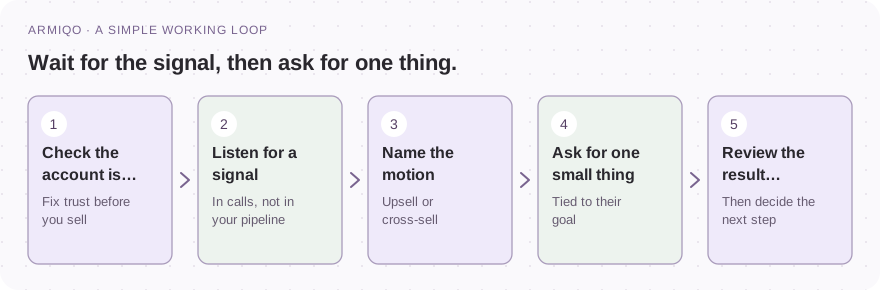
Check the account before you ask for more
Three questions, before any expansion.
- Is the account healthy?
- Is there a recent win the client recognises?
- Has the client told you what they want next?
If one is a "no", stop. A client who went quiet last month needs trust, not an offer. Selling more to an unhappy client speeds up the exit.
Not sure where the account stands? Our guide to client renewal risk warning signs shows what to check. And if you only know one person there, read single-threaded accounts first.
Rule of thumb: trust >> pipeline.
Want help putting this into practice? See how we can help
Signals that a client is ready
Signals show up in conversations, not in your CRM. Listen for them in your next five calls.
| What you hear | What it often means | Motion |
|---|---|---|
| "We're swamped, can you take more of this?" | Capacity is their bottleneck | Upsell |
| "Could you also look at our checkout?" | A nearby problem you could solve | Cross-sell |
| "Our other team has the same issue." | Your result is visible beyond the first team | Cross-sell into a new team |
| "Can we lock in this rate for next year?" | They want stability | Longer term |
| "That report was great, who else sees it?" | A recent win they're proud of | Introduction or case study |
Signals are probabilities, not verdicts. "Often means" is the right phrase. Ask a question before you assume.
Write the signal down with the date and the client's own words. That quote becomes the first line of your proposal.
Takeaway: a signal in their words beats a gut feeling in yours.
How to ask without pushing
Ask for one thing at a time. Tie it to the client's goal. Make yes easy: a small first step, a clear outcome, a short timeline.
Say this instead of pitching:
COPY & ADAPT
You mentioned [the problem in their words] last week.
We could [small first step] over [short timeline], and we'd measure it by [one checkable outcome].
Would it help if I sent a one-page proposal?
Then send the one-page proposal. Our proposal template for consulting services shows the structure.
A fictional example. An agency runs paid media for Lakeside Outdoor. On a monthly call, the marketing lead says the checkout loses people. The agency doesn't pitch a programme. It proposes a six-week review of the checkout with three recommendations and one test. Small, specific, easy to approve.
Takeaway: a small step is easier to say yes to.
Proposal Template for Consulting Services: Pilot, Expansion, Renewal ↗
The upsell: more of what they already buy
An upsell works when you're at capacity with their goals, or when a higher tier would remove a bottleneck.
Do it after a visible result. Say what the extra hours or the higher tier would change, in their terms. Put the new scope and price in writing the same week.
Two traps:
- Scope without results. More hours don't help if the current hours haven't paid off.
- Surprise pricing. Raise the topic early. A new rate in the paperwork stage feels like a trick. Our guide to raising rates with existing clients covers the framing.
Takeaway: upsell after the result, not before.
The cross-sell: something new, often to someone new
A cross-sell is harder, because you're introducing something unfamiliar. Rework notes that cross-selling asks more of the buyer than upselling does, and that it often routes through a different decision maker (Rework, retrieved 5 November 2026).
Treat it as a fresh buying decision.
- Ask your champion for an introduction. Don't go around them.
- Offer a short workshop or a one-off review, not a contract.
- Find who holds the budget. Your weekly contact may not.
If the new team has never worked with you, start with a small pilot. The stakeholder map method shows how to find the right people.
I ask the champion directly. Someone I already have a relationship with: "Who decides on the budget, and when?" It differs by company, and especially by country, so you have to ask. I've never had trouble getting an answer. I also ask for the rough range of the budget, not an exact number. It matters to them to save money, so they'll be careful with details.
Takeaway: a cross-sell starts with an introduction.
Use AI to spot signals in your call notes
AI is good at scanning notes for patterns. It's bad at facts you never gave it. Paste your last three call notes, ask for signals, and check every quote.
COPY & ADAPT
You are an account manager at a B2B agency. Below are notes from my last three client calls.
Find every sentence where the client mentions: a bottleneck, a nearby problem, another team,
a budget or term question, or pride in a result. For each, quote the exact words, say whether it
points to an upsell, a cross-sell, a longer term or an introduction, and give one small first step.
Only use what is in the notes. If nothing qualifies, say so. Do not invent quotes.
Notes: [paste]
For a full plan around a growth goal, use the free Account plan generator and its ready-made AI prompt.
Takeaway: AI finds the pattern, you check the quote.
Where upsell and cross-sell fit in B2B key account management
In B2B key account management, expansion isn't a campaign. It's the result of a healthy relationship, a plan and a rhythm.
Your account plan tells you which expansion is worth proposing. Your stakeholder map tells you who has to approve it. And your calls tell you when to ask. Our guide to B2B account expansion shows how to find the next conversation, and the account plan template is the quickest way to start.
Review it every quarter: which accounts showed a signal, what did you ask, what happened?
Takeaway: expansion is a habit, not a campaign.
B2B account expansion: grow agency clients without pushing an upsell ↗
Common mistakes
Most of these are quick to fix before you send or ask for anything.
- Treating upsell and cross-sell as the same thing.
- Selling more to an account that isn't healthy.
- Asking for more than one thing.
- Pitching before the client gave a signal.
- Going around your champion to reach a new team.
- Raising the rate in the paperwork stage.
- Tracking only total expansion revenue.
Your next step
Look at your last five client calls. Pick one signal. Write it down with the date and the client's exact words.
Then ask for one small thing.
Which client are you sure has a signal you haven't acted on? :)
Start with one account this week
- Confirm the account is healthy and a recent win is visible.
- Write down the signal, with the date and the client's own words.
- Decide: upsell, cross-sell, longer term or introduction.
- Ask for one small thing tied to their goal.
- For a cross-sell, ask your champion for an introduction first.
- Find out who approves spend of this size.
- Send a one-page proposal and book a short call.
- Put the scope and price in writing the same week.
- Track upsell and cross-sell separately.
- Review signals and results every quarter.
Common questions
What is the difference between upselling and cross-selling?
Upselling moves a client to a higher tier or larger volume of what they already buy. Cross-selling offers something additional and different that complements it. For agencies: more retainer hours is an upsell, a new service line is a cross-sell.
Which is easier for an agency?
Usually the upsell, because trust and a decision maker already exist. A cross-sell often involves a different buyer and takes longer. Both need a healthy account first.
When should an agency ask for more work?
After a recent win, when the account is healthy, and when the client has given a signal such as a bottleneck, a nearby problem or a request about another team.
How do I upsell without sounding pushy?
Ask for one small thing tied to a goal the client already named. Use their own words, propose a short first step, and agree how you'll measure it.
Should I track upsell and cross-sell separately?
Yes. Both count as expansion revenue, but they come from different triggers and owners. If you only track the total, you can't tell which motion is working.