ACCOUNT EXPANSION · B2B AGENCIES
White Space Analysis for Agencies: How to Find What Your Clients Don't Buy Yet
A plain guide to white space analysis in account management for agencies and service firms: a five-step method, a services-by-clients map, a filled example, questions to ask and an AI prompt.
Be honest: could you list, today, which of your services each client does not use yet? :)
Most agencies know what each client buys. Far fewer know what each client could usefully buy and doesn't. That gap is called white space. It sounds like sales jargon, but it is really an account management habit: knowing your clients well enough to see where you could help more.
This guide explains white space analysis in plain words, for agencies and service firms. You get a five-step method, a filled example, the questions that find real white space, where to raise it, a prompt for your AI assistant and a free white space map generator to build the map in a few minutes. We built a software agency from zero to 110 people and exited, so this guide is written from the agency side.
What is white space, in plain words?
White space is the difference between what a client already buys from you and what they could buy. If a client pays you for design and development but has never talked to you about testing or hosting, testing and hosting are white space on that account.
The term comes from sales and account management. A white space analysis is a map. Services go across the top, clients go down the side, and each cell says whether the client buys the service. Empty cells are candidates for a conversation.
It's not a list of things to sell. An empty cell might mean the client doesn't need the service, buys it elsewhere or isn't ready. The map doesn't decide. It tells you where to ask.
For the wider picture of growing existing accounts, see our guide to B2B account expansion.
Takeaway: white space is a map of questions, not a list of sales.
B2B account expansion: grow agency clients without pushing an upsell ↗
Why white space matters for agencies
An existing client already trusts you. They know your people and how you work. That makes the next conversation about a new service easier than a first conversation with a stranger.
It also matters for the client. A client often doesn't know what they don't know. They may be sure that the design is covered and that testing is somebody else's job, and they are sometimes wrong. A good agency notices what's missing and says so kindly.
Finally, it's about attention. If no one looks at the whole account, each client is served one project at a time. Nobody sees the larger picture, and the opportunities pass unnoticed.
Takeaway: the client benefits when you notice what they have missed.
Want help putting this into practice? See how we can help
How we found white space: pre-sales with specialists
At our agency we did pre-sales with every client, and the calls included specialists from several fields. A lead might write to us about a website or an app. We would bring a UI/UX designer, a DevOps engineer, an engineering lead, a delivery lead or a QA specialist, depending on what we thought could be added to the project.
The point was to find white space. The client often believed everything was prepared: documentation ready, design covered, testing arranged. Then a specialist asked the right questions and showed that something wasn't ready after all, and that we could help prepare it.
It wasn't pushing. It was consulting selling. We tried to understand the client and propose the most complete solution. The client didn't have to know much about building an application, because we did, and we shared it.
Two habits made this work:
- We knew who bought what. It was written down.
- We had a list of our services and capabilities that a salesperson or a delivery lead could use in the conversation.
Takeaway: a specialist's question finds what a pitch never would.
The five-step method
| Step | What you do | Output |
|---|---|---|
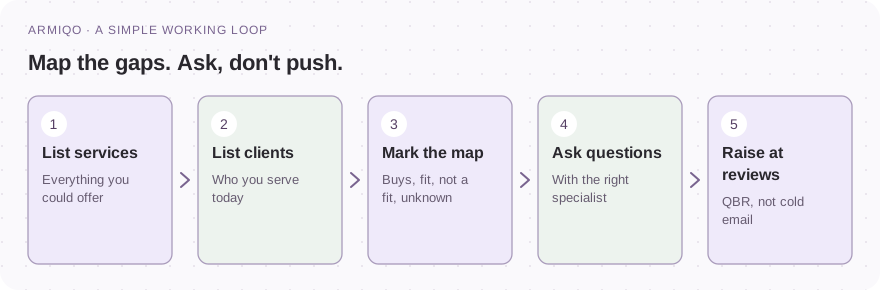
| 1. List your services | Everything you can offer, including what you'd partner for | A short service list |
| 2. List your clients | The accounts you serve today, starting with key accounts | A client list |
| 3. Mark the map | For each cell: buys it, likely fit, not a fit or unknown | A filled map |
| 4. Ask questions | Talk to the client about the problem, with a specialist if useful | Facts, not guesses |
| 5. Raise it at a review | Bring one or two opportunities to the QBR or planning call | A decision or a "not now" |
Mark "likely fit" only when you have a reason from the client, such as something they said, a goal or a plan. Everything else is "unknown", and that is a useful answer. It shows where you don't know the client well enough yet.
You can build the map in a spreadsheet, or use the free white space map generator, which also ranks the gaps and suggests questions.
Takeaway: most cells should say "unknown" at first, and that's fine.
A filled example (fictional)
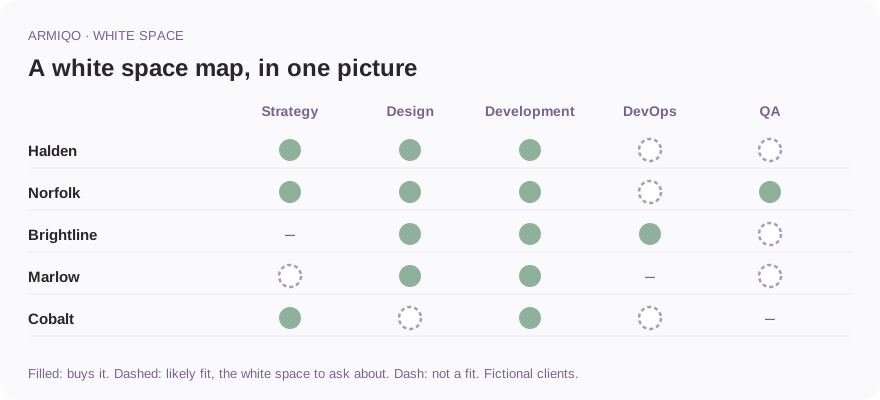
A fictional agency has five clients and five services. After the first pass, the map looks like this.
| Client | Strategy | Design | Development | DevOps | QA |
|---|---|---|---|---|---|
| Halden Logistics | Buys | Buys | Buys | Likely fit | Likely fit |
| Norfolk Retail | Buys | Buys | Buys | Likely fit | Buys |
| Brightline Health | Not a fit | Buys | Buys | Buys | Likely fit |
| Marlow Foods | Likely fit | Buys | Buys | Not a fit | Likely fit |
| Cobalt Fintech | Buys | Likely fit | Buys | Likely fit | Not a fit |
Three things stand out. Three clients could use QA, so QA is a good topic for the next reviews, with a QA lead in the room. Two clients buy DevOps already, which proves the service works in your portfolio. And the "not a fit" cells save you from wasting a conversation.
The numbers and names are made up to show the format. Use your own.
Takeaway: the map shows where to ask, and where not to.
Where to raise it: the QBR, not a cold email
We usually raised new services at the QBR. We told clients what new services we had in our portfolio, and commented on them, so they knew what else we did. We also sent a newsletter to clients. But the QBR was the most natural moment, because the client was already looking at the year ahead.
If you want a structure for that meeting, see the QBR action plan for the next quarter. For a smaller, regular rhythm inside your team, the weekly account review is a good place to update the map.
Keep it light. One or two ideas per meeting is plenty. Ask how the client handles the area today, listen and offer help only if there's a real problem.
Takeaway: raise it where the client already expects to talk about what's next.
QBR Action Plan: Turn Your Review Into a Next-Quarter Plan ↗
Story: when the client's problem needs a service you don't have
Sometimes the client's problem isn't one of your services at all. We had a case where a client needed DevOps, and DevOps wasn't in our portfolio. The need came from the client.
Together with the team we researched companies that could help, then asked them for help. Later, on that basis, we built a department to serve that need.
You don't have to build a whole department to sell a single service. You can start by finding a partner, serving one client well and learning from it. If the demand repeats, then you can decide to build.
Takeaway: a client's problem can be the start of a new service.
Story: the opportunity we missed
The opposite case taught us as much. A client told us about a problem they had and what they wanted to do. The people who spoke to them weren't technical specialists. It was a salesperson. They didn't realise the problem could be connected to DevOps and could be turned into work for us.
The cause wasn't a lack of effort. It was a lack of account management: no one was having an active conversation with the client from the delivery side, from the project manager's side or from the salesperson's side. Nobody was the first person the client would call with a problem.
If you want clients to bring you their problems, someone has to be close enough to hear them and technical enough to recognise them. Our guide to assigning managers to client accounts shows how to make that clear, and building B2B client relationships covers the trust that makes clients open up.
Takeaway: white space is found by the person who listens to the client.
Should you assign a PM to a client account? Product vs project roles ↗
Build B2B client relationships: become useful beyond the status call ↗
Questions that find white space
Questions work better than pitches. These are examples, to be adapted to each service.
| Area | Question to ask | Who can ask it |
|---|---|---|
| Design and UX | "How do users get through this flow today? What do they complain about?" | A designer |
| Testing and QA | "How do you check that a release works before users see it?" | A QA lead |
| DevOps and hosting | "What happens when you deploy? Who is on call if it breaks?" | A DevOps engineer |
| Delivery | "What makes releases late or stressful for your team?" | A delivery lead |
| Strategy | "What are the top three goals for next year, and who owns them?" | The account owner |
| Reporting | "How do you see the results today, and who reads them?" | The account owner |
If an answer sounds like "we have it covered", believe it and move on. If it sounds unsure, you may have found white space. The right response isn't a pitch. It's "would it help if we looked at that together?".
Takeaway: ask about their problem and let them tell you where the gap is.
Use AI to build and read your map
AI is good at turning notes into a map and suggesting questions. It can't know your clients. Give it facts and ask it to mark gaps as unknown.
COPY & ADAPT
You are a head of account management helping me find white space across my existing clients.
Services we offer: [list]. Services we could offer with a partner: [list].
Clients and the services each already buys: [client: services].
What I know about each client's goals or problems, in their words: [notes].
Specialists I can bring to a call: [roles].
Produce: (1) a table with clients down the side and services across the top, marked as
buys / likely fit / not a fit / unknown, using "unknown" when I gave no evidence;
(2) the five best opportunities, ranked, each with the reason it fits, the specialist to bring
and one open question to ask; (3) where to raise each one and what not to say.
Rules: use only my facts. Do not invent client needs, numbers or results. Flag anything you guess.
You can also copy this prompt from the free white space map generator.
Takeaway: AI organises the map, you supply the truth.
Where white space fits into B2B key account management
In B2B key account management, white space analysis is the growth part of the account plan. It sits next to goals, stakeholders and health. A healthy account with trusted contacts is where a client brings you problems, and the map helps you spot which of those problems you can help with.
Pair it with a stakeholder map so you know who to talk to in each area, and with a client health score so you raise new ideas with accounts that are healthy enough to listen. For the system that holds these pieces together, see the simple account management system for agencies.
Takeaway: growth starts with a relationship good enough to hear the problem.
Stakeholder map for client accounts: a 6-step method ↗
Client health score for agencies: a simple 5-factor model ↗
The simple account management system behind our 110-person agency ↗
Common mistakes
Most of these are easy to fix before the next review.
- Treating every empty cell as a sale.
- Marking "likely fit" without evidence from the client.
- Pitching a service before asking about the problem.
- Leaving account owners alone, with no specialist to bring to the call.
- Raising new services only by cold email.
- Never updating the map after a review.
- Having nobody own the account closely enough to hear problems.
Your next step
Pick your three biggest clients and five services. Mark the map in ten minutes, then choose one "unknown" cell and find out the answer at your next call.
What do you think you'll discover? :)
Start with one account this week
- List every service you offer, including partner-delivered ones.
- List your key accounts.
- Mark each cell: buys, likely fit, not a fit or unknown.
- Mark "likely fit" only with a reason from the client.
- Choose one or two gaps to explore per review.
- Bring the right specialist to the conversation.
- Ask about the problem before you offer a service.
- Raise ideas at the QBR or planning call.
- Name an owner who listens to each account.
- Update the map after every review.
Common questions
What is white space analysis?
White space analysis compares what each client buys from you with what you could offer. The gaps are the white space. It tells you which conversations to start, not what to push.
What is white space in account management?
It is the set of services or needs an existing client doesn't yet buy from you but may value. In account management it is a prompt for questions, linked to the client's goals.
How do I do a white space analysis for an agency?
List your services, list your clients, mark what each client buys, ask questions about the gaps with the right specialist in the room, and raise one or two ideas at a review.
How is white space different from upselling and cross-selling?
White space is the map. Upselling means more of what a client already has. Cross-selling means a different service. The map helps you decide which one to explore.
How do I find white space if a client doesn't know what they need?
Bring a specialist. A designer, QA lead or DevOps engineer asks questions the client may not know to ask. If the client has it covered, you learn that. If not, you can help.
Is there a free white space analysis tool?
Yes. The free white space map generator on this site lets you map services against clients, rank the opportunities and copy the questions to ask. It runs in your browser and stores nothing.