PILOTS · B2B AGENCIES
Paid Pilot for Existing Clients: Price, Scope and Exit
How to run a paid pilot with a client you already work with: when to charge, how to size the scope, how to price it, what success looks like and how it ends.
Should a pilot be free?
For a client you already work with, I'd say no. Charge for it. A small fee changes how both sides behave. :)
This guide shows when to charge, how to size the scope, three ways to price it, what success should look like and how a pilot ends. It's for agencies and consultancies that want to try new work with an existing client without drifting into free work. You also get a one-page pilot agreement you can copy and a few calm answers for when the client asks for a freebie. We built a software agency from zero to 110 people and exited. Most of our best long-term work started as something small that we proposed and the client tried.
Clients have asked me for a discount, and one asked for work basically for free: "build it now, I'll pay after you deliver a part, because I need this to hit my numbers."
My rule is to look for win-win. If the request is reasonable, and not just someone trying to squeeze out a few dollars, it can be worth investing in the client. It's even easier when you have people on the bench who aren't earning anything anyway. Then a temporary discount, or some free work, is an investment in the relationship, and often a good one.
I also use what I call the foot-in-the-door move: a small pilot or small first project. The client often needs a demo to show their own stakeholders that the idea makes sense. Sometimes we've even covered part of the cost ourselves, to get the return later.
What is a paid pilot (and what it isn't)
A pilot is a short trial of something new. A paid pilot is the same trial with a fee attached.
With an existing client, it's different from the pilot a software start-up runs with a stranger. You already have trust, a history and a contact. What you don't have is proof that the new work is worth buying. The pilot exists to produce that proof.
It isn't a favour. It isn't a discount in disguise. And it isn't a way to start the full engagement at half price and hope nobody notices.
| Pilot | Project | Retainer | |
|---|---|---|---|
| Purpose | Test new work and decide | Deliver an agreed result | Ongoing support |
| Length | 4 to 12 weeks | Defined by scope | Open or yearly |
| Ends with | A choice: continue, adjust or stop | Delivery | Renewal |
| Risk for the client | Low, by design | Medium | Medium |
Takeaway: a pilot is a test that ends in a decision.
Should a pilot be free?
Pear VC's Pepe Agell, writing for software founders, takes a strong line: pilots should never be free. His reasoning is that when a customer pays for a pilot, even a small amount, they signal seriousness, assign resources, show up to weekly check-ins and stay accountable. He also writes that if someone refuses to pay for a pilot, it's usually a sign they won't convert into a strong customer (Pear VC, "Why pilots matter more than you think—and how to run them right", 19 March 2026, retrieved 5 November 2026).
That's one investor's view, aimed at software companies selling to enterprises. Your situation is different: the client already buys from you. But the behaviour he describes is familiar. A free pilot is the first thing to slip when the week gets busy.
Here's how I'd weigh it for an existing client.
| Paid pilot | Free pilot | |
|---|---|---|
| Client attention | Gets a named owner and a slot in the week | Gets postponed |
| Your attention | Treated as real work | Treated as a favour |
| Signal | Both sides are serious | Unclear |
| Risk | The client says no to paying | You work for free and the pilot drifts |
| Best when | The new work is real and you can define it | It's tiny, short and a goodwill gesture after a miss |
My rule of thumb: if it needs a plan, an owner and a decision, it needs a price.
Takeaway: payment buys attention on both sides.
Want help putting this into practice? See how we can help
Step 1: pick one problem
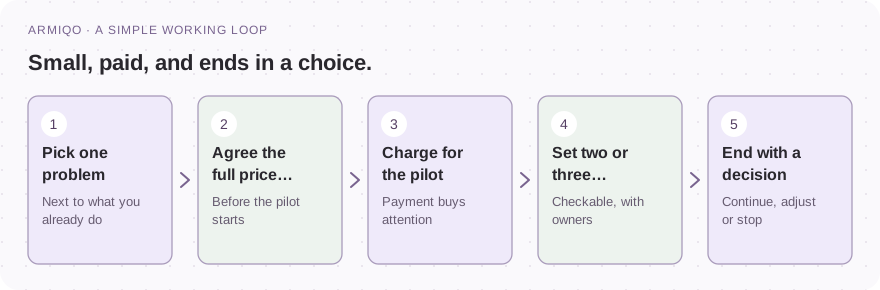
A pilot answers one question. Pick one problem, next to what you already do, that the client has already named.
Good pilot topics sound like this.
- "Can we run the same reporting routine for the two newest depots?"
- "Can we test a new channel for three months before the client commits budget?"
- "Can we add a planning workshop and see if the team uses it?"
Bad ones sound like "a strategic partnership" or "a transformation". They're too big to test and too vague to judge.
Use the client's own words. Our proposal template for consulting services shows why the real quote is the best line you can write.
Takeaway: one problem, in their words.
Proposal Template for Consulting Services: Pilot, Expansion, Renewal ↗
Step 2: agree the full price before the pilot starts
Pear VC's guide makes a point that applies here too: ideally the full contract value is discussed before the pilot begins, so you don't go into a pilot blind (Pear VC, as above).
For an agency, that means a simple conversation before you quote the pilot.
- "If this works, what would the full version look like?"
- "Who would approve the budget for it?"
- "What would you need to see to say yes?"
Write the answers down. They become the last page of your proposal. If the client can't imagine buying the full version at any price, the pilot won't change that. Better to know now.
Check the account first, too. A pilot is an expansion move, and expansion works best on a healthy account with a recent win. Our guide to upsell vs cross-sell for agencies lists the signals to wait for.
Takeaway: know what "yes" would look like before you start.
Step 3: size it and price it
Keep it short. Pear VC suggests aiming for about one month and keeping software pilots under three months. For an agency, four to twelve weeks is a good range: long enough to show a result, short enough that the client doesn't lose interest (Pear VC, as above).
Then price it in one of three ways.
| Option | How it works | Good when |
|---|---|---|
| Fixed fee | One price for the whole pilot | The scope is clear and short |
| Monthly with a credit | Monthly fee during the pilot, with part credited toward the full engagement if they continue within a set window | You want to encourage a quick decision |
| Paid discovery first | A small paid phase to define the scope, then the pilot | The problem isn't clear yet |
Pear VC describes the credit idea: charge monthly, and credit the pilot cost toward the annual contract if the customer moves forward within a defined period (Pear VC, as above). For a service business, it can be as simple as crediting one month of the pilot fee against the first month of the full engagement.
A fictional example. Harborview Marine buys monthly reporting from an agency. The full routine for all four depots would cost 4,000 a month. The marketing director wants to try it on two depots first. The agency proposes a twelve-week pilot at 2,000 a month, 6,000 in total. If Harborview continues within 30 days, one month of the pilot fee is credited to the first month of the full engagement.
Don't price the pilot as a loss leader. It should cover your time. A deeply discounted pilot says "this isn't worth much".
Takeaway: a fair price for a small scope, with an easy path to the full one.
Step 4: set two or three measures
Measures are where most pilots go soft. Pick two or three. Make each one checkable by someone who wasn't in the room.
- A written plan with named owners for each depot by week three.
- The monthly review held on time, every month.
- The sponsor confirms at week twelve that the routine is useful.
Pear VC also recommends a clear owner for the pilot inside the customer organisation, with a counterpart on your side, and putting the pilot definition in a formal document, not only an email thread (Pear VC, as above).
I'd add the client's steps to the plan. Access, approvals and introductions are where pilots stall. Our mutual action plan template shows how to put both sides' steps on one page, with one owner and one date each.
Takeaway: two or three measures, with an owner on each side.
Step 5: end with a choice
A pilot needs an ending written down before it begins. Otherwise it drifts into unpaid work.
At the decision meeting, review the results against the measures and choose one of three paths.
| Choice | What it means | What happens next |
|---|---|---|
| Continue | The measures were met and the client wants the full version | Agree the full scope and price; apply the credit if you offered one |
| Adjust | Partly worked | Agree one change and a short second phase, or stop cleanly |
| Stop | It didn't work or isn't a priority | Thank them, share what you learned, no hard feelings |
Stopping is a valid outcome. It's cheaper than a long, half-hearted engagement, and it protects the relationship.
Takeaway: the end is a choice, not a surprise.
A one-page pilot agreement
Copy this. Replace the brackets. Put it in a proposal, a purchase order or a short agreement, not only in an email thread.
COPY & ADAPT
PILOT: [name] for [Client]
Problem: [one problem, in the client's words]
Duration: [start date] to [end date] ([n] weeks)
Scope: [what we will do]    Not included: [list]
Fee: [amount] ([fixed / monthly]). Credit: [if they continue by [date], one month credited]
Owners: [name, client]  /  [name, our side]
Measures:
  1. [checkable measure]
  2. [checkable measure]
  3. [checkable measure]
Checkpoint: [date]   Decision meeting: [date]
At the end: continue, adjust or stop. No obligation either way.
Full engagement if it works: [scope and price, as discussed]
Our Client proposal generator fills a pilot proposal from your answers and includes an AI prompt. For the dated plan, use the Mutual action plan builder.
Takeaway: write the ending before the start.
What to say when they ask for it free
Most clients ask. That's fine. Stay calm and ask a question.
| What they say | A calm reply |
|---|---|
| "We're not sure it'll work, so can you do it free?" | "That's exactly what the pilot is for. A small fee means both of us treat it as real. What budget is realistic?" |
| "We always do pilots free." | "I understand. For us a pilot needs a named owner and a weekly slot on both sides. A fee keeps it a priority. Could we agree a smaller scope?" |
| "Can you discount it?" | Reduce the scope, not the quality. Or ask for something back: a faster decision, a case study if it works, or a longer term. |
Don't apologise for the fee. Don't over-explain your costs. And never give it away for nothing. A free pilot teaches the client that your work is optional.
Takeaway: shrink the scope before you drop the price.
Where pilots fit into B2B key account management
In B2B key account management, a pilot is a low-risk way to open the next chapter of an account. It sits between your account plan, which names the goal, and a full proposal, which asks for the larger commitment.
Use it for the moves that matter: a new team, a new service, a new channel. Link it to your stakeholder map, because a pilot with the wrong owner won't survive. And link it to renewal planning, because a good pilot is a reason to keep the relationship growing. Our guide to B2B account expansion covers the wider picture, and moving from projects to retainers shows what the full version can look like.
Takeaway: a pilot is a bridge from the account plan to a bigger deal.
B2B account expansion: grow agency clients without pushing an upsell ↗
Project to retainer: make B2B agency revenue more predictable ↗
Common mistakes
Most of these are quick to fix before you send or ask for anything.
- Running a pilot for free "to build trust".
- Making the scope too big to judge.
- Skipping the conversation about the full price.
- Setting vague measures that can't be checked.
- Leaving out the client's steps and owner.
- Writing no ending, so the pilot drifts.
- Discounting the price instead of shrinking the scope.
- Piloting on an account that isn't healthy.
Your next step
Think of one client who mentioned a nearby problem in the last month. Write the problem in their words. Then write what the full version would cost.
Draft the pilot on one page, and propose it.
What's the one piece of free work you'd have charged for, looking back? :)
Start with one account this week
- Confirm the account is healthy and a recent result is visible.
- Pick one problem, in the client's words.
- Discuss the full engagement and its price before the pilot.
- Set a length of four to twelve weeks.
- Price it to cover your time, and choose fixed, monthly with credit, or paid discovery.
- Write two or three checkable measures.
- Name an owner on each side, and list the client's steps.
- Write the ending: continue, adjust or stop.
- Put it in a proposal, purchase order or short agreement.
- Book the decision meeting before the pilot starts.
Common questions
What is a paid pilot?
A short, paid test of new work for a client. It has a small scope, a fixed duration, agreed success measures and an ending where the client chooses to continue, adjust or stop.
Should a pilot be paid?
Often yes, even at a reduced scope. Payment signals that both sides take it seriously and gets it a place in the week. Whether it fits depends on the client and the size of the pilot, but either way agree the measures and the ending first.
How long should a pilot be?
Four to twelve weeks suits most agency work. Long enough to produce a result, short enough that nobody loses interest. Pear VC's guide for software founders suggests aiming for about a month and keeping pilots under three months.
How do I price a pilot?
Price it to cover your time and roughly in line with a share of what the full engagement would cost. Agree the full price before you start. You can credit part of the pilot fee against the full engagement if the client continues within a set window.
What if the client refuses to pay for a pilot?
Ask what budget is realistic and shrink the scope. If they still won't pay for anything, treat it as information: the work may not be a priority for them yet.