CONTRACTS · B2B AGENCIES
Statement of Work Template for Agencies: Copy-Ready SOW With Scope, Deliverables and Change Control
A copy-ready statement of work (SOW) template for agencies and service firms: scope, deliverables, assumptions, client responsibilities, change control, a filled example and an AI prompt.
Be honest: when a client last said "I thought that was included", could you point to a sentence that proved otherwise? :)
Most agency disputes about scope start with a vague document. A proposal sells the work. A statement of work (SOW) defines it, so that both sides can say yes to the same thing.
This guide gives you a statement of work template you can copy today. It's built for agencies and service firms: ten parts, a filled example, a table of vague phrases and their fixes, a change-control clause and a prompt for your AI assistant. We built a software agency from zero to 110 people and exited, so this guide is written from the agency side.
What is a statement of work?
A statement of work (SOW) is a document that describes the work you will do for a client: what, how much, by when, with what inputs and how you will both know it is done. It usually sits under a master services agreement (MSA) or is attached to a contract.
Many people search for "scope of work template" and "statement of work template" and mean the same thing. In practice, a scope of work is one section of an SOW. The SOW is the whole page set: scope, deliverables, timeline, responsibilities and rules for change.
The SOW also differs from a proposal. A proposal answers "why should we choose you?". An SOW answers "what exactly will happen once we have?". If you need the first one, see our proposal template for consulting services.
Takeaway: a proposal sells the work, an SOW defines it.
Proposal Template for Consulting Services: Pilot, Expansion, Renewal ↗
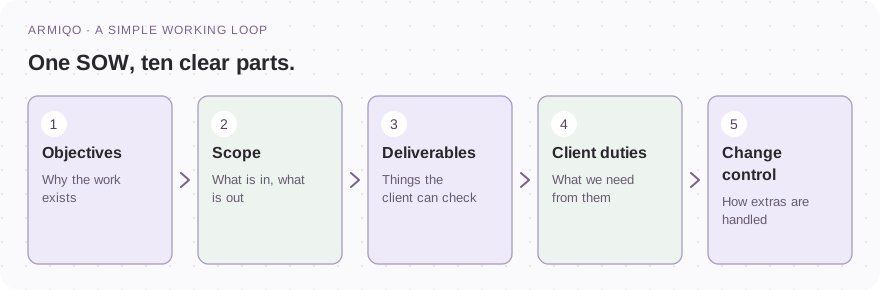
The ten parts of an agency SOW
| # | Part | What it answers |
|---|---|---|
| 1 | Background | Who is the client, and why does this work exist? |
| 2 | Objectives | What should be true when the work is done? |
| 3 | Scope | What exactly will we do? |
| 4 | Out of scope | What will we not do, even if it's related? |
| 5 | Deliverables | What will the client receive, in what form? |
| 6 | Timeline | Which milestones, with which dates? |
| 7 | Client responsibilities | What do we need from the client, and by when? |
| 8 | Assumptions | What are we taking for granted? |
| 9 | Change control | How are extra requests handled? |
| 10 | Acceptance and fees | How is the work approved and what does it cost? |
Don't skip parts 4, 7 and 8. They are the parts that feel awkward to write and prevent the most trouble later.
Takeaway: the awkward parts do the most work.
Want help putting this into practice? See how we can help
Statement of work template (copy and adapt)
Replace everything in brackets. Delete what doesn't apply.
COPY & ADAPT
STATEMENT OF WORK
Agreement: [Master services agreement / contract name and date]
SOW number: [001]   Date: [date]
Client: [company name]   Agency: [company name]
Client sponsor: [name, role]   Agency lead: [name, role]

1. BACKGROUND
[Two to four sentences: who the client is and why this work is needed.]

2. OBJECTIVES
- [Objective 1, stated as an outcome the client cares about.]
- [Objective 2.]

3. SCOPE OF WORK
The agency will:
- [Activity 1, with quantity or limit, e.g. "design up to 5 page templates".]
- [Activity 2.]
- [Activity 3.]

4. OUT OF SCOPE
The following are not included unless added through change control:
- [Item 1, e.g. "copywriting for pages beyond the 5 templates".]
- [Item 2, e.g. "ongoing hosting and maintenance".]

5. DELIVERABLES
| Deliverable | Format | Acceptance check |
| [Deliverable 1] | [file / link / meeting] | [how the client can check it] |
| [Deliverable 2] | [format] | [check] |

6. TIMELINE
- Start date: [date]
- Milestone 1: [what] by [date]
- Milestone 2: [what] by [date]
- Final delivery: [date]
Dates assume the client responsibilities below are met on time.

7. CLIENT RESPONSIBILITIES
- Provide [access / content / files] by [date].
- Name one decision-maker who can approve work within [2] working days.
- Attend [kickoff and weekly check-ins].

8. ASSUMPTIONS
- [e.g. "Up to two rounds of revisions per deliverable."]
- [e.g. "Client supplies final copy and images."]
- [e.g. "Client's systems allow the integration described in section 3."]

9. CHANGE CONTROL
Any request outside sections 3 and 5 is handled as a change request. The agency will
describe the effect on cost and timeline in writing. Work on the change starts only after
the client approves it in writing.

10. ACCEPTANCE AND FEES
- Each deliverable is reviewed by the client within [5] working days of delivery.
- Silence for [5] working days after delivery means the deliverable is accepted.
- Fees: [fixed fee / hourly rate / monthly retainer], invoiced [schedule].
- Expenses: [included / billed at cost with prior approval].

Signed for the client: [name, date]
Signed for the agency: [name, date]
Have your lawyer review the final text, especially parts 9 and 10. Payment terms, liability, intellectual property and termination usually belong in the master agreement, not in each SOW.
Takeaway: ten parts, in order, with out of scope written down.
Write deliverables the client can check
The most common weakness in an SOW is a deliverable that cannot be verified. "Improved website performance" is a hope. "A report with page load times for five named pages, before and after" is a deliverable.
| Vague phrase | Why it causes trouble | Better version |
|---|---|---|
| "Website redesign" | No limit on pages or rounds | "Design of 5 page templates, 2 rounds of revisions" |
| "Ongoing support" | Unlimited by default | "Up to 10 hours per month, requests answered within 2 working days" |
| "Content creation" | Unclear who writes and approves | "4 articles of 1,200 words per month, client approves each within 3 working days" |
| "Strategy" | No visible output | "A 10-page strategy document and a 90-minute workshop" |
| "Reporting" | Any report at any time | "One monthly report by the 5th, including [list of metrics]" |
| "Optimisation" | No stop point | "Up to 3 tests per month on [named pages]" |
| "As needed" | An open door | A number, a limit or a deadline |
Whenever you write "as needed", "ongoing" or "support", add a number. A number turns a feeling into an agreement.
Takeaway: if you can't count it or check it, rewrite it.
A filled example (fictional)
A fictional agency, Northbeam Studio, signs a small project with a fictional client, Harbor Logistics. This is how the middle of their SOW might read.
Scope (extract):
- Northbeam will design up to five page templates for the Harbor Logistics website: home, services, a service detail page, case study and contact.
- Northbeam will build the five templates in the client's existing content management system.
- Two rounds of consolidated revisions per template are included.
Out of scope (extract):
- Writing page copy, photography and translation.
- Migration of old pages beyond the five templates.
- Hosting, security updates and monthly maintenance.
Client responsibilities (extract):
- Harbor Logistics provides final copy and images for each template by day 15.
- One named approver gives written feedback within three working days of each delivery.
Notice that the example says who writes the copy. Almost every agency has had a project where the copy arrived late, and the SOW had nothing to say about it. Naming the dependency also protects the timeline: if the copy arrives late, the dates move, and the document says so.
Takeaway: write the dependency down, so the date can move when the input is late.
Change control: the clause that protects the relationship
Change control is the section that turns a surprise into a process. It doesn't mean refusing every extra request. It means no extra work happens by accident.
A short version that works in most SOWs:
COPY & ADAPT
Change request process
1. Either side may propose a change to scope, deliverables, timeline or fees.
2. The agency describes the change, the effect on cost and timeline, and any trade-offs.
3. The client approves in writing (email is enough) before work on the change begins.
4. Approved changes are recorded as an addendum to this SOW.
Keep a one-page form for the written record. Our change request form template gives you one, and scope creep with existing clients shows what to say when a request arrives in the middle of a meeting.
Takeaway: every extra gets a name, a price and a yes before work begins.
SOW or something else? Choosing the right document
| Situation | Use | Why |
|---|---|---|
| New client, one clear project | SOW under an MSA | Defines the work and the dependencies |
| Ongoing monthly work | Retainer SOW with hours or deliverables per month | Limits the scope that renews every month |
| Small or exploratory piece | Shorter SOW or a paid pilot | Less paperwork, same clarity |
| Client asks for something new mid-project | Change request, then an addendum | Keeps the original SOW intact |
| Existing client, new service | New SOW referencing the existing agreement | Keeps each piece of work separate |
| Client wants "just a quick start" | A one-page SOW for the first phase | Starting without a document is how unclear scope begins |
If your work runs on a monthly basis, our guide to transitioning to agency retainers explains how to structure what's included each month.
Takeaway: one document per piece of work, even when the client is old.
Project to retainer: make B2B agency revenue more predictable ↗
Use AI to draft your SOW
AI is useful for structure and wording. It cannot know what you promised in the sales call, so give it facts and review the output carefully.
COPY & ADAPT
You are an agency operations lead drafting a statement of work for a client project.
Client: [name, industry]. Agency: [name].
Project: [one-paragraph description]. Objectives: [outcomes, in the client's words].
In scope: [activities with quantities]. Out of scope: [list].
Deliverables: [list with format and how the client checks them].
Timeline: [start date, milestones, end date].
Client responsibilities: [access, content, approvals, with dates].
Assumptions: [revision rounds, tools, systems].
Fees: [model and schedule].
Write a statement of work with these ten parts: background, objectives, scope, out of scope,
deliverables, timeline, client responsibilities, assumptions, change control, acceptance and fees.
Rules: use only my facts. Do not invent quantities, dates, prices or legal terms.
Replace any vague phrase ("as needed", "ongoing", "support") with a question for me.
Mark gaps as "To confirm". Add a note listing what a lawyer should review.
Read the result against your sales notes. Delete anything that wasn't promised and add anything that was.
Takeaway: AI drafts the structure, you check every promise.
Where the SOW fits into B2B key account management
In B2B key account management, the SOW is the first agreement in a long relationship. A good one becomes the reference point for every conversation about scope, changes and renewals. A vague one becomes the source of every awkward conversation.
When you start the work, turn the client responsibilities and dates into a mutual action plan so both sides share the same checklist. Use the client onboarding checklist to make sure access and decisions are covered in the first 30 days.
Takeaway: the SOW is page one of the account plan.
Common mistakes
Most of these are easy to fix before you send the next SOW.
- Writing deliverables nobody can check.
- Leaving out the "out of scope" section.
- Using "as needed", "ongoing" or "support" without a number.
- Not naming what the client must provide, and by when.
- Putting change control in an email thread instead of the SOW.
- Using one SOW for two unrelated pieces of work.
- Sending the document without legal review.
Your next step
Open your last signed SOW or proposal. Find three phrases like "as needed" or "ongoing". Replace each with a number or a limit.
Which of your clients would be most surprised by that change? :)
Start with one account this week
- Write the background and objectives in the client's words.
- List scope with quantities and limits.
- Write an "out of scope" list.
- Describe each deliverable so the client can check it.
- Add milestones with dates.
- Name client responsibilities, with due dates.
- List your assumptions, including revision rounds.
- Include a change-control clause.
- Define acceptance and what silence means.
- Have a lawyer review the final text.
Common questions
What is a statement of work?
A statement of work (SOW) is a document that defines the work an agency will deliver: scope, deliverables, timeline, client responsibilities and how changes are handled.
What is the difference between an SOW and a scope of work?
The scope of work is one section of an SOW. It lists the activities. The SOW also covers deliverables, dates, responsibilities, assumptions and change control.
What is the difference between a proposal and an SOW?
A proposal persuades the client to choose you. An SOW defines the work after they have. Many agencies reuse the proposal's text, then tighten it into an SOW.
How long should an SOW be?
Two to six pages is usual for agency work. Shorter is fine for small projects, as long as it covers scope, out of scope, responsibilities and change control.
Do I need a lawyer to write an SOW?
You can draft one yourself, but have a lawyer review the final version, especially payment, liability, intellectual property and termination terms. This guide is not legal advice.
Can I use one SOW for a monthly retainer?
Yes. State what is included each month (hours or deliverables), what is not, how requests are prioritised and how unused hours are handled.