FEEDBACK · B2B AGENCIES
Client Satisfaction Survey for B2B Agencies: 15 Questions and How to Read the Answers
A client satisfaction survey for B2B agencies: when to use a survey instead of a conversation, 15 questions, a 5-question short form, CSAT and NPS explained and an AI prompt.
Be honest: if you sent a client survey to your 20 biggest clients tomorrow, would you know what to do with the answers? :)
Client satisfaction surveys are everywhere, but most advice is written for shops and apps with thousands of customers. A B2B agency has 10 to 60 clients, each worth a lot. The maths, the questions and the follow-up are different.
This guide shows how to run a client satisfaction survey for a B2B agency: when to use one instead of a conversation, a five-question short form, 15 questions to choose from, CSAT and NPS in plain words, how to read small numbers and a prompt for your AI assistant. We built a software agency from zero to 110 people and exited, so this guide is written from the agency side.
Survey or conversation?
You already have a way to get feedback: talking to your clients. A survey is a complement, not a replacement.
| Situation | Better choice |
|---|---|
| Few key accounts with regular meetings | Conversation (see [how to ask for client feedback](/blog/how-to-ask-for-client-feedback/)) |
| A larger group of core and standard clients | Short survey |
| A client who has gone quiet | A personal call, then a survey if needed |
| You want to compare clients or periods | Survey with the same questions |
| After a problem | Conversation first, survey later |
Use a survey once or twice a year for all clients. Use conversations for the important accounts, every quarter. If you only have eight clients, skip the survey.
Takeaway: surveys compare. Conversations understand.
The five-question short form
Send it by email, from a named person, with a short note.
COPY & ADAPT
Hi [name], a quick one. We ask all our clients these five questions twice a year.
It takes about two minutes, and I read every answer personally.

1. How satisfied are you with working with us? (1 = very unhappy, 5 = very happy)
2. How well do we understand your goals? (1-5)
3. How useful are our reports and meetings? (1-5)
4. How likely are you to recommend us to a colleague? (0-10)
5. What's one thing we could do that would make this work better for you? (open text)

Thank you. I'll come back to you within a week with what I've heard and what we'll change.
[Name]
Add one more question if you need it, but don't go above seven. Longer surveys lower the response rate and the quality.
Takeaway: five questions, one open, one score you can track.
Want help putting this into practice? See how we can help
15 questions to choose from
Pick three to five. Don't use all fifteen.
| Purpose | Question | Type |
|---|---|---|
| Overall | How satisfied are you with working with us? | 1-5 |
| Overall | How likely are you to recommend us to a colleague? | 0-10 |
| Results | How well are we helping you reach your goals? | 1-5 |
| Results | Which result from the last six months mattered most to you? | Open |
| Goals | How well do we understand your priorities? | 1-5 |
| Goals | Have your priorities changed since we last talked? | Yes/No + open |
| Communication | How clear and timely is our communication? | 1-5 |
| Communication | Who else should be kept informed? | Open |
| Reporting | How useful are our reports and meetings? | 1-5 |
| Team | How easy are we to work with? | 1-5 |
| Value | How would you rate the value for the price? | 1-5 |
| Improve | What's one thing we could do better? | Open |
| Improve | What should we stop doing? | Open |
| Future | What would you like us to help with next? | Open |
| Renewal | Is there anything that could stop you continuing with us? | Open |
Always include at least one open question. The numbers tell you that something is off. The words tell you what.
Takeaway: a score tells you where to look. A sentence tells you what to fix.
CSAT and NPS in plain words
Two common scores. Both are simple.
- CSAT (customer satisfaction score): ask "How satisfied are you?" on a 1-5 scale. Many teams report the share who answer 4 or 5.
- NPS (net promoter score): ask "How likely are you to recommend us?" on a 0-10 scale. Promoters answer 9-10, passives 7-8, detractors 0-6. NPS is the percentage of promoters minus the percentage of detractors.
For a B2B agency with 20 clients, one client changing a score moves the percentage a lot. So:
- Track each client's own answers over time.
- Look at who gave low scores and why.
- Don't compare your number to a "benchmark" that mixes very different businesses.
| Client | Satisfaction (1-5) | Recommend (0-10) | What they wrote |
|---|---|---|---|
| A | 5 | 9 | "Reports are exactly what our board needs." |
| B | 4 | 8 | "Slow to respond when our contact is away." |
| C | 3 | 5 | "We aren't sure what we get for the retainer." |
| D | 5 | 10 | "Keep doing what you're doing." |
The average satisfaction is 4.25, which hides client C, who has a clear problem and a possible risk. The sentences matter more than the average.
Takeaway: read clients one by one.
What to do with the answers
- Read every response yourself. Within 48 hours.
- Sort them. Green (happy), amber (something to fix), red (risk).
- Call the amber and red clients within a week. Thank them, ask a follow-up, agree a fix.
- Add the results to your client health score.
- Look for patterns across clients. If three say reporting is unclear, fix reporting.
- Share what you heard and one change you'll make. With all clients, in a short note.
For handling a specific problem, see how to handle client complaints. For early signs of trouble, see renewal risk warning signs.
Takeaway: the survey starts the conversation. It doesn't end it.
Make people answer
B2B clients are busy. Help them.
- Send it from a person they know, not a no-reply address.
- Say how long it takes (two minutes) and why you're asking.
- Send it when you aren't also asking for a decision or payment.
- Remind once, after a few days, personally.
- For key accounts, offer to ask the questions on a call instead.
- Tell them what you did with last time's answers.
Don't make answers compulsory or tie them to anything. Don't offer gifts for good scores.
Takeaway: a short, personal ask beats a clever tool.
A one-page results summary
After a survey round, write one page for your team. It makes the data usable.
| Section | What to include |
|---|---|
| Response | Who answered, who didn't, and who you'll chase personally |
| Scores | Each client's scores next to the last round, not an average |
| Themes | Three to five themes from the open answers, with short quotes |
| Risks | Clients marked amber or red, with a reason from their words |
| Actions | Three changes you'll make, each with an owner and a date |
| Message to clients | A short note: what you heard and what you're changing |
Keep the quotes short and don't expose a client's name beyond the team. If someone raised a sensitive point about a person, handle it privately and fairly.
At the next round, start by showing what changed since the last one. It's the best way to increase the response rate and trust.
Takeaway: one page, three actions, one note to clients.
Use AI to design and read your survey
AI is good at drafting questions and sorting open answers. It must not invent responses or conclusions. Give it real data, and check the sorting.
COPY & ADAPT
You are a customer research assistant for a B2B agency with [number] clients.
Draft a five-question client satisfaction survey (one satisfaction score 1-5, one
recommend score 0-10, two specific multiple-choice or scale questions about [topics],
one open question) with a short, personal email note.
Later I will paste responses [client | scores | open answers]. Then:
(1) group the open answers by theme, quoting short phrases,
(2) mark each client green, amber or red with a reason from their words,
(3) list the three patterns across clients, and one change we could make for each,
(4) draft a short follow-up message for each amber and red client.
Do not invent answers, scores or benchmarks. Mark unclear items as "To confirm".
Check themes and ratings against the raw answers before acting.
Takeaway: AI sorts the words, you decide what they mean.
Where it fits into B2B key account management
In B2B key account management, a survey is one input among several: meetings, health scores, results and renewal conversations. It's most useful for core and standard clients, where you have less direct contact. Feed the answers into the account plan and the monthly review. For habits that keep clients, see client retention strategies for agencies.
Takeaway: a survey widens your view. It doesn't replace your attention.
Common mistakes
Most of these are easy to fix before your next survey round.
- Sending a long, generic survey.
- Averaging a very small group.
- Not reading the open answers.
- No follow-up and no visible change.
- Surveying a client in the middle of a problem.
- Comparing your NPS with unrelated industry numbers.
- Asking leading questions.
Your next step
Write the five questions for your next survey. Pick three clients and imagine their answers. Which would you call first?
What would you change if you knew what your quietest client really thinks? :)
Start with one account this week
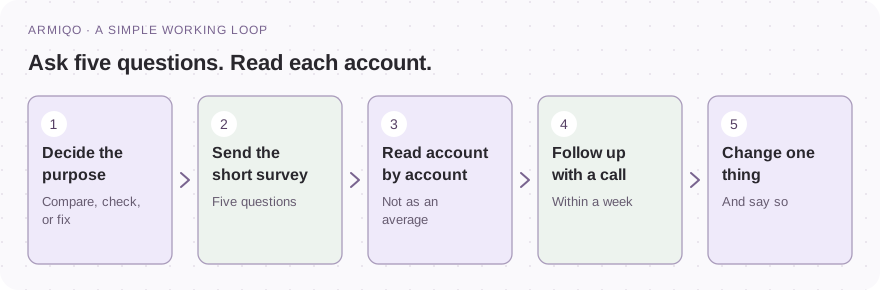
- Decide the purpose: compare, check or fix.
- Choose five questions with one open question.
- Send from a named person with a short note.
- Read every answer within 48 hours.
- Mark clients green, amber or red.
- Call amber and red clients within a week.
- Look for patterns across clients.
- Add results to the health score.
- Share one change with all clients.
- Repeat once or twice a year.
Common questions
What should a B2B client satisfaction survey include?
A satisfaction score, a recommend score, two or three specific questions and one open question. Keep it to five to seven questions.
How often should I survey clients?
Once or twice a year. Use conversations more often for key accounts.
Is NPS useful for an agency?
It can be, as a trend per client. With few clients, individual answers matter more than the overall number.
What is a good response rate?
It varies. A personal ask from a named person usually gets more answers than a generic link. Follow up personally with those who don't respond.
What if a client gives a low score?
Call them within a week, thank them, ask what's behind the score and agree one change.
Should surveys be anonymous?
For B2B agencies, usually not. You need to know who said what to follow up. Be clear about how you'll use the answers.